

selection; it does not oppose cellular individuals but rather
groups of cells. Of course, this totally peaceful interaction is
made possible by the perfect genetic similarity of the cells
constituting the group. Evidence of the importance of this
similarity is provided by instances where mutations lead to
the emergence of rival groups within the same population.
11.1.4 Dynamics of Interactions
Interactions, whether involving predator–prey relationships
in a forest or more complex relationships between bacterial
populations in the soil, can only be understood in a perspective that is both dynamic and Darwinian. Interaction dynamics are important to consider because the terms of the
interactions change over time, even if sometimes they oscillate momentarily around an equilibrium position. A Darwinian perspective is also needed because biotic interactions are
the result of selective pressures that organisms exert on each
other, even if other factors such as genetic drift can also
affect the reproductive success of individuals.
When interactions are conflictual, they usually give rise to
an arms race. Arms races represent one of the fundamental
drivers of evolution, because selective pressures that
organisms exert on each other remain the sine qua non of
evolutionary change. In a 1973 paper, the American evolutionist Leigh Van Valen gave for this driver of evolution an
explanation known as the Red Queen hypothesis, which has
become a classic (Fig. 11.2). He suggested that changes
constantly generate new adaptations to meet adaptations in
the competing species; if species share, even partially, the
same spatial or energy resources, and if one of them increases
its fitness, the other species have then to compensate for this
adaptive advantage or else will disappear. Species that adapt
will in turn modify the fitness of the others; and so forth, says
Van Valen, life is in a self-sustaining perpetual movement.
Van Valen’s hypothesis leads to the concept that humans and
bacteria, although differing profoundly in their complexity, may
be equally adapted to their environment. Indeed, microorganisms can thrive in environments where vertebrate cannot survive and adapt quickly to drastic changes in their environment.
In mutualistic interactions, one can have the impression that
the arms race concept does not apply. However, as we have
seen, even an interaction as ancient as that of the eukaryotic cell
with mitochondria is not without discordant notes. If we add
that, throughout the history of the association, the majority of
genes in mitochondria (it is the same for chloroplasts) was
transferred to the nucleus, this interaction – capital for evolution
– can be seen as a trusteeship followed by genetic looting.
11.1.5 Weapons Specific to Microorganisms
In Red Queen-type clashes, infectious disease agents have their
own weapons. One of them, particularly formidable, is their
very short generation time, inherited from the early ages of life,
which can lead to high production of individuals with mutated
genes. In contrast, hosts of microbial parasites must compose
with one major constraint that evolution has imposed onto
multicellular organisms, i.e., their long generation time. Indeed,
the advent of multicellularity was accompanied by increased
body size, which resulted also, inevitably, in longer generation
time. While the time between two divisions, thus opportunities
for mutations and selection, is sometimes counted in minutes in
bacteria, many multicellular organisms only acquire the ability
to reproduce, and thus to mutate, after several years (somatic
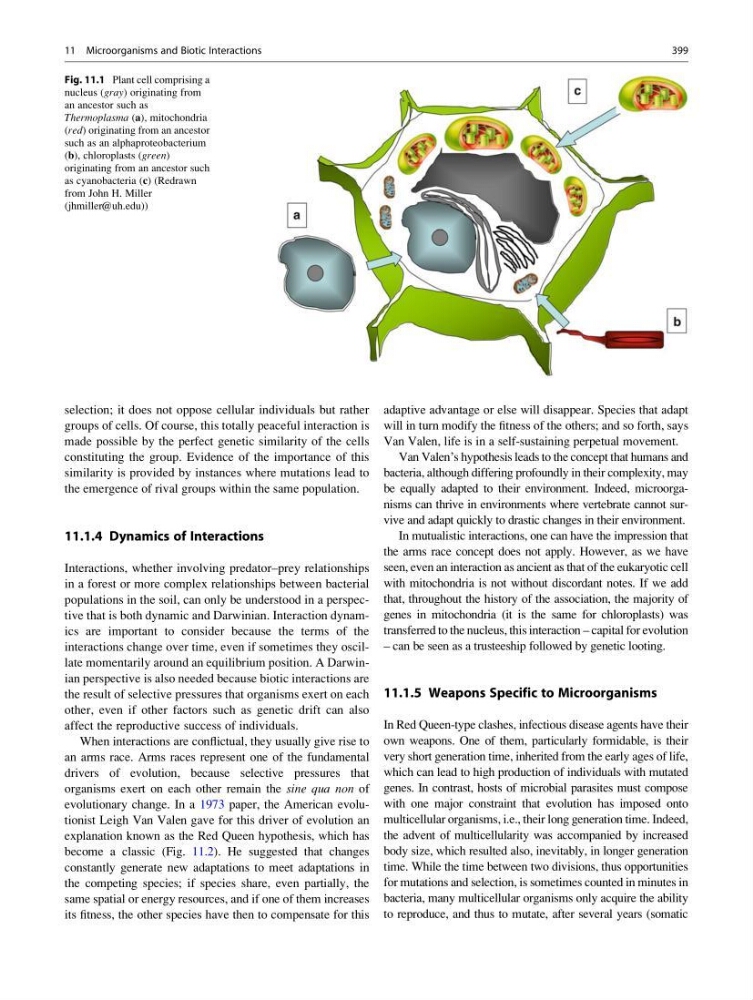
Fig. 11.1 Plant cell comprising a
nucleus (gray) originating from
an ancestor such as
Thermoplasma (a), mitochondria
(red) originating from an ancestor
such as an alphaproteobacterium
(b), chloroplasts (green)
originating from an ancestor such
as cyanobacteria (c) (Redrawn
from John H. Miller
(jhmiller@uh.edu))
11 Microorganisms and Biotic Interactions
399
groups of cells. Of course, this totally peaceful interaction is
made possible by the perfect genetic similarity of the cells
constituting the group. Evidence of the importance of this
similarity is provided by instances where mutations lead to
the emergence of rival groups within the same population.
11.1.4 Dynamics of Interactions
Interactions, whether involving predator–prey relationships
in a forest or more complex relationships between bacterial
populations in the soil, can only be understood in a perspective that is both dynamic and Darwinian. Interaction dynamics are important to consider because the terms of the
interactions change over time, even if sometimes they oscillate momentarily around an equilibrium position. A Darwinian perspective is also needed because biotic interactions are
the result of selective pressures that organisms exert on each
other, even if other factors such as genetic drift can also
affect the reproductive success of individuals.
When interactions are conflictual, they usually give rise to
an arms race. Arms races represent one of the fundamental
drivers of evolution, because selective pressures that
organisms exert on each other remain the sine qua non of
evolutionary change. In a 1973 paper, the American evolutionist Leigh Van Valen gave for this driver of evolution an
explanation known as the Red Queen hypothesis, which has
become a classic (Fig. 11.2). He suggested that changes
constantly generate new adaptations to meet adaptations in
the competing species; if species share, even partially, the
same spatial or energy resources, and if one of them increases
its fitness, the other species have then to compensate for this
adaptive advantage or else will disappear. Species that adapt
will in turn modify the fitness of the others; and so forth, says
Van Valen, life is in a self-sustaining perpetual movement.
Van Valen’s hypothesis leads to the concept that humans and
bacteria, although differing profoundly in their complexity, may
be equally adapted to their environment. Indeed, microorganisms can thrive in environments where vertebrate cannot survive and adapt quickly to drastic changes in their environment.
In mutualistic interactions, one can have the impression that
the arms race concept does not apply. However, as we have
seen, even an interaction as ancient as that of the eukaryotic cell
with mitochondria is not without discordant notes. If we add
that, throughout the history of the association, the majority of
genes in mitochondria (it is the same for chloroplasts) was
transferred to the nucleus, this interaction – capital for evolution
– can be seen as a trusteeship followed by genetic looting.
11.1.5 Weapons Specific to Microorganisms
In Red Queen-type clashes, infectious disease agents have their
own weapons. One of them, particularly formidable, is their
very short generation time, inherited from the early ages of life,
which can lead to high production of individuals with mutated
genes. In contrast, hosts of microbial parasites must compose
with one major constraint that evolution has imposed onto
multicellular organisms, i.e., their long generation time. Indeed,
the advent of multicellularity was accompanied by increased
body size, which resulted also, inevitably, in longer generation
time. While the time between two divisions, thus opportunities
for mutations and selection, is sometimes counted in minutes in
bacteria, many multicellular organisms only acquire the ability
to reproduce, and thus to mutate, after several years (somatic
Fig. 11.1 Plant cell comprising a
nucleus (gray) originating from
an ancestor such as
Thermoplasma (a), mitochondria
(red) originating from an ancestor
such as an alphaproteobacterium
(b), chloroplasts (green)
originating from an ancestor such
as cyanobacteria (c) (Redrawn
from John H. Miller
(jhmiller@uh.edu))
11 Microorganisms and Biotic Interactions
399