

It should be added that the distinction between parasitism
and mutualism is not always easy to make. In some cases it is
difficult to measure mutual benefits; in other cases we can
question the “honesty” of the interaction. To cite just one
example, many organisms living in deep ocean hydrothermal
ecosystems harbor sulfate-reducing bacteria that provide the
bulk of their energy resources. This interaction can be seen as a
simple exchange of protection against food, but if we take into
account that the host regularly consumes part of the bacterial
population, one can also see true parasitism. The length of the
interaction is not an absolute guarantee of peace between the
partners. For instance, “mitochondrial bacteria,” which in sexually reproducing organisms are usually transmitted to zygotes
by females, “endeavor” to skew the sex ratio at the expense of
males. This is a well-known strategy in the interaction between
Wolbachia bacteria and their arthropod hosts (cf. Sect. 11.4.3).
The mutualistic interaction reaches perhaps its perfection
in multicellular organisms. While in a population of unicellular organisms, competition for resources is the rule, it is
logically excluded between members of multicellular organism that constitute a clone: there is a real change in target
Box 11.1: Story of a Word, Symbiosis
Yvan Moe ¨nne-Loccoz
Symbiosis, from the Greek “syn” (with) and “biosis”
(life), illustrates the ongoing interaction (obligatory) of
two or more organisms, their lack of autonomy. It has
been defined, at least initially, as the intimate and
sustained interaction of two organisms belonging to
different species. Currently, the symbiosis is generally
regarded, especially in Microbial Ecology, as a mutually
beneficial obligatory interaction.
The paternity of the term has been attributed to Heinrich
Anton de Bary (de Bary 1879), a German botanist
(1831–1888) who described in his book Die Erscheinung
der Symbiose (The Phenomenon of Symbiosis) life in association of different organisms, definition thus including the
parasitism of fungi, on which de Bary worked all his life.
This term has quickly gained popularity and has been
applied in 1885 to mycorrhizae and in 1889 to nodules
induced by Rhizobium on peas by the German botanist
Albert Bernhard Frank (1885, 1889) who would prove to
be an effective proselytizer of the word. Root nodules form
following sophisticated molecular dialogues and are
inhabited by nitrogen-fixing Actinobacteria (Frankia;
Box Fig. 11.1) or Proteobacteria (Rhizobium and many
other taxa), depending on the type of plant partner.
The term has been modified by different prefixes or
adjectives. We thus speak of endosymbiosis and
ectosymbiosis whether the host is penetrated or not, of
obligatory or facultative symbiosis, depending on
whether or not the partners can live without the other. In
the latter case, which corresponds to cooperation, partners are sometimes termed aposymbiotic, asymbiotic, or
pre- or post-symbiotic. The word protosymbiosis is also
used, when the relationship is with little mutual benefit as
in the case of yogurt where Lactobacillus bulgaricus and
Streptococcus thermophilus coexist without strong metabolic complementarity. The term associative symbiosis is
also used as a synonym for cooperation, especially in the
case of saprophytic microorganisms in the rhizosphere
that enhance plant growth. Parasymbiosis is a symbiosis
where an additional organism secondarily joins an
already formed symbiosis.
The meaning of symbiosis has evolved over time, and
today the term is rarely used anymore in biology to talk
of parasitism. On the contrary, some confusion has
emerged about the distinction between mutualism (sustainable, mutually beneficial interaction) and symbiosis.
According to Odum (1971), true symbiosis (obligatory)
and mutualism are equivalent, which also corresponds to
(continued)
Box 11.1 (continued)
the definition given in the manual of Microbial Ecology
of Atlas and Bartha (1981). However, others, such as
Barbault (1997), distinguish mutualism (not obligatory)
from symbiosis (mandatory).
A Google search permitted to identify in June 2014
more than 10 million sites with “symbiosis” in the
fields of biology, management, politics, and culture.
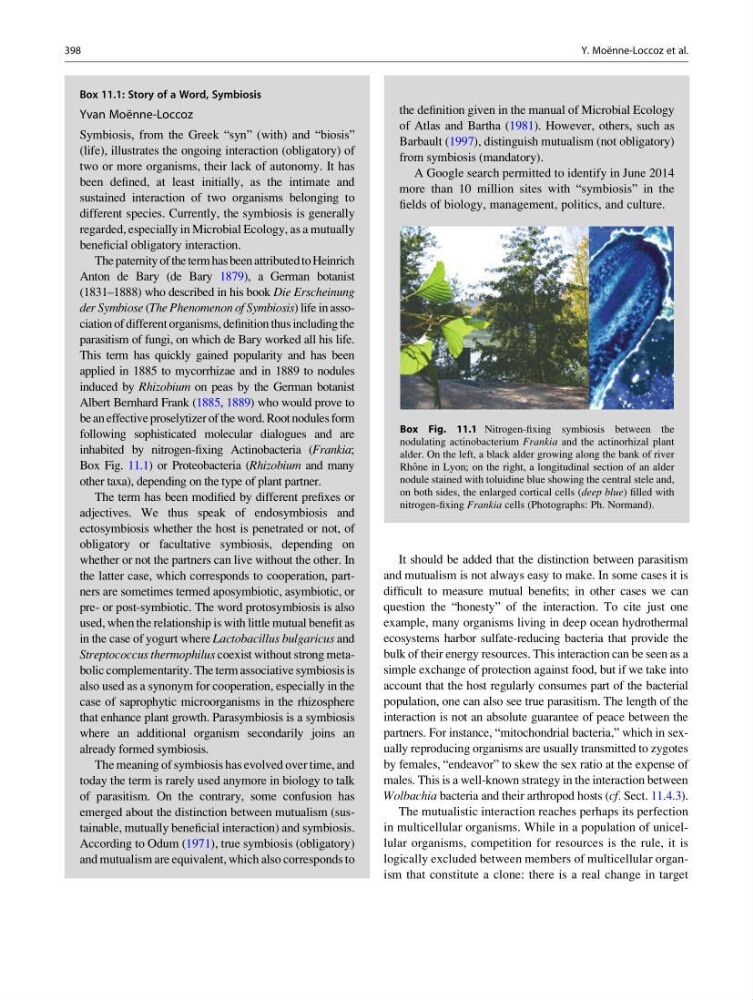
Box Fig. 11.1 Nitrogen-fixing symbiosis between the
nodulating actinobacterium Frankia and the actinorhizal plant
alder. On the left, a black alder growing along the bank of river
Rho ˆne in Lyon; on the right, a longitudinal section of an alder
nodule stained with toluidine blue showing the central stele and,
on both sides, the enlarged cortical cells (deep blue) filled with
nitrogen-fixing Frankia cells (Photographs: Ph. Normand).
398
Y. Moe ¨nne-Loccoz et al.
and mutualism is not always easy to make. In some cases it is
difficult to measure mutual benefits; in other cases we can
question the “honesty” of the interaction. To cite just one
example, many organisms living in deep ocean hydrothermal
ecosystems harbor sulfate-reducing bacteria that provide the
bulk of their energy resources. This interaction can be seen as a
simple exchange of protection against food, but if we take into
account that the host regularly consumes part of the bacterial
population, one can also see true parasitism. The length of the
interaction is not an absolute guarantee of peace between the
partners. For instance, “mitochondrial bacteria,” which in sexually reproducing organisms are usually transmitted to zygotes
by females, “endeavor” to skew the sex ratio at the expense of
males. This is a well-known strategy in the interaction between
Wolbachia bacteria and their arthropod hosts (cf. Sect. 11.4.3).
The mutualistic interaction reaches perhaps its perfection
in multicellular organisms. While in a population of unicellular organisms, competition for resources is the rule, it is
logically excluded between members of multicellular organism that constitute a clone: there is a real change in target
Box 11.1: Story of a Word, Symbiosis
Yvan Moe ¨nne-Loccoz
Symbiosis, from the Greek “syn” (with) and “biosis”
(life), illustrates the ongoing interaction (obligatory) of
two or more organisms, their lack of autonomy. It has
been defined, at least initially, as the intimate and
sustained interaction of two organisms belonging to
different species. Currently, the symbiosis is generally
regarded, especially in Microbial Ecology, as a mutually
beneficial obligatory interaction.
The paternity of the term has been attributed to Heinrich
Anton de Bary (de Bary 1879), a German botanist
(1831–1888) who described in his book Die Erscheinung
der Symbiose (The Phenomenon of Symbiosis) life in association of different organisms, definition thus including the
parasitism of fungi, on which de Bary worked all his life.
This term has quickly gained popularity and has been
applied in 1885 to mycorrhizae and in 1889 to nodules
induced by Rhizobium on peas by the German botanist
Albert Bernhard Frank (1885, 1889) who would prove to
be an effective proselytizer of the word. Root nodules form
following sophisticated molecular dialogues and are
inhabited by nitrogen-fixing Actinobacteria (Frankia;
Box Fig. 11.1) or Proteobacteria (Rhizobium and many
other taxa), depending on the type of plant partner.
The term has been modified by different prefixes or
adjectives. We thus speak of endosymbiosis and
ectosymbiosis whether the host is penetrated or not, of
obligatory or facultative symbiosis, depending on
whether or not the partners can live without the other. In
the latter case, which corresponds to cooperation, partners are sometimes termed aposymbiotic, asymbiotic, or
pre- or post-symbiotic. The word protosymbiosis is also
used, when the relationship is with little mutual benefit as
in the case of yogurt where Lactobacillus bulgaricus and
Streptococcus thermophilus coexist without strong metabolic complementarity. The term associative symbiosis is
also used as a synonym for cooperation, especially in the
case of saprophytic microorganisms in the rhizosphere
that enhance plant growth. Parasymbiosis is a symbiosis
where an additional organism secondarily joins an
already formed symbiosis.
The meaning of symbiosis has evolved over time, and
today the term is rarely used anymore in biology to talk
of parasitism. On the contrary, some confusion has
emerged about the distinction between mutualism (sustainable, mutually beneficial interaction) and symbiosis.
According to Odum (1971), true symbiosis (obligatory)
and mutualism are equivalent, which also corresponds to
(continued)
Box 11.1 (continued)
the definition given in the manual of Microbial Ecology
of Atlas and Bartha (1981). However, others, such as
Barbault (1997), distinguish mutualism (not obligatory)
from symbiosis (mandatory).
A Google search permitted to identify in June 2014
more than 10 million sites with “symbiosis” in the
fields of biology, management, politics, and culture.
Box Fig. 11.1 Nitrogen-fixing symbiosis between the
nodulating actinobacterium Frankia and the actinorhizal plant
alder. On the left, a black alder growing along the bank of river
Rho ˆne in Lyon; on the right, a longitudinal section of an alder
nodule stained with toluidine blue showing the central stele and,
on both sides, the enlarged cortical cells (deep blue) filled with
nitrogen-fixing Frankia cells (Photographs: Ph. Normand).
398
Y. Moe ¨nne-Loccoz et al.