

10.6.2 Diversity of Extreme Acidic
Environments
Acidic environments are poorly characterized environments
due to the physiological peculiarities of the microorganisms
associated to them. Furthermore, strict acidophilic
chemolithotrophs are, in general, not easy to grow, especially in solid media (Hallberg and Johnson 2001).
Prokaryotic microorganisms that are metabolically active
in extreme acidic environments are distributed in the domains
Bacteria and Archaea and can be classified according to their
energy and carbon sources (cf. Sect. 9.6.3).
A variety of chemoautolithotrophic microorganisms capable of oxidizing iron and sulfur-containing minerals have
been isolated from acidic environments. The mineraloxidizing bacteria found in these natural environments are
ubiquitous and the most commonly encountered have been
characterized
as
Acidithiobacillus
ferrooxidans,
Leptospirillum spp., Acidithiobacillus thiooxidans, Acidithiobacillus caldus and Sulfobacillus spp. in Bacteria Domain,
and members of the archaeal Ferroplasmaceae family.
In acidic environments there is also a variety of acidophilic heterotrophs such as those belonging to the genera
Acidiphilium or facultative heterotrophs such as
Acidimicrobium spp. and Ferromicrobium spp. Acidophiles
can also be categorized using other physiological criteria,
such as temperature (mesophiles, moderate thermophiles,
thermophiles, and hyperthermophiles), optimal pH, or on
the basis of their carbon source (autotrophs, heterotrophs,
and mixotrophs). In general, the most extremely thermophilic acidophiles correspond to the domain Archaea.
10.6.2.1 Bacteria Domain
The majority of the best characterized acidophilic
microorganisms correspond to the bacterial domain.
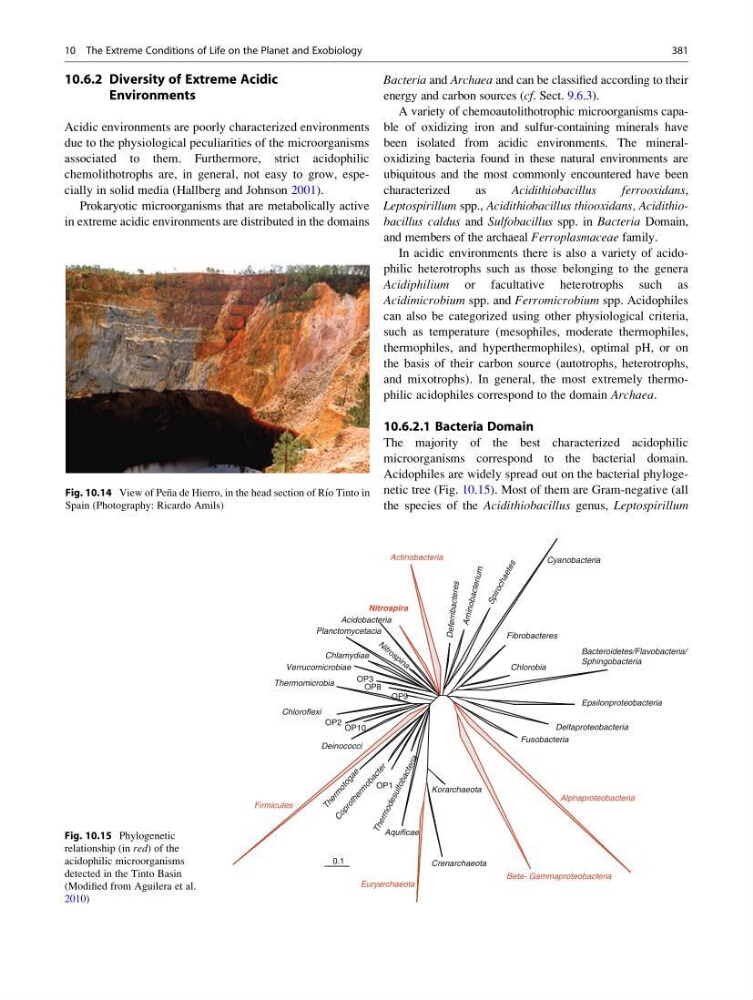
Acidophiles are widely spread out on the bacterial phylogenetic tree (Fig. 10.15). Most of them are Gram-negative (all
the species of the Acidithiobacillus genus, Leptospirillum
Fig. 10.14 View of Pen ˜a de Hierro, in the head section of Rı ´o Tinto in
Spain (Photography: Ricardo Amils)
Firmicutes
Actinobacteria
OP2
OP9
OP8
OP3
OP10
Aquificae
Chloroflexi
Thermomicrobia
Deinococci
Bacteroidetes/Flavobacteria/
Sphingobacteria
Fibrobacteres
Nitrospira
Def erri bac tere s
S p ir o c h a e te s
Fusobacteria
T h e r m
o t o g a e
T h e r m o d e s u lf o b a c te r ia
Chlorobia
Planctomycetacia
Verrucomicrobiae
Chlamydiae
Acidobacteria
Cyanobacteria
Alphaproteobacteria
Epsilonproteobacteria
Beta- Gammaproteobacteria
Euryarchaeota
Crenarchaeota
Korarchaeota
N it r o s p in a
A m in ob ac te riu m
C o p r o t h e r m
o b a c t e r
OP1
Deltaproteobacteria
0.1
Fig. 10.15 Phylogenetic
relationship (in red) of the
acidophilic microorganisms
detected in the Tinto Basin
(Modified from Aguilera et al.
2010)
10 The Extreme Conditions of Life on the Planet and Exobiology
381
Environments
Acidic environments are poorly characterized environments
due to the physiological peculiarities of the microorganisms
associated to them. Furthermore, strict acidophilic
chemolithotrophs are, in general, not easy to grow, especially in solid media (Hallberg and Johnson 2001).
Prokaryotic microorganisms that are metabolically active
in extreme acidic environments are distributed in the domains
Bacteria and Archaea and can be classified according to their
energy and carbon sources (cf. Sect. 9.6.3).
A variety of chemoautolithotrophic microorganisms capable of oxidizing iron and sulfur-containing minerals have
been isolated from acidic environments. The mineraloxidizing bacteria found in these natural environments are
ubiquitous and the most commonly encountered have been
characterized
as
Acidithiobacillus
ferrooxidans,
Leptospirillum spp., Acidithiobacillus thiooxidans, Acidithiobacillus caldus and Sulfobacillus spp. in Bacteria Domain,
and members of the archaeal Ferroplasmaceae family.
In acidic environments there is also a variety of acidophilic heterotrophs such as those belonging to the genera
Acidiphilium or facultative heterotrophs such as
Acidimicrobium spp. and Ferromicrobium spp. Acidophiles
can also be categorized using other physiological criteria,
such as temperature (mesophiles, moderate thermophiles,
thermophiles, and hyperthermophiles), optimal pH, or on
the basis of their carbon source (autotrophs, heterotrophs,
and mixotrophs). In general, the most extremely thermophilic acidophiles correspond to the domain Archaea.
10.6.2.1 Bacteria Domain
The majority of the best characterized acidophilic
microorganisms correspond to the bacterial domain.
Acidophiles are widely spread out on the bacterial phylogenetic tree (Fig. 10.15). Most of them are Gram-negative (all
the species of the Acidithiobacillus genus, Leptospirillum
Fig. 10.14 View of Pen ˜a de Hierro, in the head section of Rı ´o Tinto in
Spain (Photography: Ricardo Amils)
Firmicutes
Actinobacteria
OP2
OP9
OP8
OP3
OP10
Aquificae
Chloroflexi
Thermomicrobia
Deinococci
Bacteroidetes/Flavobacteria/
Sphingobacteria
Fibrobacteres
Nitrospira
Def erri bac tere s
S p ir o c h a e te s
Fusobacteria
T h e r m
o t o g a e
T h e r m o d e s u lf o b a c te r ia
Chlorobia
Planctomycetacia
Verrucomicrobiae
Chlamydiae
Acidobacteria
Cyanobacteria
Alphaproteobacteria
Epsilonproteobacteria
Beta- Gammaproteobacteria
Euryarchaeota
Crenarchaeota
Korarchaeota
N it r o s p in a
A m in ob ac te riu m
C o p r o t h e r m
o b a c t e r
OP1
Deltaproteobacteria
0.1
Fig. 10.15 Phylogenetic
relationship (in red) of the
acidophilic microorganisms
detected in the Tinto Basin
(Modified from Aguilera et al.
2010)
10 The Extreme Conditions of Life on the Planet and Exobiology
381