

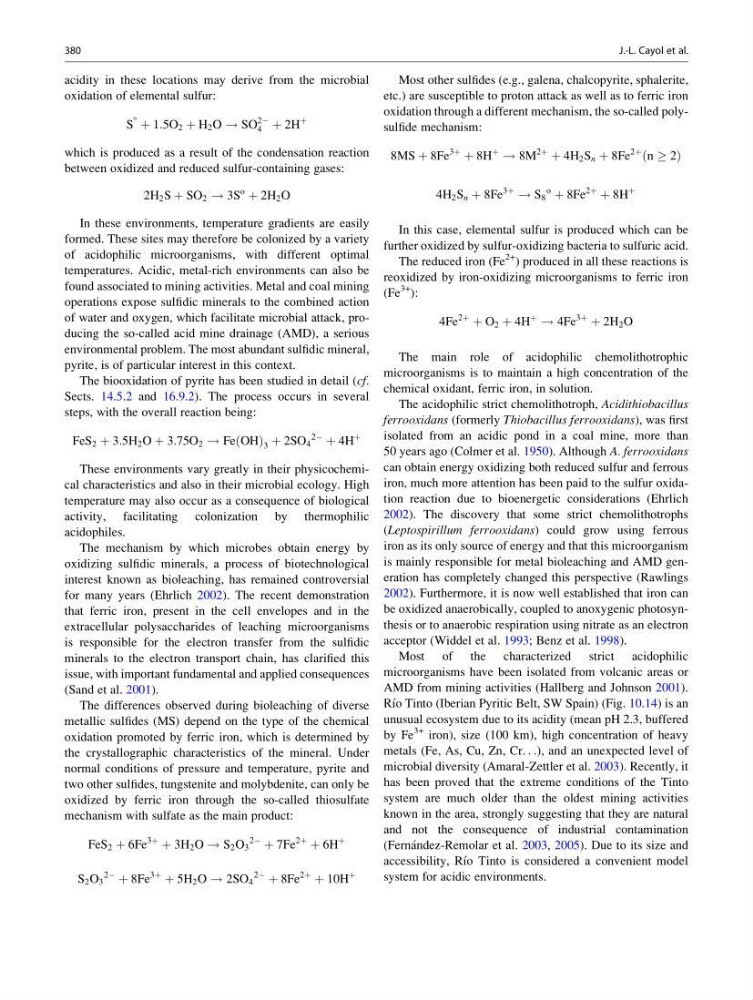
acidity in these locations may derive from the microbial
oxidation of elemental sulfur:
S
o þ 1:5O 2 þ H 2 O ! SO
2À
4 þ 2H
þ
which is produced as a result of the condensation reaction
between oxidized and reduced sulfur-containing gases:
2H 2 S þ SO 2 ! 3S
o
þ 2H 2 O
In these environments, temperature gradients are easily
formed. These sites may therefore be colonized by a variety
of acidophilic microorganisms, with different optimal
temperatures. Acidic, metal-rich environments can also be
found associated to mining activities. Metal and coal mining
operations expose sulfidic minerals to the combined action
of water and oxygen, which facilitate microbial attack, producing the so-called acid mine drainage (AMD), a serious
environmental problem. The most abundant sulfidic mineral,
pyrite, is of particular interest in this context.
The biooxidation of pyrite has been studied in detail (cf.
Sects. 14.5.2 and 16.9.2). The process occurs in several
steps, with the overall reaction being:
FeS 2 þ 3:5H 2 O þ 3:75O 2 ! Fe OH
ð Þ 3 þ 2SO 4
2À
þ 4H
þ
These environments vary greatly in their physicochemical characteristics and also in their microbial ecology. High
temperature may also occur as a consequence of biological
activity, facilitating colonization by thermophilic
acidophiles.
The mechanism by which microbes obtain energy by
oxidizing sulfidic minerals, a process of biotechnological
interest known as bioleaching, has remained controversial
for many years (Ehrlich 2002). The recent demonstration
that ferric iron, present in the cell envelopes and in the
extracellular polysaccharides of leaching microorganisms
is responsible for the electron transfer from the sulfidic
minerals to the electron transport chain, has clarified this
issue, with important fundamental and applied consequences
(Sand et al. 2001).
The differences observed during bioleaching of diverse
metallic sulfides (MS) depend on the type of the chemical
oxidation promoted by ferric iron, which is determined by
the crystallographic characteristics of the mineral. Under
normal conditions of pressure and temperature, pyrite and
two other sulfides, tungstenite and molybdenite, can only be
oxidized by ferric iron through the so-called thiosulfate
mechanism with sulfate as the main product:
FeS 2 þ 6Fe
3þ
þ 3H 2 O ! S 2 O 3
2À
þ 7Fe
2þ
þ 6H
þ
S 2 O 3
2À
þ 8Fe
3þ
þ 5H 2 O ! 2SO 4
2À
þ 8Fe
2þ
þ 10H
þ
Most other sulfides (e.g., galena, chalcopyrite, sphalerite,
etc.) are susceptible to proton attack as well as to ferric iron
oxidation through a different mechanism, the so-called polysulfide mechanism:
8MS þ 8Fe
3þ
þ 8H
þ
! 8M
2þ
þ 4H 2 S n þ 8Fe
2þ n ! 2
ð
Þ
4H 2 S n þ 8Fe
3þ
! S 8
o
þ 8Fe
2þ
þ 8H
þ
In this case, elemental sulfur is produced which can be
further oxidized by sulfur-oxidizing bacteria to sulfuric acid.
The reduced iron (Fe
2+ ) produced in all these reactions is
reoxidized by iron-oxidizing microorganisms to ferric iron
(Fe
3+ ):
4Fe
2þ
þ O 2 þ 4H
þ
! 4Fe
3þ
þ 2H 2 O
The main role of acidophilic chemolithotrophic
microorganisms is to maintain a high concentration of the
chemical oxidant, ferric iron, in solution.
The acidophilic strict chemolithotroph, Acidithiobacillus
ferrooxidans (formerly Thiobacillus ferrooxidans), was first
isolated from an acidic pond in a coal mine, more than
50 years ago (Colmer et al. 1950). Although A. ferrooxidans
can obtain energy oxidizing both reduced sulfur and ferrous
iron, much more attention has been paid to the sulfur oxidation reaction due to bioenergetic considerations (Ehrlich
2002). The discovery that some strict chemolithotrophs
(Leptospirillum ferrooxidans) could grow using ferrous
iron as its only source of energy and that this microorganism
is mainly responsible for metal bioleaching and AMD generation has completely changed this perspective (Rawlings
2002). Furthermore, it is now well established that iron can
be oxidized anaerobically, coupled to anoxygenic photosynthesis or to anaerobic respiration using nitrate as an electron
acceptor (Widdel et al. 1993; Benz et al. 1998).
Most of the characterized strict acidophilic
microorganisms have been isolated from volcanic areas or
AMD from mining activities (Hallberg and Johnson 2001).
Rı ´o Tinto (Iberian Pyritic Belt, SW Spain) (Fig. 10.14) is an
unusual ecosystem due to its acidity (mean pH 2.3, buffered
by Fe
3+ iron), size (100 km), high concentration of heavy
metals (Fe, As, Cu, Zn, Cr. . .), and an unexpected level of
microbial diversity (Amaral-Zettler et al. 2003). Recently, it
has been proved that the extreme conditions of the Tinto
system are much older than the oldest mining activities
known in the area, strongly suggesting that they are natural
and not the consequence of industrial contamination
(Ferna ´ndez-Remolar et al. 2003, 2005). Due to its size and
accessibility, Rı ´o Tinto is considered a convenient model
system for acidic environments.
380
J.-L. Cayol et al.
oxidation of elemental sulfur:
S
o þ 1:5O 2 þ H 2 O ! SO
2À
4 þ 2H
þ
which is produced as a result of the condensation reaction
between oxidized and reduced sulfur-containing gases:
2H 2 S þ SO 2 ! 3S
o
þ 2H 2 O
In these environments, temperature gradients are easily
formed. These sites may therefore be colonized by a variety
of acidophilic microorganisms, with different optimal
temperatures. Acidic, metal-rich environments can also be
found associated to mining activities. Metal and coal mining
operations expose sulfidic minerals to the combined action
of water and oxygen, which facilitate microbial attack, producing the so-called acid mine drainage (AMD), a serious
environmental problem. The most abundant sulfidic mineral,
pyrite, is of particular interest in this context.
The biooxidation of pyrite has been studied in detail (cf.
Sects. 14.5.2 and 16.9.2). The process occurs in several
steps, with the overall reaction being:
FeS 2 þ 3:5H 2 O þ 3:75O 2 ! Fe OH
ð Þ 3 þ 2SO 4
2À
þ 4H
þ
These environments vary greatly in their physicochemical characteristics and also in their microbial ecology. High
temperature may also occur as a consequence of biological
activity, facilitating colonization by thermophilic
acidophiles.
The mechanism by which microbes obtain energy by
oxidizing sulfidic minerals, a process of biotechnological
interest known as bioleaching, has remained controversial
for many years (Ehrlich 2002). The recent demonstration
that ferric iron, present in the cell envelopes and in the
extracellular polysaccharides of leaching microorganisms
is responsible for the electron transfer from the sulfidic
minerals to the electron transport chain, has clarified this
issue, with important fundamental and applied consequences
(Sand et al. 2001).
The differences observed during bioleaching of diverse
metallic sulfides (MS) depend on the type of the chemical
oxidation promoted by ferric iron, which is determined by
the crystallographic characteristics of the mineral. Under
normal conditions of pressure and temperature, pyrite and
two other sulfides, tungstenite and molybdenite, can only be
oxidized by ferric iron through the so-called thiosulfate
mechanism with sulfate as the main product:
FeS 2 þ 6Fe
3þ
þ 3H 2 O ! S 2 O 3
2À
þ 7Fe
2þ
þ 6H
þ
S 2 O 3
2À
þ 8Fe
3þ
þ 5H 2 O ! 2SO 4
2À
þ 8Fe
2þ
þ 10H
þ
Most other sulfides (e.g., galena, chalcopyrite, sphalerite,
etc.) are susceptible to proton attack as well as to ferric iron
oxidation through a different mechanism, the so-called polysulfide mechanism:
8MS þ 8Fe
3þ
þ 8H
þ
! 8M
2þ
þ 4H 2 S n þ 8Fe
2þ n ! 2
ð
Þ
4H 2 S n þ 8Fe
3þ
! S 8
o
þ 8Fe
2þ
þ 8H
þ
In this case, elemental sulfur is produced which can be
further oxidized by sulfur-oxidizing bacteria to sulfuric acid.
The reduced iron (Fe
2+ ) produced in all these reactions is
reoxidized by iron-oxidizing microorganisms to ferric iron
(Fe
3+ ):
4Fe
2þ
þ O 2 þ 4H
þ
! 4Fe
3þ
þ 2H 2 O
The main role of acidophilic chemolithotrophic
microorganisms is to maintain a high concentration of the
chemical oxidant, ferric iron, in solution.
The acidophilic strict chemolithotroph, Acidithiobacillus
ferrooxidans (formerly Thiobacillus ferrooxidans), was first
isolated from an acidic pond in a coal mine, more than
50 years ago (Colmer et al. 1950). Although A. ferrooxidans
can obtain energy oxidizing both reduced sulfur and ferrous
iron, much more attention has been paid to the sulfur oxidation reaction due to bioenergetic considerations (Ehrlich
2002). The discovery that some strict chemolithotrophs
(Leptospirillum ferrooxidans) could grow using ferrous
iron as its only source of energy and that this microorganism
is mainly responsible for metal bioleaching and AMD generation has completely changed this perspective (Rawlings
2002). Furthermore, it is now well established that iron can
be oxidized anaerobically, coupled to anoxygenic photosynthesis or to anaerobic respiration using nitrate as an electron
acceptor (Widdel et al. 1993; Benz et al. 1998).
Most of the characterized strict acidophilic
microorganisms have been isolated from volcanic areas or
AMD from mining activities (Hallberg and Johnson 2001).
Rı ´o Tinto (Iberian Pyritic Belt, SW Spain) (Fig. 10.14) is an
unusual ecosystem due to its acidity (mean pH 2.3, buffered
by Fe
3+ iron), size (100 km), high concentration of heavy
metals (Fe, As, Cu, Zn, Cr. . .), and an unexpected level of
microbial diversity (Amaral-Zettler et al. 2003). Recently, it
has been proved that the extreme conditions of the Tinto
system are much older than the oldest mining activities
known in the area, strongly suggesting that they are natural
and not the consequence of industrial contamination
(Ferna ´ndez-Remolar et al. 2003, 2005). Due to its size and
accessibility, Rı ´o Tinto is considered a convenient model
system for acidic environments.
380
J.-L. Cayol et al.