

Two interesting studies, carried out independently, were
published on this topic. The first study reported the discovery of an obligate piezophilic hyperthermophile isolated
from a deep-sea hydrothermal vent sample, collected at a
depth of 4,200 m: Pyrococcus yayanosii. This organism
grows in a temperature ranges from 85 to 105
C. The
optimum pressure for growth is 52 MPa at 98
C, but no
growth was observed for pressure below 20 MPa. At 105
C,
optimum pressure is extended to 60 MPa. Growth was still
detectable at 130 MPa and 110
C, and P. abyssi cells could
survive at 125
C and 145 MPa for at least 48 h. The second
study concerned analysis of marine sediments collected at
1,600 m beneath the seafloor, itself at a depth of 3.5 km. In
these old sediments (110 million years) and most probably
hot (100
C), novel molecular signatures of Pyrococcus and
Thermococcus (hyperthermophilic Archaea) were detected.
Since these independent studies showed that obligate
piezophilic hyperthermophiles and deep sediment hyperthermophiles (certainly piezophilic) exist, the hypothesis of the
deep, thermophilic, and piezophilic biosphere is enhanced.
10.5.6 Other Piezophiles to Be Discovered
Aquifers, oil reservoirs, and deep sediment layers are
environments exposed to high pressures. Although the
occurrence of microorganisms living in these ecosystems
has been reported and studied, very few data about pressure
are available. Nevertheless, according to estimations by
Whittman, the majority of Prokaryotes would live in subsurface environments, particularly beneath the seafloor
(Whitman et al. 1998). But if the effect of pressure remains
a question, the most important questions concern the energy
and carbon sources available. Do these nutrients come from
the surface? Are these deep subsurface microorganisms
dependant, although not directly, from photosynthesis and
solar energy? Are they definitely buried in deep sediment
layers or transported by deep circulating fluids? Are they
active or under a dormant stage? What is their doubling time
(certain estimations suggest thousands of years)? Do they
use dihydrogen and carbon dioxide produced during abiotic
reactions as energy and carbon sources? If the answer to the
last question is yes, these organisms would be totally independent from solar energy, like the first organisms living
about 4 billion years ago. Certainly, the study of these
recently discovered subsurface environments and their
inhabitants, all obligate piezophiles, would contribute to
raise novel hypothesis about the origin of life on Earth.
10.6 Acidophilic Microorganisms
10.6.1 Presentation
Organisms that thrive under extreme conditions have
recently attracted considerable attention due to their peculiar
physiology, ecology, as well as their biotechnological potential (Rawlings 2002). Acidic environments are especially
interesting because, in general, the low pH of the habitat is
the consequence of microbial metabolism (Ehrlich 2002)
and not to condition imposed by the system, as is the case
for other extreme environments (temperature, ionic strength,
high pH, radiation, pressure, etc.). The case of the animal
stomach was discussed in Chap. 9 (cf. Sect. 9.6.3).
Acidic, metal-rich environments have two major origins.
The first one is associated with volcanic activities. The
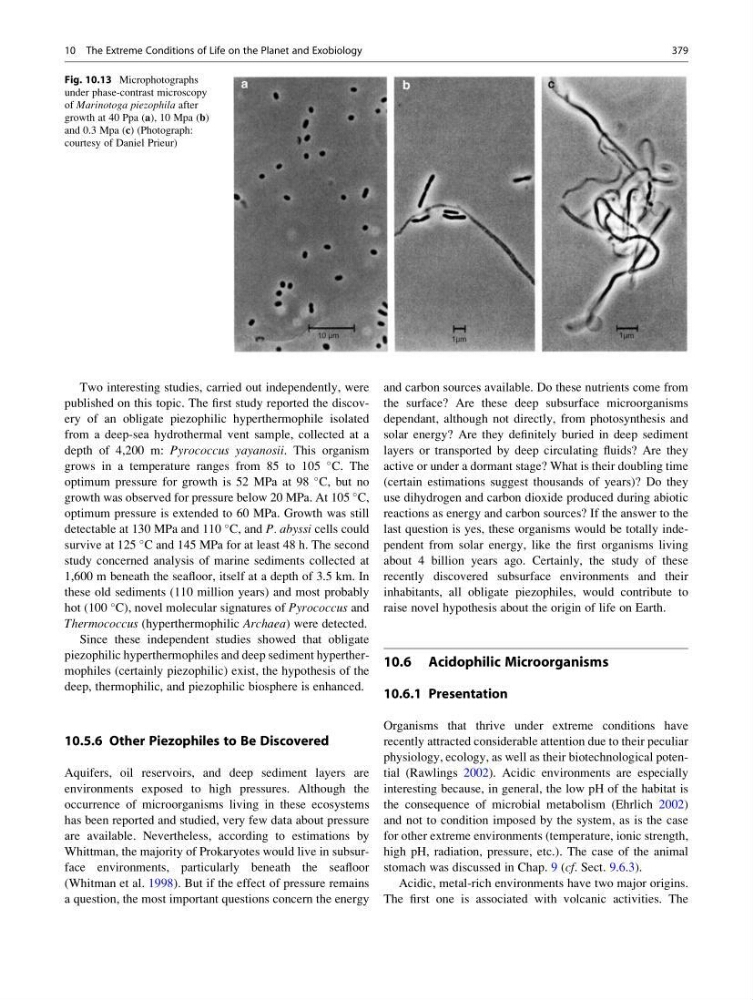
Fig. 10.13 Microphotographs
under phase-contrast microscopy
of Marinotoga piezophila after
growth at 40 Ppa (a), 10 Mpa (b)
and 0.3 Mpa (c) (Photograph:
courtesy of Daniel Prieur)
10 The Extreme Conditions of Life on the Planet and Exobiology
379
published on this topic. The first study reported the discovery of an obligate piezophilic hyperthermophile isolated
from a deep-sea hydrothermal vent sample, collected at a
depth of 4,200 m: Pyrococcus yayanosii. This organism
grows in a temperature ranges from 85 to 105
C. The
optimum pressure for growth is 52 MPa at 98
C, but no
growth was observed for pressure below 20 MPa. At 105
C,
optimum pressure is extended to 60 MPa. Growth was still
detectable at 130 MPa and 110
C, and P. abyssi cells could
survive at 125
C and 145 MPa for at least 48 h. The second
study concerned analysis of marine sediments collected at
1,600 m beneath the seafloor, itself at a depth of 3.5 km. In
these old sediments (110 million years) and most probably
hot (100
C), novel molecular signatures of Pyrococcus and
Thermococcus (hyperthermophilic Archaea) were detected.
Since these independent studies showed that obligate
piezophilic hyperthermophiles and deep sediment hyperthermophiles (certainly piezophilic) exist, the hypothesis of the
deep, thermophilic, and piezophilic biosphere is enhanced.
10.5.6 Other Piezophiles to Be Discovered
Aquifers, oil reservoirs, and deep sediment layers are
environments exposed to high pressures. Although the
occurrence of microorganisms living in these ecosystems
has been reported and studied, very few data about pressure
are available. Nevertheless, according to estimations by
Whittman, the majority of Prokaryotes would live in subsurface environments, particularly beneath the seafloor
(Whitman et al. 1998). But if the effect of pressure remains
a question, the most important questions concern the energy
and carbon sources available. Do these nutrients come from
the surface? Are these deep subsurface microorganisms
dependant, although not directly, from photosynthesis and
solar energy? Are they definitely buried in deep sediment
layers or transported by deep circulating fluids? Are they
active or under a dormant stage? What is their doubling time
(certain estimations suggest thousands of years)? Do they
use dihydrogen and carbon dioxide produced during abiotic
reactions as energy and carbon sources? If the answer to the
last question is yes, these organisms would be totally independent from solar energy, like the first organisms living
about 4 billion years ago. Certainly, the study of these
recently discovered subsurface environments and their
inhabitants, all obligate piezophiles, would contribute to
raise novel hypothesis about the origin of life on Earth.
10.6 Acidophilic Microorganisms
10.6.1 Presentation
Organisms that thrive under extreme conditions have
recently attracted considerable attention due to their peculiar
physiology, ecology, as well as their biotechnological potential (Rawlings 2002). Acidic environments are especially
interesting because, in general, the low pH of the habitat is
the consequence of microbial metabolism (Ehrlich 2002)
and not to condition imposed by the system, as is the case
for other extreme environments (temperature, ionic strength,
high pH, radiation, pressure, etc.). The case of the animal
stomach was discussed in Chap. 9 (cf. Sect. 9.6.3).
Acidic, metal-rich environments have two major origins.
The first one is associated with volcanic activities. The
Fig. 10.13 Microphotographs
under phase-contrast microscopy
of Marinotoga piezophila after
growth at 40 Ppa (a), 10 Mpa (b)
and 0.3 Mpa (c) (Photograph:
courtesy of Daniel Prieur)
10 The Extreme Conditions of Life on the Planet and Exobiology
379