

production were uncoupled: pressure increased maximal
temperature for methanogenesis only.
Several microbiologists carried out enrichment cultures
from deep-sea hydrothermal vent samples under elevated
temperatures and pressures, using specific pressurized
bioreactors. This method allowed to isolate Thermococcus
barophilus, an heterotrophic anaerobic hyperthermophilic
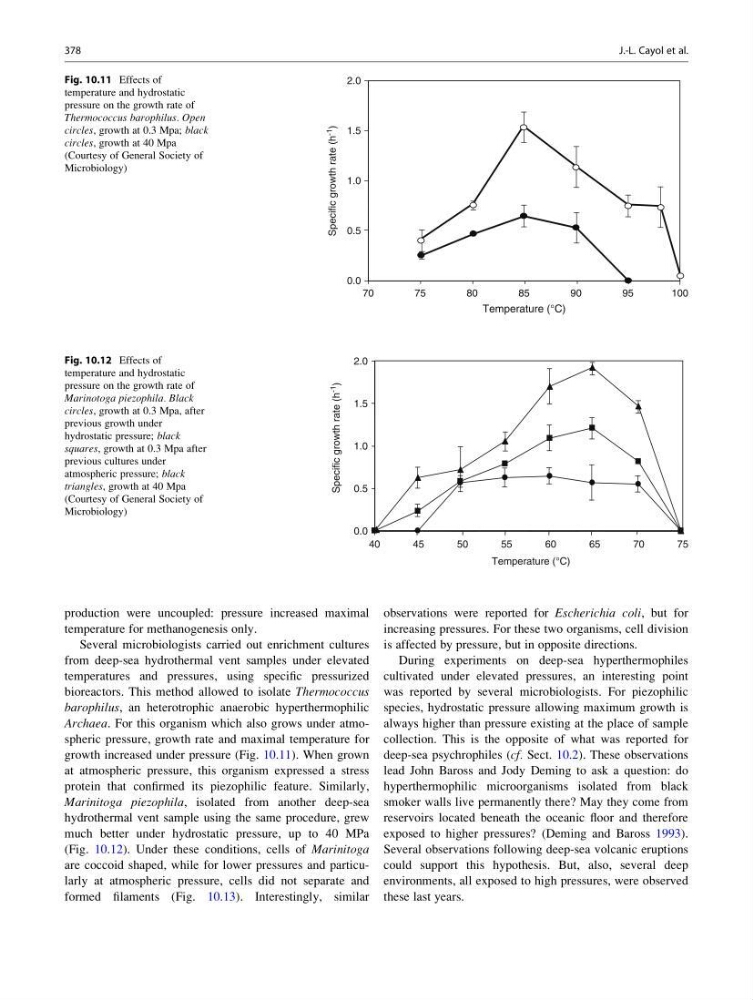
Archaea. For this organism which also grows under atmospheric pressure, growth rate and maximal temperature for
growth increased under pressure (Fig. 10.11). When grown
at atmospheric pressure, this organism expressed a stress
protein that confirmed its piezophilic feature. Similarly,
Marinitoga piezophila, isolated from another deep-sea
hydrothermal vent sample using the same procedure, grew
much better under hydrostatic pressure, up to 40 MPa
(Fig. 10.12). Under these conditions, cells of Marinitoga
are coccoid shaped, while for lower pressures and particularly at atmospheric pressure, cells did not separate and
formed filaments (Fig. 10.13). Interestingly, similar
observations were reported for Escherichia coli, but for
increasing pressures. For these two organisms, cell division
is affected by pressure, but in opposite directions.
During experiments on deep-sea hyperthermophiles
cultivated under elevated pressures, an interesting point
was reported by several microbiologists. For piezophilic
species, hydrostatic pressure allowing maximum growth is
always higher than pressure existing at the place of sample
collection. This is the opposite of what was reported for
deep-sea psychrophiles (cf. Sect. 10.2). These observations
lead John Baross and Jody Deming to ask a question: do
hyperthermophilic microorganisms isolated from black
smoker walls live permanently there? May they come from
reservoirs located beneath the oceanic floor and therefore
exposed to higher pressures? (Deming and Baross 1993).
Several observations following deep-sea volcanic eruptions
could support this hypothesis. But, also, several deep
environments, all exposed to high pressures, were observed
these last years.
0.0
0.5
1.0
1.5
2.0
70
75
80
85
90
95
100
Temperature (°C)
Specific growth rate (h
-1
)
Fig. 10.11 Effects of
temperature and hydrostatic
pressure on the growth rate of
Thermococcus barophilus. Open
circles, growth at 0.3 Mpa; black
circles, growth at 40 Mpa
(Courtesy of General Society of
Microbiology)
0.0
0.5
1.0
1.5
2.0
40
50
60
70
Temperature (°C)
Specific growth rate (h
-1
)
45
55
65
75
Fig. 10.12 Effects of
temperature and hydrostatic
pressure on the growth rate of
Marinotoga piezophila. Black
circles, growth at 0.3 Mpa, after
previous growth under
hydrostatic pressure; black
squares, growth at 0.3 Mpa after
previous cultures under
atmospheric pressure; black
triangles, growth at 40 Mpa
(Courtesy of General Society of
Microbiology)
378
J.-L. Cayol et al.
temperature for methanogenesis only.
Several microbiologists carried out enrichment cultures
from deep-sea hydrothermal vent samples under elevated
temperatures and pressures, using specific pressurized
bioreactors. This method allowed to isolate Thermococcus
barophilus, an heterotrophic anaerobic hyperthermophilic
Archaea. For this organism which also grows under atmospheric pressure, growth rate and maximal temperature for
growth increased under pressure (Fig. 10.11). When grown
at atmospheric pressure, this organism expressed a stress
protein that confirmed its piezophilic feature. Similarly,
Marinitoga piezophila, isolated from another deep-sea
hydrothermal vent sample using the same procedure, grew
much better under hydrostatic pressure, up to 40 MPa
(Fig. 10.12). Under these conditions, cells of Marinitoga
are coccoid shaped, while for lower pressures and particularly at atmospheric pressure, cells did not separate and
formed filaments (Fig. 10.13). Interestingly, similar
observations were reported for Escherichia coli, but for
increasing pressures. For these two organisms, cell division
is affected by pressure, but in opposite directions.
During experiments on deep-sea hyperthermophiles
cultivated under elevated pressures, an interesting point
was reported by several microbiologists. For piezophilic
species, hydrostatic pressure allowing maximum growth is
always higher than pressure existing at the place of sample
collection. This is the opposite of what was reported for
deep-sea psychrophiles (cf. Sect. 10.2). These observations
lead John Baross and Jody Deming to ask a question: do
hyperthermophilic microorganisms isolated from black
smoker walls live permanently there? May they come from
reservoirs located beneath the oceanic floor and therefore
exposed to higher pressures? (Deming and Baross 1993).
Several observations following deep-sea volcanic eruptions
could support this hypothesis. But, also, several deep
environments, all exposed to high pressures, were observed
these last years.
0.0
0.5
1.0
1.5
2.0
70
75
80
85
90
95
100
Temperature (°C)
Specific growth rate (h
-1
)
Fig. 10.11 Effects of
temperature and hydrostatic
pressure on the growth rate of
Thermococcus barophilus. Open
circles, growth at 0.3 Mpa; black
circles, growth at 40 Mpa
(Courtesy of General Society of
Microbiology)
0.0
0.5
1.0
1.5
2.0
40
50
60
70
Temperature (°C)
Specific growth rate (h
-1
)
45
55
65
75
Fig. 10.12 Effects of
temperature and hydrostatic
pressure on the growth rate of
Marinotoga piezophila. Black
circles, growth at 0.3 Mpa, after
previous growth under
hydrostatic pressure; black
squares, growth at 0.3 Mpa after
previous cultures under
atmospheric pressure; black
triangles, growth at 40 Mpa
(Courtesy of General Society of
Microbiology)
378
J.-L. Cayol et al.