

10.3 Thermophilic and Hyperthermophilic
Prokaryotes
10.3.1 Presentation
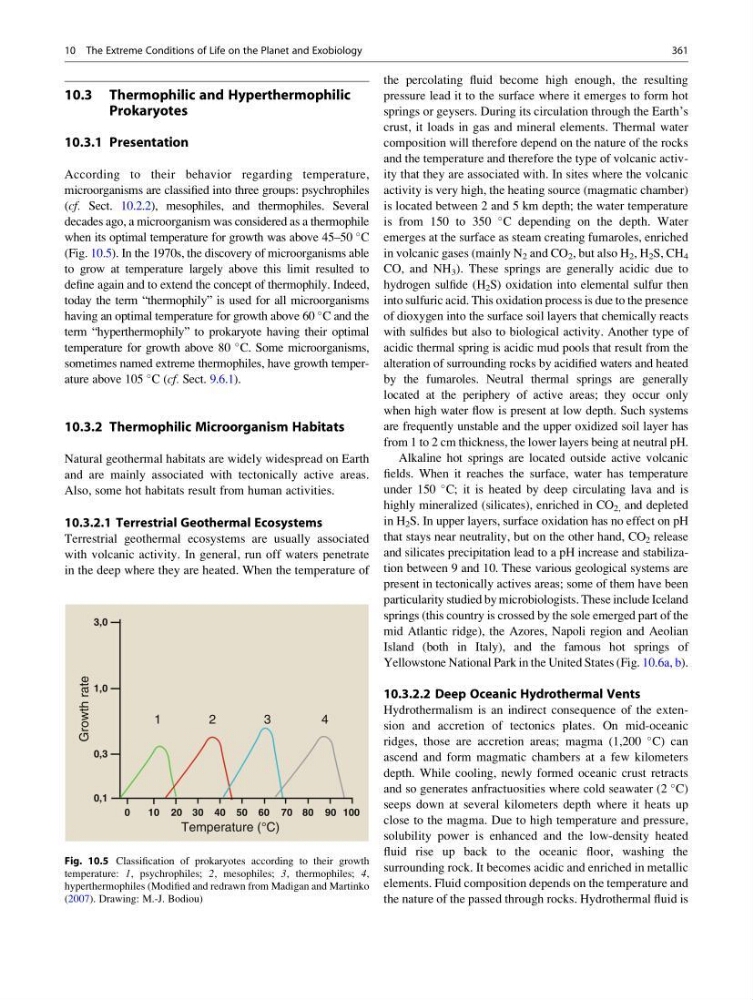
According to their behavior regarding temperature,
microorganisms are classified into three groups: psychrophiles
(cf. Sect. 10.2.2), mesophiles, and thermophiles. Several
decades ago, a microorganism was considered as a thermophile
when its optimal temperature for growth was above 45–50
C
(Fig. 10.5). In the 1970s, the discovery of microorganisms able
to grow at temperature largely above this limit resulted to
define again and to extend the concept of thermophily. Indeed,
today the term “thermophily” is used for all microorganisms
having an optimal temperature for growth above 60
C and the
term “hyperthermophily” to prokaryote having their optimal
temperature for growth above 80
C. Some microorganisms,
sometimes named extreme thermophiles, have growth temperature above 105
C (cf. Sect. 9.6.1).
10.3.2 Thermophilic Microorganism Habitats
Natural geothermal habitats are widely widespread on Earth
and are mainly associated with tectonically active areas.
Also, some hot habitats result from human activities.
10.3.2.1 Terrestrial Geothermal Ecosystems
Terrestrial geothermal ecosystems are usually associated
with volcanic activity. In general, run off waters penetrate
in the deep where they are heated. When the temperature of
the percolating fluid become high enough, the resulting
pressure lead it to the surface where it emerges to form hot
springs or geysers. During its circulation through the Earth’s
crust, it loads in gas and mineral elements. Thermal water
composition will therefore depend on the nature of the rocks
and the temperature and therefore the type of volcanic activity that they are associated with. In sites where the volcanic
activity is very high, the heating source (magmatic chamber)
is located between 2 and 5 km depth; the water temperature
is from 150 to 350
C depending on the depth. Water
emerges at the surface as steam creating fumaroles, enriched
in volcanic gases (mainly N 2 and CO 2 , but also H 2 , H 2 S, CH 4
CO, and NH 3 ). These springs are generally acidic due to
hydrogen sulfide (H 2 S) oxidation into elemental sulfur then
into sulfuric acid. This oxidation process is due to the presence
of dioxygen into the surface soil layers that chemically reacts
with sulfides but also to biological activity. Another type of
acidic thermal spring is acidic mud pools that result from the
alteration of surrounding rocks by acidified waters and heated
by the fumaroles. Neutral thermal springs are generally
located at the periphery of active areas; they occur only
when high water flow is present at low depth. Such systems
are frequently unstable and the upper oxidized soil layer has
from 1 to 2 cm thickness, the lower layers being at neutral pH.
Alkaline hot springs are located outside active volcanic
fields. When it reaches the surface, water has temperature
under 150
C; it is heated by deep circulating lava and is
highly mineralized (silicates), enriched in CO 2, and depleted
in H 2 S. In upper layers, surface oxidation has no effect on pH
that stays near neutrality, but on the other hand, CO 2 release
and silicates precipitation lead to a pH increase and stabilization between 9 and 10. These various geological systems are
present in tectonically actives areas; some of them have been
particularity studied by microbiologists. These include Iceland
springs (this country is crossed by the sole emerged part of the
mid Atlantic ridge), the Azores, Napoli region and Aeolian
Island (both in Italy), and the famous hot springs of
Yellowstone National Park in the United States (Fig. 10.6a, b).
10.3.2.2 Deep Oceanic Hydrothermal Vents
Hydrothermalism is an indirect consequence of the extension and accretion of tectonics plates. On mid-oceanic
ridges, those are accretion areas; magma (1,200
C) can
ascend and form magmatic chambers at a few kilometers
depth. While cooling, newly formed oceanic crust retracts
and so generates anfractuosities where cold seawater (2
C)
seeps down at several kilometers depth where it heats up
close to the magma. Due to high temperature and pressure,
solubility power is enhanced and the low-density heated
fluid rise up back to the oceanic floor, washing the
surrounding rock. It becomes acidic and enriched in metallic
elements. Fluid composition depends on the temperature and
the nature of the passed through rocks. Hydrothermal fluid is
Growth rate
Temperature (°C)
0
10 20 30 40 50 60 70 80 90 100
1,0
0,1
3,0
0,3
1
2
3
4
Fig. 10.5 Classification of prokaryotes according to their growth
temperature: 1, psychrophiles; 2, mesophiles; 3, thermophiles; 4,
hyperthermophiles (Modified and redrawn from Madigan and Martinko
(2007). Drawing: M.-J. Bodiou)
10 The Extreme Conditions of Life on the Planet and Exobiology
361
Prokaryotes
10.3.1 Presentation
According to their behavior regarding temperature,
microorganisms are classified into three groups: psychrophiles
(cf. Sect. 10.2.2), mesophiles, and thermophiles. Several
decades ago, a microorganism was considered as a thermophile
when its optimal temperature for growth was above 45–50
C
(Fig. 10.5). In the 1970s, the discovery of microorganisms able
to grow at temperature largely above this limit resulted to
define again and to extend the concept of thermophily. Indeed,
today the term “thermophily” is used for all microorganisms
having an optimal temperature for growth above 60
C and the
term “hyperthermophily” to prokaryote having their optimal
temperature for growth above 80
C. Some microorganisms,
sometimes named extreme thermophiles, have growth temperature above 105
C (cf. Sect. 9.6.1).
10.3.2 Thermophilic Microorganism Habitats
Natural geothermal habitats are widely widespread on Earth
and are mainly associated with tectonically active areas.
Also, some hot habitats result from human activities.
10.3.2.1 Terrestrial Geothermal Ecosystems
Terrestrial geothermal ecosystems are usually associated
with volcanic activity. In general, run off waters penetrate
in the deep where they are heated. When the temperature of
the percolating fluid become high enough, the resulting
pressure lead it to the surface where it emerges to form hot
springs or geysers. During its circulation through the Earth’s
crust, it loads in gas and mineral elements. Thermal water
composition will therefore depend on the nature of the rocks
and the temperature and therefore the type of volcanic activity that they are associated with. In sites where the volcanic
activity is very high, the heating source (magmatic chamber)
is located between 2 and 5 km depth; the water temperature
is from 150 to 350
C depending on the depth. Water
emerges at the surface as steam creating fumaroles, enriched
in volcanic gases (mainly N 2 and CO 2 , but also H 2 , H 2 S, CH 4
CO, and NH 3 ). These springs are generally acidic due to
hydrogen sulfide (H 2 S) oxidation into elemental sulfur then
into sulfuric acid. This oxidation process is due to the presence
of dioxygen into the surface soil layers that chemically reacts
with sulfides but also to biological activity. Another type of
acidic thermal spring is acidic mud pools that result from the
alteration of surrounding rocks by acidified waters and heated
by the fumaroles. Neutral thermal springs are generally
located at the periphery of active areas; they occur only
when high water flow is present at low depth. Such systems
are frequently unstable and the upper oxidized soil layer has
from 1 to 2 cm thickness, the lower layers being at neutral pH.
Alkaline hot springs are located outside active volcanic
fields. When it reaches the surface, water has temperature
under 150
C; it is heated by deep circulating lava and is
highly mineralized (silicates), enriched in CO 2, and depleted
in H 2 S. In upper layers, surface oxidation has no effect on pH
that stays near neutrality, but on the other hand, CO 2 release
and silicates precipitation lead to a pH increase and stabilization between 9 and 10. These various geological systems are
present in tectonically actives areas; some of them have been
particularity studied by microbiologists. These include Iceland
springs (this country is crossed by the sole emerged part of the
mid Atlantic ridge), the Azores, Napoli region and Aeolian
Island (both in Italy), and the famous hot springs of
Yellowstone National Park in the United States (Fig. 10.6a, b).
10.3.2.2 Deep Oceanic Hydrothermal Vents
Hydrothermalism is an indirect consequence of the extension and accretion of tectonics plates. On mid-oceanic
ridges, those are accretion areas; magma (1,200
C) can
ascend and form magmatic chambers at a few kilometers
depth. While cooling, newly formed oceanic crust retracts
and so generates anfractuosities where cold seawater (2
C)
seeps down at several kilometers depth where it heats up
close to the magma. Due to high temperature and pressure,
solubility power is enhanced and the low-density heated
fluid rise up back to the oceanic floor, washing the
surrounding rock. It becomes acidic and enriched in metallic
elements. Fluid composition depends on the temperature and
the nature of the passed through rocks. Hydrothermal fluid is
Growth rate
Temperature (°C)
0
10 20 30 40 50 60 70 80 90 100
1,0
0,1
3,0
0,3
1
2
3
4
Fig. 10.5 Classification of prokaryotes according to their growth
temperature: 1, psychrophiles; 2, mesophiles; 3, thermophiles; 4,
hyperthermophiles (Modified and redrawn from Madigan and Martinko
(2007). Drawing: M.-J. Bodiou)
10 The Extreme Conditions of Life on the Planet and Exobiology
361