

psychrotrophic bacterium of the genus Pseudoalteromonas,
there is an increase of the production of high-molecularweight polyanionic EPS at temperatures below the optimum
temperature for growth of this bacterium. The EPS may have
a role in cryoprotection in cold environments, such as liquid
veins of sea ice. The EPS produced by strain CAM025 at low
temperatures contain more uronic acid (negatively charged)
than those produced at a higher temperature. Due to their
polyanionic property, the EPS could complex metals such as
iron which is poorly available in Antarctica (D’Amico et al.
2006). In Lactobacillus sakei strain 0–1, the low
temperatures and the use of glucose as carbon source also
increased EPS production.
Nucleating Proteins and Antifreeze Proteins
The formation of intra- or extracellular ice is harmful to the
cells. Indeed, ice crystals can lyse the cells mechanically.
Furthermore, the formation of ice results in the concentration of solutes causing osmotic shock and cell dehydration.
Some bacteria are able to withstand freezing, thanks to
several types of proteins and glycoproteins that they possess.
Nucleating proteins allow the formation of ice crystals at a
temperature above the freezing temperature of water. They
are secreted outside the bacteria.
Therefore, when the temperature decreases, small crystals
of ice are formed outside the cell which conduct to a gradual
dehydration by concentrating the intracellular fluid. Consequently the freezing point also decreases. Beside nucleation
proteins, there are intra- or extracellular antifreeze proteins
which inhibit ice crystal formation by a complementary
binding process to them, thus preventing the enlargement
of existing crystals by water. In these conditions, the antifreeze proteins are 500 times more effective to decrease the
freezing point of water as compared to NaCl at the same
concentration. Antifreeze proteins were mainly known in
fish but they have been discovered in a bacterium originating
from Antarctic, Marinomonas primoryensis (D’Amico et al.
2006). The rhizobacterium Pseudomonas putida strain GR
12-2 secretes an antifreeze protein having a nucleating activity. This is the first report of an antifreeze protein having
these two opposing activities. This phenomenon still
remains to be elucidated (D’Amico et al. 2006).
Cold-Shock Proteins
When bacteria are suddenly transferred to a colder temperature, they generally enter in a lag phase with no more cell
division. During this period, the synthesis of most proteins is
inhibited. However, some proteins called “cold-shock
proteins” or Csp are synthesized and help to reduce the
harmful effects due to the drop in temperature.
The phenomenon of cold shock has been widely studied
in E. coli where the most abundant Csp is CspA which
would act as a chaperone destabilizing RNA secondary
structures thus improving the efficiency of translation.
Other proteins are involved in protein folding, regulation
of membrane fluidity, transcription, and translation
(D’Amico et al. 2006). In psychrophilic bacteria, the
effects of a cold shock are different from those found in
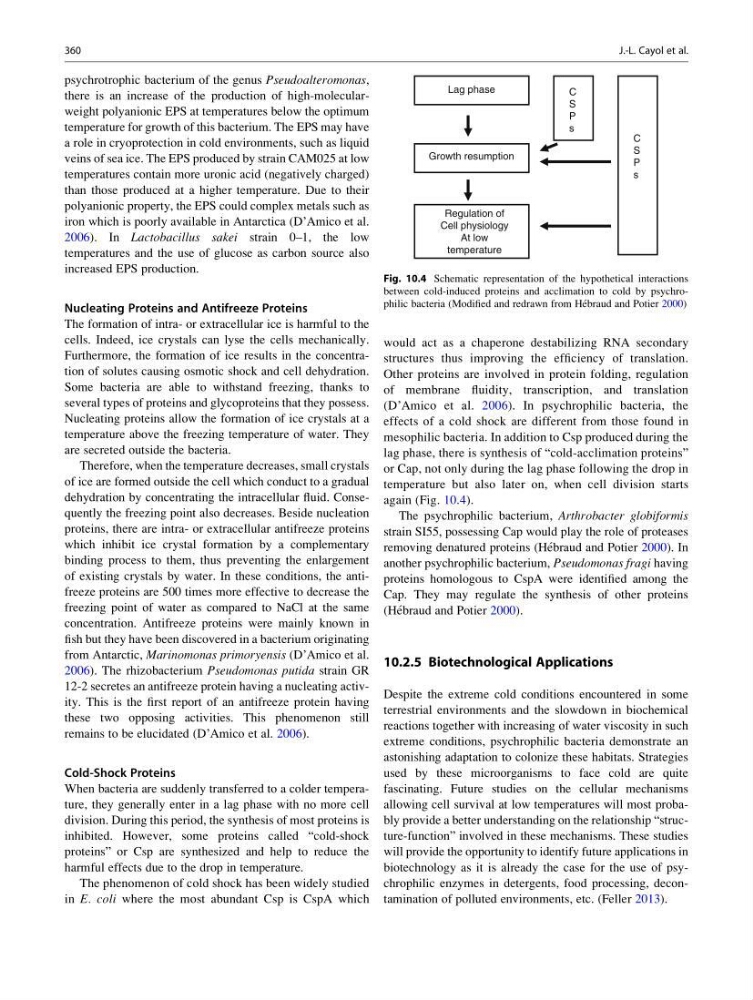
mesophilic bacteria. In addition to Csp produced during the
lag phase, there is synthesis of “cold-acclimation proteins”
or Cap, not only during the lag phase following the drop in
temperature but also later on, when cell division starts
again (Fig. 10.4).
The psychrophilic bacterium, Arthrobacter globiformis
strain SI55, possessing Cap would play the role of proteases
removing denatured proteins (He ´braud and Potier 2000). In
another psychrophilic bacterium, Pseudomonas fragi having
proteins homologous to CspA were identified among the
Cap. They may regulate the synthesis of other proteins
(He ´braud and Potier 2000).
10.2.5 Biotechnological Applications
Despite the extreme cold conditions encountered in some
terrestrial environments and the slowdown in biochemical
reactions together with increasing of water viscosity in such
extreme conditions, psychrophilic bacteria demonstrate an
astonishing adaptation to colonize these habitats. Strategies
used by these microorganisms to face cold are quite
fascinating. Future studies on the cellular mechanisms
allowing cell survival at low temperatures will most probably provide a better understanding on the relationship “structure-function” involved in these mechanisms. These studies
will provide the opportunity to identify future applications in
biotechnology as it is already the case for the use of psychrophilic enzymes in detergents, food processing, decontamination of polluted environments, etc. (Feller 2013).
Regulation of
Cell physiology
At low
temperature
C
S
P
s
C
S
P
s
Lag phase
Growth resumption
Fig. 10.4 Schematic representation of the hypothetical interactions
between cold-induced proteins and acclimation to cold by psychrophilic bacteria (Modified and redrawn from He ´braud and Potier 2000)
360
J.-L. Cayol et al.
there is an increase of the production of high-molecularweight polyanionic EPS at temperatures below the optimum
temperature for growth of this bacterium. The EPS may have
a role in cryoprotection in cold environments, such as liquid
veins of sea ice. The EPS produced by strain CAM025 at low
temperatures contain more uronic acid (negatively charged)
than those produced at a higher temperature. Due to their
polyanionic property, the EPS could complex metals such as
iron which is poorly available in Antarctica (D’Amico et al.
2006). In Lactobacillus sakei strain 0–1, the low
temperatures and the use of glucose as carbon source also
increased EPS production.
Nucleating Proteins and Antifreeze Proteins
The formation of intra- or extracellular ice is harmful to the
cells. Indeed, ice crystals can lyse the cells mechanically.
Furthermore, the formation of ice results in the concentration of solutes causing osmotic shock and cell dehydration.
Some bacteria are able to withstand freezing, thanks to
several types of proteins and glycoproteins that they possess.
Nucleating proteins allow the formation of ice crystals at a
temperature above the freezing temperature of water. They
are secreted outside the bacteria.
Therefore, when the temperature decreases, small crystals
of ice are formed outside the cell which conduct to a gradual
dehydration by concentrating the intracellular fluid. Consequently the freezing point also decreases. Beside nucleation
proteins, there are intra- or extracellular antifreeze proteins
which inhibit ice crystal formation by a complementary
binding process to them, thus preventing the enlargement
of existing crystals by water. In these conditions, the antifreeze proteins are 500 times more effective to decrease the
freezing point of water as compared to NaCl at the same
concentration. Antifreeze proteins were mainly known in
fish but they have been discovered in a bacterium originating
from Antarctic, Marinomonas primoryensis (D’Amico et al.
2006). The rhizobacterium Pseudomonas putida strain GR
12-2 secretes an antifreeze protein having a nucleating activity. This is the first report of an antifreeze protein having
these two opposing activities. This phenomenon still
remains to be elucidated (D’Amico et al. 2006).
Cold-Shock Proteins
When bacteria are suddenly transferred to a colder temperature, they generally enter in a lag phase with no more cell
division. During this period, the synthesis of most proteins is
inhibited. However, some proteins called “cold-shock
proteins” or Csp are synthesized and help to reduce the
harmful effects due to the drop in temperature.
The phenomenon of cold shock has been widely studied
in E. coli where the most abundant Csp is CspA which
would act as a chaperone destabilizing RNA secondary
structures thus improving the efficiency of translation.
Other proteins are involved in protein folding, regulation
of membrane fluidity, transcription, and translation
(D’Amico et al. 2006). In psychrophilic bacteria, the
effects of a cold shock are different from those found in
mesophilic bacteria. In addition to Csp produced during the
lag phase, there is synthesis of “cold-acclimation proteins”
or Cap, not only during the lag phase following the drop in
temperature but also later on, when cell division starts
again (Fig. 10.4).
The psychrophilic bacterium, Arthrobacter globiformis
strain SI55, possessing Cap would play the role of proteases
removing denatured proteins (He ´braud and Potier 2000). In
another psychrophilic bacterium, Pseudomonas fragi having
proteins homologous to CspA were identified among the
Cap. They may regulate the synthesis of other proteins
(He ´braud and Potier 2000).
10.2.5 Biotechnological Applications
Despite the extreme cold conditions encountered in some
terrestrial environments and the slowdown in biochemical
reactions together with increasing of water viscosity in such
extreme conditions, psychrophilic bacteria demonstrate an
astonishing adaptation to colonize these habitats. Strategies
used by these microorganisms to face cold are quite
fascinating. Future studies on the cellular mechanisms
allowing cell survival at low temperatures will most probably provide a better understanding on the relationship “structure-function” involved in these mechanisms. These studies
will provide the opportunity to identify future applications in
biotechnology as it is already the case for the use of psychrophilic enzymes in detergents, food processing, decontamination of polluted environments, etc. (Feller 2013).
Regulation of
Cell physiology
At low
temperature
C
S
P
s
C
S
P
s
Lag phase
Growth resumption
Fig. 10.4 Schematic representation of the hypothetical interactions
between cold-induced proteins and acclimation to cold by psychrophilic bacteria (Modified and redrawn from He ´braud and Potier 2000)
360
J.-L. Cayol et al.