

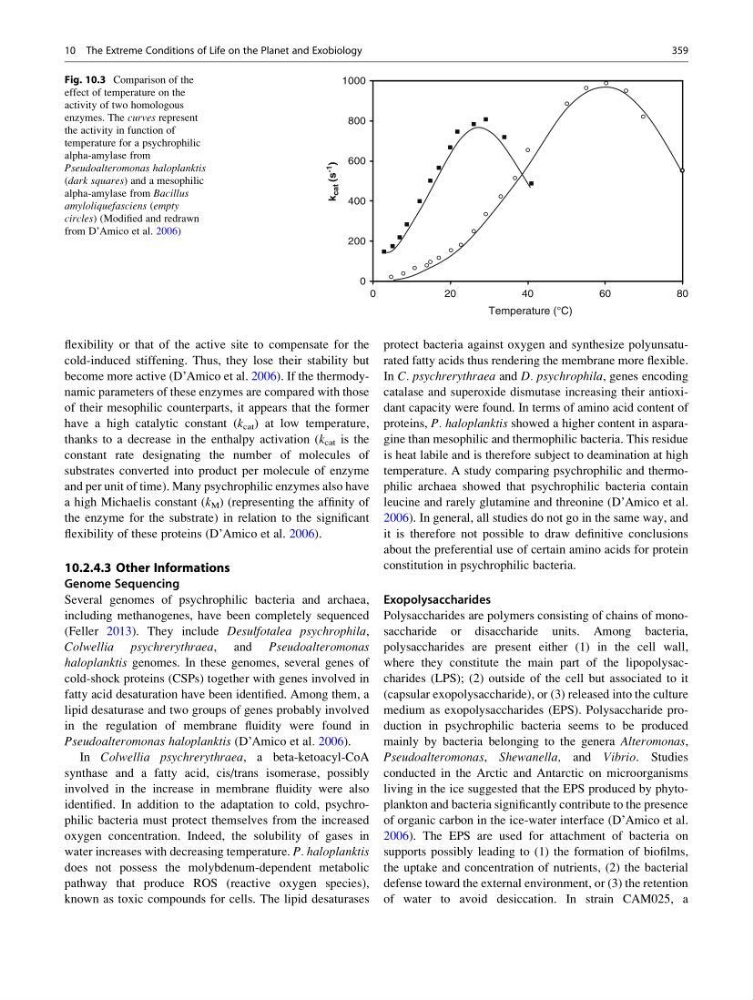
flexibility or that of the active site to compensate for the
cold-induced stiffening. Thus, they lose their stability but
become more active (D’Amico et al. 2006). If the thermodynamic parameters of these enzymes are compared with those
of their mesophilic counterparts, it appears that the former
have a high catalytic constant (k cat ) at low temperature,
thanks to a decrease in the enthalpy activation (k cat is the
constant rate designating the number of molecules of
substrates converted into product per molecule of enzyme
and per unit of time). Many psychrophilic enzymes also have
a high Michaelis constant (k M ) (representing the affinity of
the enzyme for the substrate) in relation to the significant
flexibility of these proteins (D’Amico et al. 2006).
10.2.4.3 Other Informations
Genome Sequencing
Several genomes of psychrophilic bacteria and archaea,
including methanogenes, have been completely sequenced
(Feller 2013). They include Desulfotalea psychrophila,
Colwellia psychrerythraea, and Pseudoalteromonas
haloplanktis genomes. In these genomes, several genes of
cold-shock proteins (CSPs) together with genes involved in
fatty acid desaturation have been identified. Among them, a
lipid desaturase and two groups of genes probably involved
in the regulation of membrane fluidity were found in
Pseudoalteromonas haloplanktis (D’Amico et al. 2006).
In Colwellia psychrerythraea, a beta-ketoacyl-CoA
synthase and a fatty acid, cis/trans isomerase, possibly
involved in the increase in membrane fluidity were also
identified. In addition to the adaptation to cold, psychrophilic bacteria must protect themselves from the increased
oxygen concentration. Indeed, the solubility of gases in
water increases with decreasing temperature. P. haloplanktis
does not possess the molybdenum-dependent metabolic
pathway that produce ROS (reactive oxygen species),
known as toxic compounds for cells. The lipid desaturases
protect bacteria against oxygen and synthesize polyunsaturated fatty acids thus rendering the membrane more flexible.
In C. psychrerythraea and D. psychrophila, genes encoding
catalase and superoxide dismutase increasing their antioxidant capacity were found. In terms of amino acid content of
proteins, P. haloplanktis showed a higher content in asparagine than mesophilic and thermophilic bacteria. This residue
is heat labile and is therefore subject to deamination at high
temperature. A study comparing psychrophilic and thermophilic archaea showed that psychrophilic bacteria contain
leucine and rarely glutamine and threonine (D’Amico et al.
2006). In general, all studies do not go in the same way, and
it is therefore not possible to draw definitive conclusions
about the preferential use of certain amino acids for protein
constitution in psychrophilic bacteria.
Exopolysaccharides
Polysaccharides are polymers consisting of chains of monosaccharide or disaccharide units. Among bacteria,
polysaccharides are present either (1) in the cell wall,
where they constitute the main part of the lipopolysaccharides (LPS); (2) outside of the cell but associated to it
(capsular exopolysaccharide), or (3) released into the culture
medium as exopolysaccharides (EPS). Polysaccharide production in psychrophilic bacteria seems to be produced
mainly by bacteria belonging to the genera Alteromonas,
Pseudoalteromonas, Shewanella, and Vibrio. Studies
conducted in the Arctic and Antarctic on microorganisms
living in the ice suggested that the EPS produced by phytoplankton and bacteria significantly contribute to the presence
of organic carbon in the ice-water interface (D’Amico et al.
2006). The EPS are used for attachment of bacteria on
supports possibly leading to (1) the formation of biofilms,
the uptake and concentration of nutrients, (2) the bacterial
defense toward the external environment, or (3) the retention
of water to avoid desiccation. In strain CAM025, a
0
200
400
600
800
1000
0
2 0
4 0
6 0
8 0
k
cat (s
-1
)
Temperature (°C)
Fig. 10.3 Comparison of the
effect of temperature on the
activity of two homologous
enzymes. The curves represent
the activity in function of
temperature for a psychrophilic
alpha-amylase from
Pseudoalteromonas haloplanktis
(dark squares) and a mesophilic
alpha-amylase from Bacillus
amyloliquefasciens (empty
circles) (Modified and redrawn
from D’Amico et al. 2006)
10 The Extreme Conditions of Life on the Planet and Exobiology
359
cold-induced stiffening. Thus, they lose their stability but
become more active (D’Amico et al. 2006). If the thermodynamic parameters of these enzymes are compared with those
of their mesophilic counterparts, it appears that the former
have a high catalytic constant (k cat ) at low temperature,
thanks to a decrease in the enthalpy activation (k cat is the
constant rate designating the number of molecules of
substrates converted into product per molecule of enzyme
and per unit of time). Many psychrophilic enzymes also have
a high Michaelis constant (k M ) (representing the affinity of
the enzyme for the substrate) in relation to the significant
flexibility of these proteins (D’Amico et al. 2006).
10.2.4.3 Other Informations
Genome Sequencing
Several genomes of psychrophilic bacteria and archaea,
including methanogenes, have been completely sequenced
(Feller 2013). They include Desulfotalea psychrophila,
Colwellia psychrerythraea, and Pseudoalteromonas
haloplanktis genomes. In these genomes, several genes of
cold-shock proteins (CSPs) together with genes involved in
fatty acid desaturation have been identified. Among them, a
lipid desaturase and two groups of genes probably involved
in the regulation of membrane fluidity were found in
Pseudoalteromonas haloplanktis (D’Amico et al. 2006).
In Colwellia psychrerythraea, a beta-ketoacyl-CoA
synthase and a fatty acid, cis/trans isomerase, possibly
involved in the increase in membrane fluidity were also
identified. In addition to the adaptation to cold, psychrophilic bacteria must protect themselves from the increased
oxygen concentration. Indeed, the solubility of gases in
water increases with decreasing temperature. P. haloplanktis
does not possess the molybdenum-dependent metabolic
pathway that produce ROS (reactive oxygen species),
known as toxic compounds for cells. The lipid desaturases
protect bacteria against oxygen and synthesize polyunsaturated fatty acids thus rendering the membrane more flexible.
In C. psychrerythraea and D. psychrophila, genes encoding
catalase and superoxide dismutase increasing their antioxidant capacity were found. In terms of amino acid content of
proteins, P. haloplanktis showed a higher content in asparagine than mesophilic and thermophilic bacteria. This residue
is heat labile and is therefore subject to deamination at high
temperature. A study comparing psychrophilic and thermophilic archaea showed that psychrophilic bacteria contain
leucine and rarely glutamine and threonine (D’Amico et al.
2006). In general, all studies do not go in the same way, and
it is therefore not possible to draw definitive conclusions
about the preferential use of certain amino acids for protein
constitution in psychrophilic bacteria.
Exopolysaccharides
Polysaccharides are polymers consisting of chains of monosaccharide or disaccharide units. Among bacteria,
polysaccharides are present either (1) in the cell wall,
where they constitute the main part of the lipopolysaccharides (LPS); (2) outside of the cell but associated to it
(capsular exopolysaccharide), or (3) released into the culture
medium as exopolysaccharides (EPS). Polysaccharide production in psychrophilic bacteria seems to be produced
mainly by bacteria belonging to the genera Alteromonas,
Pseudoalteromonas, Shewanella, and Vibrio. Studies
conducted in the Arctic and Antarctic on microorganisms
living in the ice suggested that the EPS produced by phytoplankton and bacteria significantly contribute to the presence
of organic carbon in the ice-water interface (D’Amico et al.
2006). The EPS are used for attachment of bacteria on
supports possibly leading to (1) the formation of biofilms,
the uptake and concentration of nutrients, (2) the bacterial
defense toward the external environment, or (3) the retention
of water to avoid desiccation. In strain CAM025, a
0
200
400
600
800
1000
0
2 0
4 0
6 0
8 0
k
cat (s
-1
)
Temperature (°C)
Fig. 10.3 Comparison of the
effect of temperature on the
activity of two homologous
enzymes. The curves represent
the activity in function of
temperature for a psychrophilic
alpha-amylase from
Pseudoalteromonas haloplanktis
(dark squares) and a mesophilic
alpha-amylase from Bacillus
amyloliquefasciens (empty
circles) (Modified and redrawn
from D’Amico et al. 2006)
10 The Extreme Conditions of Life on the Planet and Exobiology
359