

Biofilm Formation*
In aquatic environments, when microorganisms adhere to
surfaces, they can grow by forming biofilms. These
structures consist of a matrix of exopolymers excreted by
bacteria, forming a mucoid mass spread over the surface
and in which the bacteria are glued. They develop by
constituting a biomass in this biofilm, being protected from
the environment. Biofilms trap nutrients dissolved in the
water but also contaminants (metals, organic pollutants)
which are concentrated in the matrix of exopolymers.
Nutrients allow the growth of bacteria enmeshed in biofilms.
These bacteria form a community that can be mono- or
multispecies.
The formation of a biofilm depends primarily on the
accession of free microorganisms to a surface and production of exopolysaccharides (EPS). These prokaryotes are
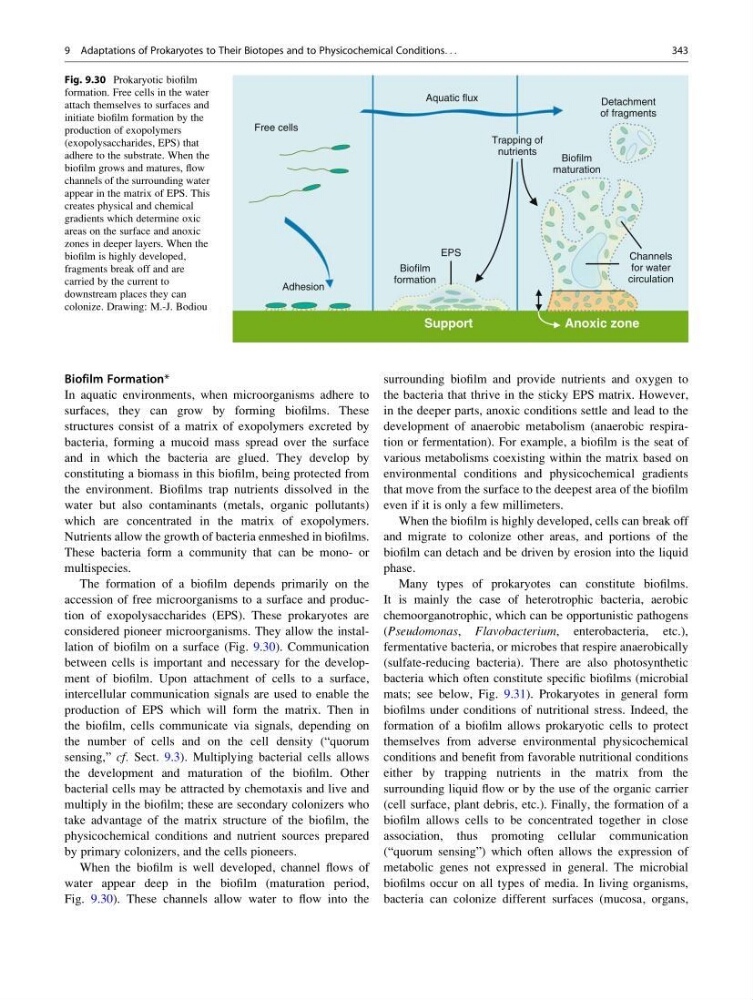
considered pioneer microorganisms. They allow the installation of biofilm on a surface (Fig. 9.30). Communication
between cells is important and necessary for the development of biofilm. Upon attachment of cells to a surface,
intercellular communication signals are used to enable the
production of EPS which will form the matrix. Then in
the biofilm, cells communicate via signals, depending on
the number of cells and on the cell density (“quorum
sensing,” cf. Sect. 9.3). Multiplying bacterial cells allows
the development and maturation of the biofilm. Other
bacterial cells may be attracted by chemotaxis and live and
multiply in the biofilm; these are secondary colonizers who
take advantage of the matrix structure of the biofilm, the
physicochemical conditions and nutrient sources prepared
by primary colonizers, and the cells pioneers.
When the biofilm is well developed, channel flows of
water appear deep in the biofilm (maturation period,
Fig. 9.30). These channels allow water to flow into the
surrounding biofilm and provide nutrients and oxygen to
the bacteria that thrive in the sticky EPS matrix. However,
in the deeper parts, anoxic conditions settle and lead to the
development of anaerobic metabolism (anaerobic respiration or fermentation). For example, a biofilm is the seat of
various metabolisms coexisting within the matrix based on
environmental conditions and physicochemical gradients
that move from the surface to the deepest area of the biofilm
even if it is only a few millimeters.
When the biofilm is highly developed, cells can break off
and migrate to colonize other areas, and portions of the
biofilm can detach and be driven by erosion into the liquid
phase.
Many types of prokaryotes can constitute biofilms.
It is mainly the case of heterotrophic bacteria, aerobic
chemoorganotrophic, which can be opportunistic pathogens
(Pseudomonas, Flavobacterium, enterobacteria, etc.),
fermentative bacteria, or microbes that respire anaerobically
(sulfate-reducing bacteria). There are also photosynthetic
bacteria which often constitute specific biofilms (microbial
mats; see below, Fig. 9.31). Prokaryotes in general form
biofilms under conditions of nutritional stress. Indeed, the
formation of a biofilm allows prokaryotic cells to protect
themselves from adverse environmental physicochemical
conditions and benefit from favorable nutritional conditions
either by trapping nutrients in the matrix from the
surrounding liquid flow or by the use of the organic carrier
(cell surface, plant debris, etc.). Finally, the formation of a
biofilm allows cells to be concentrated together in close
association, thus promoting cellular communication
(“quorum sensing”) which often allows the expression of
metabolic genes not expressed in general. The microbial
biofilms occur on all types of media. In living organisms,
bacteria can colonize different surfaces (mucosa, organs,
Free cells
Support
Anoxic zone
Biofilm
formation
Channels
for water
circulation
EPS
Aquatic flux
Trapping of
nutrients
Detachment
of fragments
Biofilm
maturation
Adhesion
Fig. 9.30 Prokaryotic biofilm
formation. Free cells in the water
attach themselves to surfaces and
initiate biofilm formation by the
production of exopolymers
(exopolysaccharides, EPS) that
adhere to the substrate. When the
biofilm grows and matures, flow
channels of the surrounding water
appear in the matrix of EPS. This
creates physical and chemical
gradients which determine oxic
areas on the surface and anoxic
zones in deeper layers. When the
biofilm is highly developed,
fragments break off and are
carried by the current to
downstream places they can
colonize. Drawing: M.-J. Bodiou
9 Adaptations of Prokaryotes to Their Biotopes and to Physicochemical Conditions. . .
343
In aquatic environments, when microorganisms adhere to
surfaces, they can grow by forming biofilms. These
structures consist of a matrix of exopolymers excreted by
bacteria, forming a mucoid mass spread over the surface
and in which the bacteria are glued. They develop by
constituting a biomass in this biofilm, being protected from
the environment. Biofilms trap nutrients dissolved in the
water but also contaminants (metals, organic pollutants)
which are concentrated in the matrix of exopolymers.
Nutrients allow the growth of bacteria enmeshed in biofilms.
These bacteria form a community that can be mono- or
multispecies.
The formation of a biofilm depends primarily on the
accession of free microorganisms to a surface and production of exopolysaccharides (EPS). These prokaryotes are
considered pioneer microorganisms. They allow the installation of biofilm on a surface (Fig. 9.30). Communication
between cells is important and necessary for the development of biofilm. Upon attachment of cells to a surface,
intercellular communication signals are used to enable the
production of EPS which will form the matrix. Then in
the biofilm, cells communicate via signals, depending on
the number of cells and on the cell density (“quorum
sensing,” cf. Sect. 9.3). Multiplying bacterial cells allows
the development and maturation of the biofilm. Other
bacterial cells may be attracted by chemotaxis and live and
multiply in the biofilm; these are secondary colonizers who
take advantage of the matrix structure of the biofilm, the
physicochemical conditions and nutrient sources prepared
by primary colonizers, and the cells pioneers.
When the biofilm is well developed, channel flows of
water appear deep in the biofilm (maturation period,
Fig. 9.30). These channels allow water to flow into the
surrounding biofilm and provide nutrients and oxygen to
the bacteria that thrive in the sticky EPS matrix. However,
in the deeper parts, anoxic conditions settle and lead to the
development of anaerobic metabolism (anaerobic respiration or fermentation). For example, a biofilm is the seat of
various metabolisms coexisting within the matrix based on
environmental conditions and physicochemical gradients
that move from the surface to the deepest area of the biofilm
even if it is only a few millimeters.
When the biofilm is highly developed, cells can break off
and migrate to colonize other areas, and portions of the
biofilm can detach and be driven by erosion into the liquid
phase.
Many types of prokaryotes can constitute biofilms.
It is mainly the case of heterotrophic bacteria, aerobic
chemoorganotrophic, which can be opportunistic pathogens
(Pseudomonas, Flavobacterium, enterobacteria, etc.),
fermentative bacteria, or microbes that respire anaerobically
(sulfate-reducing bacteria). There are also photosynthetic
bacteria which often constitute specific biofilms (microbial
mats; see below, Fig. 9.31). Prokaryotes in general form
biofilms under conditions of nutritional stress. Indeed, the
formation of a biofilm allows prokaryotic cells to protect
themselves from adverse environmental physicochemical
conditions and benefit from favorable nutritional conditions
either by trapping nutrients in the matrix from the
surrounding liquid flow or by the use of the organic carrier
(cell surface, plant debris, etc.). Finally, the formation of a
biofilm allows cells to be concentrated together in close
association, thus promoting cellular communication
(“quorum sensing”) which often allows the expression of
metabolic genes not expressed in general. The microbial
biofilms occur on all types of media. In living organisms,
bacteria can colonize different surfaces (mucosa, organs,
Free cells
Support
Anoxic zone
Biofilm
formation
Channels
for water
circulation
EPS
Aquatic flux
Trapping of
nutrients
Detachment
of fragments
Biofilm
maturation
Adhesion
Fig. 9.30 Prokaryotic biofilm
formation. Free cells in the water
attach themselves to surfaces and
initiate biofilm formation by the
production of exopolymers
(exopolysaccharides, EPS) that
adhere to the substrate. When the
biofilm grows and matures, flow
channels of the surrounding water
appear in the matrix of EPS. This
creates physical and chemical
gradients which determine oxic
areas on the surface and anoxic
zones in deeper layers. When the
biofilm is highly developed,
fragments break off and are
carried by the current to
downstream places they can
colonize. Drawing: M.-J. Bodiou
9 Adaptations of Prokaryotes to Their Biotopes and to Physicochemical Conditions. . .
343