

Hydrophobic Interactions
Many surfaces are hydrophobic in nature: oil drops in water,
cell membranes, waxy surfaces, etc. Many prokaryotes have
hydrophobic surfaces that allow them to adhere directly.
However, microbes covered with exopolysaccharides are
hydrophilic. They can produce fimbriae or pili which are
hydrophobic to help them fasten onto surfaces.
Presence of Lectins
Lectins are proteins linked to carbohydrates produced by
prokaryotes and eukaryotes. They are located at the end of
pili in prokaryotes and allow adhesion with receptor sites
specific to each lectin type. They are specific to certain
surfaces or membranes or heterotrophic or photosynthetic
prokaryotes. For instance, enteropathogenic Escherichia coli
have lectins which enable them to adhere specifically to cells
of the gut, whereas uropathogenic Escherichia coli adhere to
the cells of the bladder.
Other Adhesion Mechanisms
There are other proteins of mammalian cells such as
fibronectin or vitronectins which are receptors for different
pathogenic bacteria.
Flagella of certain bacteria (Vibrio) allow their adherence to epithelial cells of the intestine wall. Similarly,
lipoteichoic acids of Gram-positive bacteria (streptococci,
staphylococci) also help adherence to epithelial cells
or skin.
Wall of peptidoglycan
Cytoplasmic
membrane
Outer
membrane
Cell motion
Movement of outer membrane proteins
a
b
H
+
H
+
H
+
Support
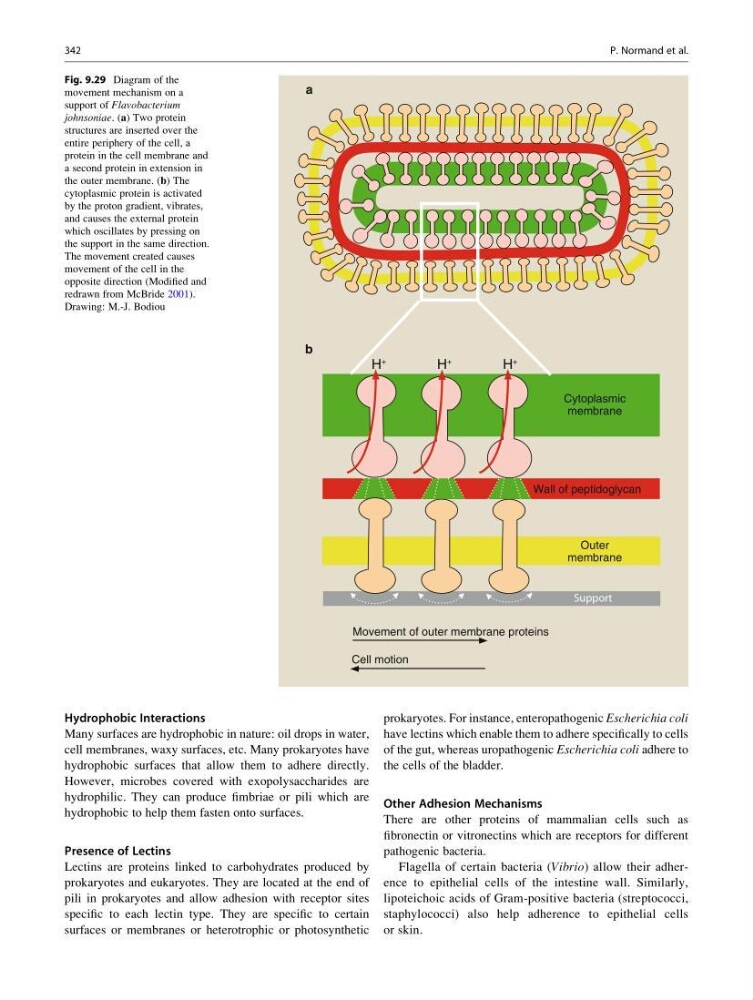
Fig. 9.29 Diagram of the
movement mechanism on a
support of Flavobacterium
johnsoniae. (a) Two protein
structures are inserted over the
entire periphery of the cell, a
protein in the cell membrane and
a second protein in extension in
the outer membrane. (b) The
cytoplasmic protein is activated
by the proton gradient, vibrates,
and causes the external protein
which oscillates by pressing on
the support in the same direction.
The movement created causes
movement of the cell in the
opposite direction (Modified and
redrawn from McBride 2001).
Drawing: M.-J. Bodiou
342
P. Normand et al.
Many surfaces are hydrophobic in nature: oil drops in water,
cell membranes, waxy surfaces, etc. Many prokaryotes have
hydrophobic surfaces that allow them to adhere directly.
However, microbes covered with exopolysaccharides are
hydrophilic. They can produce fimbriae or pili which are
hydrophobic to help them fasten onto surfaces.
Presence of Lectins
Lectins are proteins linked to carbohydrates produced by
prokaryotes and eukaryotes. They are located at the end of
pili in prokaryotes and allow adhesion with receptor sites
specific to each lectin type. They are specific to certain
surfaces or membranes or heterotrophic or photosynthetic
prokaryotes. For instance, enteropathogenic Escherichia coli
have lectins which enable them to adhere specifically to cells
of the gut, whereas uropathogenic Escherichia coli adhere to
the cells of the bladder.
Other Adhesion Mechanisms
There are other proteins of mammalian cells such as
fibronectin or vitronectins which are receptors for different
pathogenic bacteria.
Flagella of certain bacteria (Vibrio) allow their adherence to epithelial cells of the intestine wall. Similarly,
lipoteichoic acids of Gram-positive bacteria (streptococci,
staphylococci) also help adherence to epithelial cells
or skin.
Wall of peptidoglycan
Cytoplasmic
membrane
Outer
membrane
Cell motion
Movement of outer membrane proteins
a
b
H
+
H
+
H
+
Support
Fig. 9.29 Diagram of the
movement mechanism on a
support of Flavobacterium
johnsoniae. (a) Two protein
structures are inserted over the
entire periphery of the cell, a
protein in the cell membrane and
a second protein in extension in
the outer membrane. (b) The
cytoplasmic protein is activated
by the proton gradient, vibrates,
and causes the external protein
which oscillates by pressing on
the support in the same direction.
The movement created causes
movement of the cell in the
opposite direction (Modified and
redrawn from McBride 2001).
Drawing: M.-J. Bodiou
342
P. Normand et al.