

It has also been evidenced in the halophilic sulfatereducing bacteria (Welsh et al. 1996) and in halophilic
fermentative bacteria. Most of these bacteria accumulate
glycine betaine by active absorption, but some are capable of synthesizing such as phototrophic bacteria and
sulfate-reducing bacteria. Aerobic heterotrophic bacteria
and fermentative bacteria can realize a partial synthesis
from a precursor of the biosynthetic pathway (proline)
they must obtain outside in their environment. In general,
it is rare that the glycine betaine is the only compatible
solute present in a bacterium subjected to salt stress. It is
often accompanied by sugars (sucrose, trehalose),
polyalcohols (sorbitol, glycerol), or other amino acids
and their derivatives (glutamate, ectoine). Glycine
betaine is largely present in hypersaline environments.
It can also serve as a substrate for some bacteria. Thus, a
halophilic fermentative bacterium has been recently
isolated that was capable of using glycine betaine as a
substrate for energy, reducing it to trimethylamine via a
Stickland reaction (Moune ´ et al. 1999).
Halophilic Bacteria and Archaea
and Their Habitats (cf. Sect. 10.4.1)
Salty aquatic environments represent the largest part of the
aquatic environment with oceans. Oceans have a salinity
level between 35 and 37 ppm for the more salty biotopes
(Mediterranean Sea). These are environments where the pH
is neutral to slightly alkaline (7.5–8). Halophilic prokaryotes
CYTOPLASM
H
+
H
+
Cyto pla sm ic m e m b r a n
e
OUTER ENVIRONMENT
Flagellum basal
motor
Flagellum
Na
+
Na
+
Na
+
Na
+
Na
+
Na
+
S
K
+
5
1
2
3
4
Optimal concentration
of cations
( Ca
++
, Mg
++
, K
+ )
Maximum growth rate
IN OPTIMAL CONCENTRATION OF NaCl
a
b
CATION CONCENTRATION
GROWTH RATE
e
-
0
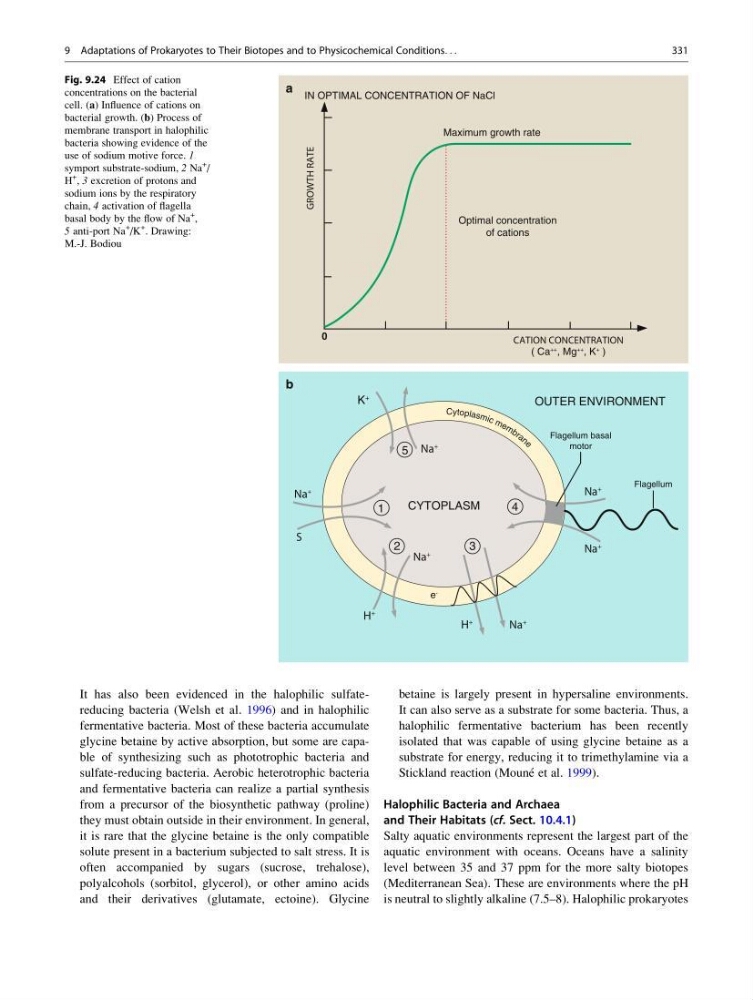
Fig. 9.24 Effect of cation
concentrations on the bacterial
cell. (a) Influence of cations on
bacterial growth. (b) Process of
membrane transport in halophilic
bacteria showing evidence of the
use of sodium motive force. 1
symport substrate-sodium, 2 Na
+ /
H
+ , 3 excretion of protons and
sodium ions by the respiratory
chain, 4 activation of flagella
basal body by the flow of Na
+ ,
5 anti-port Na
+ /K
+ . Drawing:
M.-J. Bodiou
9 Adaptations of Prokaryotes to Their Biotopes and to Physicochemical Conditions. . .
331
fermentative bacteria. Most of these bacteria accumulate
glycine betaine by active absorption, but some are capable of synthesizing such as phototrophic bacteria and
sulfate-reducing bacteria. Aerobic heterotrophic bacteria
and fermentative bacteria can realize a partial synthesis
from a precursor of the biosynthetic pathway (proline)
they must obtain outside in their environment. In general,
it is rare that the glycine betaine is the only compatible
solute present in a bacterium subjected to salt stress. It is
often accompanied by sugars (sucrose, trehalose),
polyalcohols (sorbitol, glycerol), or other amino acids
and their derivatives (glutamate, ectoine). Glycine
betaine is largely present in hypersaline environments.
It can also serve as a substrate for some bacteria. Thus, a
halophilic fermentative bacterium has been recently
isolated that was capable of using glycine betaine as a
substrate for energy, reducing it to trimethylamine via a
Stickland reaction (Moune ´ et al. 1999).
Halophilic Bacteria and Archaea
and Their Habitats (cf. Sect. 10.4.1)
Salty aquatic environments represent the largest part of the
aquatic environment with oceans. Oceans have a salinity
level between 35 and 37 ppm for the more salty biotopes
(Mediterranean Sea). These are environments where the pH
is neutral to slightly alkaline (7.5–8). Halophilic prokaryotes
CYTOPLASM
H
+
H
+
Cyto pla sm ic m e m b r a n
e
OUTER ENVIRONMENT
Flagellum basal
motor
Flagellum
Na
+
Na
+
Na
+
Na
+
Na
+
Na
+
S
K
+
5
1
2
3
4
Optimal concentration
of cations
( Ca
++
, Mg
++
, K
+ )
Maximum growth rate
IN OPTIMAL CONCENTRATION OF NaCl
a
b
CATION CONCENTRATION
GROWTH RATE
e
-
0
Fig. 9.24 Effect of cation
concentrations on the bacterial
cell. (a) Influence of cations on
bacterial growth. (b) Process of
membrane transport in halophilic
bacteria showing evidence of the
use of sodium motive force. 1
symport substrate-sodium, 2 Na
+ /
H
+ , 3 excretion of protons and
sodium ions by the respiratory
chain, 4 activation of flagella
basal body by the flow of Na
+ ,
5 anti-port Na
+ /K
+ . Drawing:
M.-J. Bodiou
9 Adaptations of Prokaryotes to Their Biotopes and to Physicochemical Conditions. . .
331