

that are living in these environments are part of the domain
bacteria and are qualified of slightly halophilic also called
marine bacteria. There are also many salt-tolerant bacteria
derived from continental areas and discharged into the
marine environment where they may develop because
of their relative salt tolerance. These latter cannot be
regarded as true marine bacteria in the strict sense of the
term. Marine bacteria are found in almost all bacterial
groups with the exception of certain groups typically
associated with soils. Thus, marine bacteria are present in
most families where they constitute differentiated genera
or differentiated species. From a metabolic point of
view, there exists chemoorganotrophic chemolithotrophic
and phototrophic marine bacteria, realizing aerobic or
anaerobic respirations, fermentations, and oxygenic or
anoxygenic photosynthesis. The presence of archaea was also
demonstrated in the oceanic waters (Karner et al. 2001;
Giovannoni and Sting 2005).
• Hypersaline environments
Seawater, which is most of the water on Earth, contains
dissolved mineral salts in concentrations that are remarkably constant; the main ones are chlorine (18.98 %),
sodium (10.556 %), sulfate (2.649 %), magnesium
(1.272 %), calcium (0.4 %), potassium (0.38 %), and
carbonate (0.14 %). Hypersaline environments are those
which exhibit concentrations of mineral salts superior to
those of seawater. This definition is not specific and does
not take into account the types of salts and their
proportions. However, the majority of hypersaline
environments originate from salts of sea water, either
directly by evaporation and concentration or indirectly
by the dissolution of fossil deposits (evaporites).
OH
OH
O
O
O
COO
-
CH 2 OH
CH 2 OH
CH 2 OH
CH 2 OH
N
N
H 2
HO
HO
HO
HO
HO
O
O
O
CH 2 OH
HO
HO
HO
HO
COO
-
N
+
+
+
+
COO
-
COO
-
H 3 N
Proline betaine
Proline
Sucrose
Trehalose
Glycine
Glycine betaine
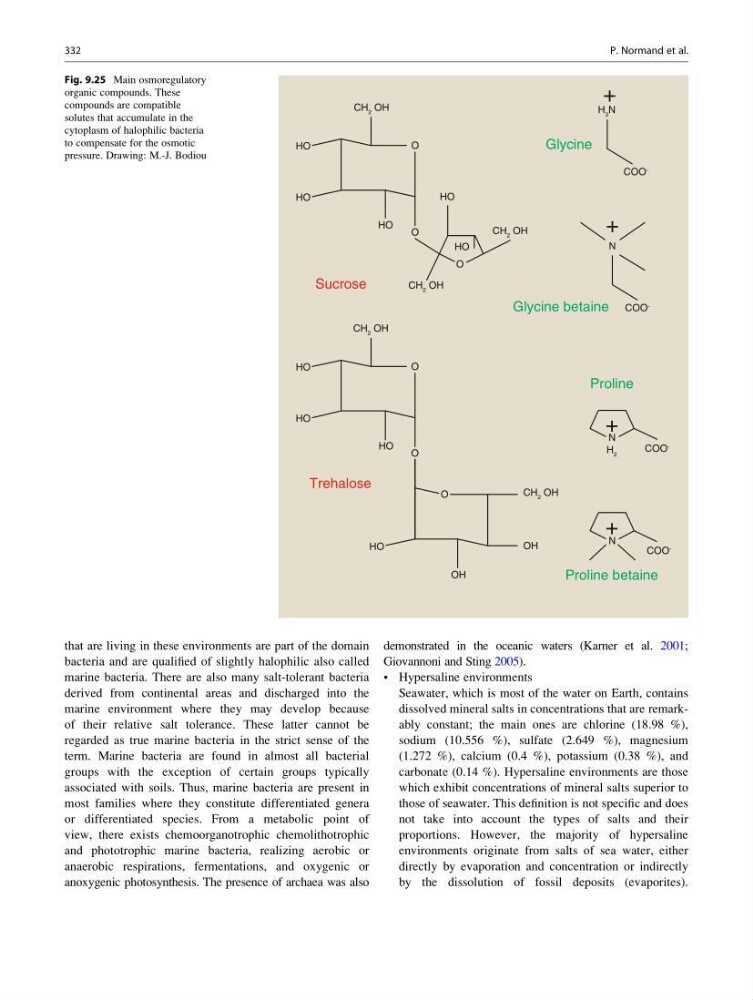
Fig. 9.25 Main osmoregulatory
organic compounds. These
compounds are compatible
solutes that accumulate in the
cytoplasm of halophilic bacteria
to compensate for the osmotic
pressure. Drawing: M.-J. Bodiou
332
P. Normand et al.
bacteria and are qualified of slightly halophilic also called
marine bacteria. There are also many salt-tolerant bacteria
derived from continental areas and discharged into the
marine environment where they may develop because
of their relative salt tolerance. These latter cannot be
regarded as true marine bacteria in the strict sense of the
term. Marine bacteria are found in almost all bacterial
groups with the exception of certain groups typically
associated with soils. Thus, marine bacteria are present in
most families where they constitute differentiated genera
or differentiated species. From a metabolic point of
view, there exists chemoorganotrophic chemolithotrophic
and phototrophic marine bacteria, realizing aerobic or
anaerobic respirations, fermentations, and oxygenic or
anoxygenic photosynthesis. The presence of archaea was also
demonstrated in the oceanic waters (Karner et al. 2001;
Giovannoni and Sting 2005).
• Hypersaline environments
Seawater, which is most of the water on Earth, contains
dissolved mineral salts in concentrations that are remarkably constant; the main ones are chlorine (18.98 %),
sodium (10.556 %), sulfate (2.649 %), magnesium
(1.272 %), calcium (0.4 %), potassium (0.38 %), and
carbonate (0.14 %). Hypersaline environments are those
which exhibit concentrations of mineral salts superior to
those of seawater. This definition is not specific and does
not take into account the types of salts and their
proportions. However, the majority of hypersaline
environments originate from salts of sea water, either
directly by evaporation and concentration or indirectly
by the dissolution of fossil deposits (evaporites).
OH
OH
O
O
O
COO
-
CH 2 OH
CH 2 OH
CH 2 OH
CH 2 OH
N
N
H 2
HO
HO
HO
HO
HO
O
O
O
CH 2 OH
HO
HO
HO
HO
COO
-
N
+
+
+
+
COO
-
COO
-
H 3 N
Proline betaine
Proline
Sucrose
Trehalose
Glycine
Glycine betaine
Fig. 9.25 Main osmoregulatory
organic compounds. These
compounds are compatible
solutes that accumulate in the
cytoplasm of halophilic bacteria
to compensate for the osmotic
pressure. Drawing: M.-J. Bodiou
332
P. Normand et al.