

9.3
Quorum Sensing*, a System
for Perception of Cell Density
9.3.1 Discovery of Quorum Sensing
In the prokaryotic world where each individual cell
reproduces by binary fission and is constantly struggling
for access to nutritional resources, recognition and cooperation between cells seemed highly unlikely. Early studies
undermining the paradigm of bacterial unicellular life and
evoking the existence of bacterial pheromones have
concerned the formation of fruiting bodies in Myxococcus
xanthus, the production of streptomycin in Streptomyces
griseus, the induction of competence in Streptococcus
pneumoniae, and control of bioluminescence in Vibrio
fischeri. In V. fischeri, a bioluminescent marine bacterium
living in symbiosis with the squid Euprymna scolopes,
bioluminescence was observed only at high cell density,
an extracellular compound accumulating during growth
could induce the phenomenon of bioluminescence in a low
cell density culture. This autoinducer compound was
purified and its structure elucidated; it is N-(3-oxohexanoyl)
homoserine lactone (3-oxo-C6-HSL) (Eberhard et al. 1981)
(Fig. 9.16).
It was not until 1992 that production of 3-oxo-C6-HSL
was detected in other bacterial species, particularly in
Erwinia carotovora now
called Pectobacterium
carotovorum, where the signal molecule regulates the
biosynthesis of carbapenem antibiotic, of the β-lactams family (Bainton et al. 1992). It was then that the term “quorum
sensing” (QS) appeared to describe the phenomenon that
allows bacteria to assess their population density via the
production of small sensor molecule (“sensing”) and initiate
a coordinated response when a certain cell density is reached
(“quorum”) (Fuqua et al. 1994). Detection of N-acylhomoserine lactones (AHLs) was made possible through
the development of biological systems based on the induction of a reporter gene or production of a pigment in
response to the addition of exogenous AHL ( Bainton et al.
1992). Several AHLs, which differ in acyl chain length
(from 4 to 18 carbons), and the substitution on the 3rd carbon
(H, O, or OH; Fig. 9.16) have been identified in various
Gram-negative bacteria belonging to subdivisions α, β, and
γ of Proteobacteria (Williams et al. 2007), and recently the
production of AHLs was discovered in a cyanobacterium
(Sharif et al. 2008). Most AHL-producing bacteria produce a
set of AHLs in various proportions (Lithgow et al. 2000).
QS regulation based on AHLs is used to control various
phenotypes (Williams et al. 2007) such as production
of virulence factors (plant pathogen Erwinia, opportunistic pathogens such as Pseudomonas aeruginosa or
Burkholderia pseudomallei), production of pigment
or antibiotics (Chromobacterium violaceum, Erwinia
carotovora, Pseudomonas aureofaciens), conjugative
transfer of plasmids (Agrobacterium tumefaciens, Rhizobium), mobility through swimming or swarming (Serratia
marcescens, Yersinia enterocolitica), development of
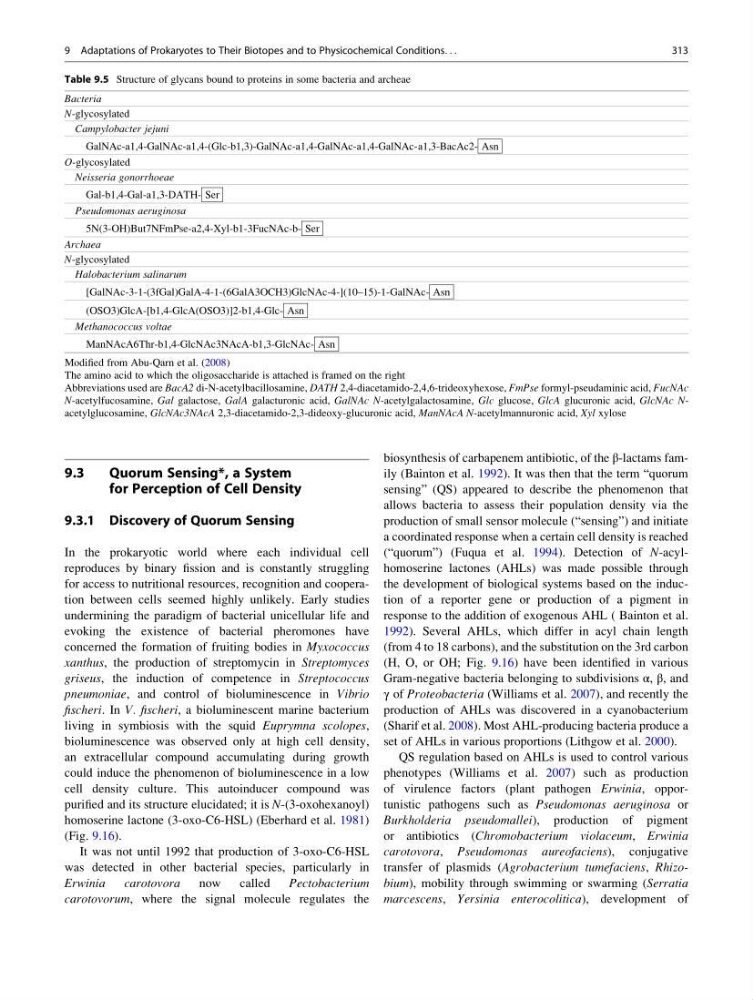
Table 9.5 Structure of glycans bound to proteins in some bacteria and archeae
Bacteria
N-glycosylated
Campylobacter jejuni
GalNAc-a1,4-GalNAc-a1,4-(Glc-b1,3)-GalNAc-a1,4-GalNAc-a1,4-GalNAc-a1,3-BacAc2- Asn
O-glycosylated
Neisseria gonorrhoeae
Gal-b1,4-Gal-a1,3-DATH- Ser
Pseudomonas aeruginosa
5N(3-OH)But7NFmPse-a2,4-Xyl-b1-3FucNAc-b- Ser
Archaea
N-glycosylated
Halobacterium salinarum
[GalNAc-3-1-(3fGal)GalA-4-1-(6GalA3OCH3)GlcNAc-4-](10–15)-1-GalNAc- Asn
(OSO3)GlcA-[b1,4-GlcA(OSO3)]2-b1,4-Glc- Asn
Methanococcus voltae
ManNAcA6Thr-b1,4-GlcNAc3NAcA-b1,3-GlcNAc- Asn
Modified from Abu-Qarn et al. (2008)
The amino acid to which the oligosaccharide is attached is framed on the right
Abbreviations used are BacA2 di-N-acetylbacillosamine, DATH 2,4-diacetamido-2,4,6-trideoxyhexose, FmPse formyl-pseudaminic acid, FucNAc
N-acetylfucosamine, Gal galactose, GalA galacturonic acid, GalNAc N-acetylgalactosamine, Glc glucose, GlcA glucuronic acid, GlcNAc Nacetylglucosamine, GlcNAc3NAcA 2,3-diacetamido-2,3-dideoxy-glucuronic acid, ManNAcA N-acetylmannuronic acid, Xyl xylose
9 Adaptations of Prokaryotes to Their Biotopes and to Physicochemical Conditions. . .
313
Quorum Sensing*, a System
for Perception of Cell Density
9.3.1 Discovery of Quorum Sensing
In the prokaryotic world where each individual cell
reproduces by binary fission and is constantly struggling
for access to nutritional resources, recognition and cooperation between cells seemed highly unlikely. Early studies
undermining the paradigm of bacterial unicellular life and
evoking the existence of bacterial pheromones have
concerned the formation of fruiting bodies in Myxococcus
xanthus, the production of streptomycin in Streptomyces
griseus, the induction of competence in Streptococcus
pneumoniae, and control of bioluminescence in Vibrio
fischeri. In V. fischeri, a bioluminescent marine bacterium
living in symbiosis with the squid Euprymna scolopes,
bioluminescence was observed only at high cell density,
an extracellular compound accumulating during growth
could induce the phenomenon of bioluminescence in a low
cell density culture. This autoinducer compound was
purified and its structure elucidated; it is N-(3-oxohexanoyl)
homoserine lactone (3-oxo-C6-HSL) (Eberhard et al. 1981)
(Fig. 9.16).
It was not until 1992 that production of 3-oxo-C6-HSL
was detected in other bacterial species, particularly in
Erwinia carotovora now
called Pectobacterium
carotovorum, where the signal molecule regulates the
biosynthesis of carbapenem antibiotic, of the β-lactams family (Bainton et al. 1992). It was then that the term “quorum
sensing” (QS) appeared to describe the phenomenon that
allows bacteria to assess their population density via the
production of small sensor molecule (“sensing”) and initiate
a coordinated response when a certain cell density is reached
(“quorum”) (Fuqua et al. 1994). Detection of N-acylhomoserine lactones (AHLs) was made possible through
the development of biological systems based on the induction of a reporter gene or production of a pigment in
response to the addition of exogenous AHL ( Bainton et al.
1992). Several AHLs, which differ in acyl chain length
(from 4 to 18 carbons), and the substitution on the 3rd carbon
(H, O, or OH; Fig. 9.16) have been identified in various
Gram-negative bacteria belonging to subdivisions α, β, and
γ of Proteobacteria (Williams et al. 2007), and recently the
production of AHLs was discovered in a cyanobacterium
(Sharif et al. 2008). Most AHL-producing bacteria produce a
set of AHLs in various proportions (Lithgow et al. 2000).
QS regulation based on AHLs is used to control various
phenotypes (Williams et al. 2007) such as production
of virulence factors (plant pathogen Erwinia, opportunistic pathogens such as Pseudomonas aeruginosa or
Burkholderia pseudomallei), production of pigment
or antibiotics (Chromobacterium violaceum, Erwinia
carotovora, Pseudomonas aureofaciens), conjugative
transfer of plasmids (Agrobacterium tumefaciens, Rhizobium), mobility through swimming or swarming (Serratia
marcescens, Yersinia enterocolitica), development of
Table 9.5 Structure of glycans bound to proteins in some bacteria and archeae
Bacteria
N-glycosylated
Campylobacter jejuni
GalNAc-a1,4-GalNAc-a1,4-(Glc-b1,3)-GalNAc-a1,4-GalNAc-a1,4-GalNAc-a1,3-BacAc2- Asn
O-glycosylated
Neisseria gonorrhoeae
Gal-b1,4-Gal-a1,3-DATH- Ser
Pseudomonas aeruginosa
5N(3-OH)But7NFmPse-a2,4-Xyl-b1-3FucNAc-b- Ser
Archaea
N-glycosylated
Halobacterium salinarum
[GalNAc-3-1-(3fGal)GalA-4-1-(6GalA3OCH3)GlcNAc-4-](10–15)-1-GalNAc- Asn
(OSO3)GlcA-[b1,4-GlcA(OSO3)]2-b1,4-Glc- Asn
Methanococcus voltae
ManNAcA6Thr-b1,4-GlcNAc3NAcA-b1,3-GlcNAc- Asn
Modified from Abu-Qarn et al. (2008)
The amino acid to which the oligosaccharide is attached is framed on the right
Abbreviations used are BacA2 di-N-acetylbacillosamine, DATH 2,4-diacetamido-2,4,6-trideoxyhexose, FmPse formyl-pseudaminic acid, FucNAc
N-acetylfucosamine, Gal galactose, GalA galacturonic acid, GalNAc N-acetylgalactosamine, Glc glucose, GlcA glucuronic acid, GlcNAc Nacetylglucosamine, GlcNAc3NAcA 2,3-diacetamido-2,3-dideoxy-glucuronic acid, ManNAcA N-acetylmannuronic acid, Xyl xylose
9 Adaptations of Prokaryotes to Their Biotopes and to Physicochemical Conditions. . .
313