

biofilm (P. aeruginosa, S. marcescens), nodulation
(Sinorhizobium meliloti, Rhizobium etli), etc. The
phenotypes regulated by AHLs are often crucial for interaction with a eukaryotic host, and production of virulence
factors in the plant pathogen Erwinia allows coordinated
action of bacterial cells to evade the defense reactions of
the host.
9.3.2 Genes Involved in Communication
by Acyl Homoserine Lactones (AHLS)
and Regulatory Cascade
AHLs synthesis is based on the presence of one or more
bacterial genes encoding AHLs synthases. Of the three
families of AHLs synthases, the most common gathers
LuxI-like proteins (the first member of this family has been
identified in V. fischeri) (Fuqua et al. 2001), the second
family includes LuxM-type proteins identified in several
species of Vibrio, and the third is represented by the enzyme
HdtS identified in P. fluorescens (Laue et al. 2000).
LuxI-type proteins synthesize AHLs by catalyzing the
amide bond between the fatty acid chain carried by a carrier
protein of an acyl group (ACP) and the amino group of
S-adenosyl methionine. Lactonization of the molecule then
takes place with the release of 5
0 -methylthioadenosine.
AHLs diffuse through cell wall and accumulate in the extracellular medium. When a threshold concentration is reached,
AHLs bind to a receptor that is a transcriptional regulator of
the LuxR family; the LuxR/AHL complex binds upstream
target genes at sequences designated “lux” boxes and
activates (or in some cases represses) target genes, such as
the lux operon responsible for bioluminescence in
V. fischeri. In many cases, the luxI gene is one of the targets
of the LuxR/AHL complex, leading to a positive feedback
loop of regulation.
Many bacteria possess multiple LuxR/LuxI/AHL
modules that are often interconnected. Most Rhizobium
strains studied harbor several LuxR/LuxI couples (up to
four in R. leguminosarum bv. viciae) under the control of
the CinR/CinI system (Wisniewski-Dye ´ and Downie 2002).
Several LuxR homologs that are not related to a luxI-type
gene (“orphans” LuxR) are also involved in these regulatory
cascades. Except the symbiotic plasmid transfer, the
functions regulated by QS are not common among the strains
studied and the majority of QS mutants retain their ability
to nodulate. The functions controlled by QS (swarming
motility, EPS production, growth inhibition, nodulation
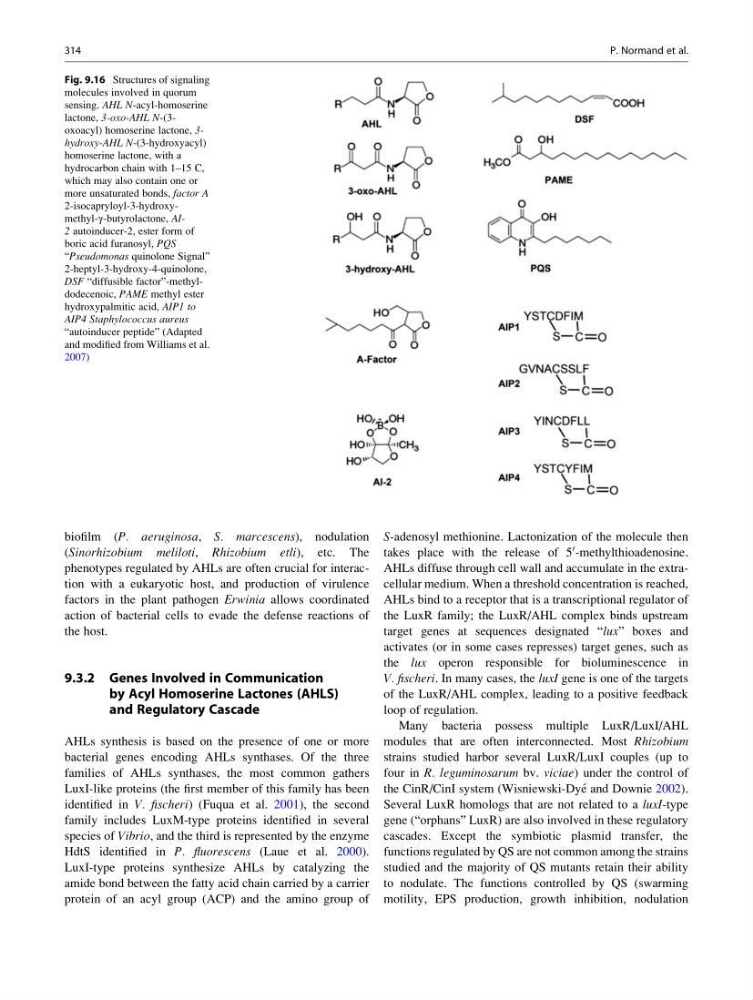
Fig. 9.16 Structures of signaling
molecules involved in quorum
sensing. AHL N-acyl-homoserine
lactone, 3-oxo-AHL N-(3oxoacyl) homoserine lactone, 3hydroxy-AHL N-(3-hydroxyacyl)
homoserine lactone, with a
hydrocarbon chain with 1–15 C,
which may also contain one or
more unsaturated bonds, factor A
2-isocapryloyl-3-hydroxymethyl-γ-butyrolactone, AI2 autoinducer-2, ester form of
boric acid furanosyl, PQS
“Pseudomonas quinolone Signal”
2-heptyl-3-hydroxy-4-quinolone,
DSF “diffusible factor”-methyldodecenoic, PAME methyl ester
hydroxypalmitic acid, AIP1 to
AIP4 Staphylococcus aureus
“autoinducer peptide” (Adapted
and modified from Williams et al.
2007)
314
P. Normand et al.
(Sinorhizobium meliloti, Rhizobium etli), etc. The
phenotypes regulated by AHLs are often crucial for interaction with a eukaryotic host, and production of virulence
factors in the plant pathogen Erwinia allows coordinated
action of bacterial cells to evade the defense reactions of
the host.
9.3.2 Genes Involved in Communication
by Acyl Homoserine Lactones (AHLS)
and Regulatory Cascade
AHLs synthesis is based on the presence of one or more
bacterial genes encoding AHLs synthases. Of the three
families of AHLs synthases, the most common gathers
LuxI-like proteins (the first member of this family has been
identified in V. fischeri) (Fuqua et al. 2001), the second
family includes LuxM-type proteins identified in several
species of Vibrio, and the third is represented by the enzyme
HdtS identified in P. fluorescens (Laue et al. 2000).
LuxI-type proteins synthesize AHLs by catalyzing the
amide bond between the fatty acid chain carried by a carrier
protein of an acyl group (ACP) and the amino group of
S-adenosyl methionine. Lactonization of the molecule then
takes place with the release of 5
0 -methylthioadenosine.
AHLs diffuse through cell wall and accumulate in the extracellular medium. When a threshold concentration is reached,
AHLs bind to a receptor that is a transcriptional regulator of
the LuxR family; the LuxR/AHL complex binds upstream
target genes at sequences designated “lux” boxes and
activates (or in some cases represses) target genes, such as
the lux operon responsible for bioluminescence in
V. fischeri. In many cases, the luxI gene is one of the targets
of the LuxR/AHL complex, leading to a positive feedback
loop of regulation.
Many bacteria possess multiple LuxR/LuxI/AHL
modules that are often interconnected. Most Rhizobium
strains studied harbor several LuxR/LuxI couples (up to
four in R. leguminosarum bv. viciae) under the control of
the CinR/CinI system (Wisniewski-Dye ´ and Downie 2002).
Several LuxR homologs that are not related to a luxI-type
gene (“orphans” LuxR) are also involved in these regulatory
cascades. Except the symbiotic plasmid transfer, the
functions regulated by QS are not common among the strains
studied and the majority of QS mutants retain their ability
to nodulate. The functions controlled by QS (swarming
motility, EPS production, growth inhibition, nodulation
Fig. 9.16 Structures of signaling
molecules involved in quorum
sensing. AHL N-acyl-homoserine
lactone, 3-oxo-AHL N-(3oxoacyl) homoserine lactone, 3hydroxy-AHL N-(3-hydroxyacyl)
homoserine lactone, with a
hydrocarbon chain with 1–15 C,
which may also contain one or
more unsaturated bonds, factor A
2-isocapryloyl-3-hydroxymethyl-γ-butyrolactone, AI2 autoinducer-2, ester form of
boric acid furanosyl, PQS
“Pseudomonas quinolone Signal”
2-heptyl-3-hydroxy-4-quinolone,
DSF “diffusible factor”-methyldodecenoic, PAME methyl ester
hydroxypalmitic acid, AIP1 to
AIP4 Staphylococcus aureus
“autoinducer peptide” (Adapted
and modified from Williams et al.
2007)
314
P. Normand et al.