

alginate synthetase of P. aeruginosa enzyme complexes,
respectively, responsible for the synthesis of
exopolysaccharides (Amikam and Galperin 2006).
• GGDEF domain proteins or degenerate EAL that
have lost their enzymatic activity, but not their ability
to bind c-di-GMP, such as LapD P. fluorescens, which
acts via a protease LapG on maintaining a LapA adhesin
on the outer membrane protein essential for biofilm
formation
• Riboswitches that are untranslated sequences of messenger RNA which control the expression of downstream
genes in response to changes in concentration of a specific ligand, here the c-di-GMP
• Transcription factors as FleQ in P. aeruginosa and VpsT in
V. cholerae or Clp in X. campestris that control the expression of genes for the biosynthesis of exopolysaccharide or
virulence
cAMP-Based Systems
The cAMP synthesized by adenylate cyclase is known to
activate the CAP (“catabolite activator protein,” also known
as CRP, “cyclic AMP receptor protein”) transcription factor
that regulates various catabolic operons. Cellular signaling
proteins involving on the one hand a membrane domain such
as MASE or CHASE as well as PAS or GAF and on the other
hand a domain having cytoplasmic adenylate cyclase activity
(ACyc) were identified in many genomes, particularly those of
cyanobacteria, mycobacteria, and alphaproteobacteria. The
molecular mechanisms involved remain largely unknown;
however, it has been shown that cyanobacterial adenylate
cyclase whose activity is modulated by light regulates the
concentration of intracellular cAMP and motility of cells
(Ohmori and Okamoto 2004). In P. aeruginosa, an adenylate
cyclase with a sensory membrane domain plays an important
role in pathogenicity by regulating the expression of a type III
secretion system (Lory et al. 2004).
An Uridylation System
After carbon, the metabolite probably the most limiting and
therefore the most important for the prokaryotic cell is
ammonium, an essential constituent of proteins, nucleic
acids, and many other components of the cell. Cells that
GGDEF
REC
REC
GGDEF
REC
REC
GGDEF
REC
REC
GGDEF
GGDEF
GGDEF
Pfam:Mase 2
GGDEF
EAL
REC
EAL
GGDEF
EAL
PAC
PAS
GGDEF
EAL
PAS
GGDEF
EAL
PAS
PAS
GGDEF
EAL
HAMP
GGDEF
EAL
PAC
PAS
GAF
PieD
CelR2
ActA
WspR
NAME MICROORGANISM
HmsT
AdrA
DgcA1
PdeA1
FimX
ScrC
MbaA
RocS
PvrR
VieA
C. crescentus
R. leguminosarum
M. xanthus
P. aeruginosa
P. aeruginosa
Y. pestis
S. enterica
G. xylinus
G. xylinus
P. aeruginosa
V. parahaemolyticus
V. cholerae
V. cholerae
V. cholerae
REC
EAL
HTH
LuxR
STRUCTURAL DOMAINS
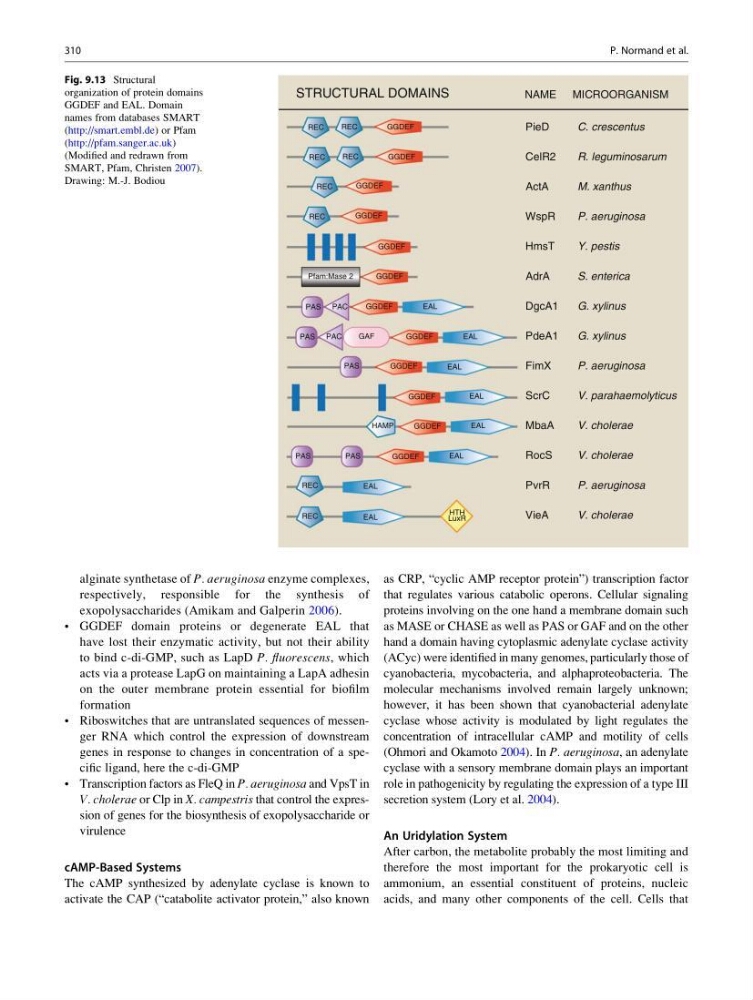
Fig. 9.13 Structural
organization of protein domains
GGDEF and EAL. Domain
names from databases SMART
(http://smart.embl.de) or Pfam
(http://pfam.sanger.ac.uk)
(Modified and redrawn from
SMART, Pfam, Christen 2007).
Drawing: M.-J. Bodiou
310
P. Normand et al.
respectively, responsible for the synthesis of
exopolysaccharides (Amikam and Galperin 2006).
• GGDEF domain proteins or degenerate EAL that
have lost their enzymatic activity, but not their ability
to bind c-di-GMP, such as LapD P. fluorescens, which
acts via a protease LapG on maintaining a LapA adhesin
on the outer membrane protein essential for biofilm
formation
• Riboswitches that are untranslated sequences of messenger RNA which control the expression of downstream
genes in response to changes in concentration of a specific ligand, here the c-di-GMP
• Transcription factors as FleQ in P. aeruginosa and VpsT in
V. cholerae or Clp in X. campestris that control the expression of genes for the biosynthesis of exopolysaccharide or
virulence
cAMP-Based Systems
The cAMP synthesized by adenylate cyclase is known to
activate the CAP (“catabolite activator protein,” also known
as CRP, “cyclic AMP receptor protein”) transcription factor
that regulates various catabolic operons. Cellular signaling
proteins involving on the one hand a membrane domain such
as MASE or CHASE as well as PAS or GAF and on the other
hand a domain having cytoplasmic adenylate cyclase activity
(ACyc) were identified in many genomes, particularly those of
cyanobacteria, mycobacteria, and alphaproteobacteria. The
molecular mechanisms involved remain largely unknown;
however, it has been shown that cyanobacterial adenylate
cyclase whose activity is modulated by light regulates the
concentration of intracellular cAMP and motility of cells
(Ohmori and Okamoto 2004). In P. aeruginosa, an adenylate
cyclase with a sensory membrane domain plays an important
role in pathogenicity by regulating the expression of a type III
secretion system (Lory et al. 2004).
An Uridylation System
After carbon, the metabolite probably the most limiting and
therefore the most important for the prokaryotic cell is
ammonium, an essential constituent of proteins, nucleic
acids, and many other components of the cell. Cells that
GGDEF
REC
REC
GGDEF
REC
REC
GGDEF
REC
REC
GGDEF
GGDEF
GGDEF
Pfam:Mase 2
GGDEF
EAL
REC
EAL
GGDEF
EAL
PAC
PAS
GGDEF
EAL
PAS
GGDEF
EAL
PAS
PAS
GGDEF
EAL
HAMP
GGDEF
EAL
PAC
PAS
GAF
PieD
CelR2
ActA
WspR
NAME MICROORGANISM
HmsT
AdrA
DgcA1
PdeA1
FimX
ScrC
MbaA
RocS
PvrR
VieA
C. crescentus
R. leguminosarum
M. xanthus
P. aeruginosa
P. aeruginosa
Y. pestis
S. enterica
G. xylinus
G. xylinus
P. aeruginosa
V. parahaemolyticus
V. cholerae
V. cholerae
V. cholerae
REC
EAL
HTH
LuxR
STRUCTURAL DOMAINS
Fig. 9.13 Structural
organization of protein domains
GGDEF and EAL. Domain
names from databases SMART
(http://smart.embl.de) or Pfam
(http://pfam.sanger.ac.uk)
(Modified and redrawn from
SMART, Pfam, Christen 2007).
Drawing: M.-J. Bodiou
310
P. Normand et al.