

in combination would be unique. The same goes for
“protozoa”, “fungi” (customary meaning), and “plants”.
Extracting information from old, or even recent literature,
to replace the current framework is therefore a difficult task.
The fact that specialists in each discipline (botanists,
zoologists), in each sub-discipline (mycologists,
phycologists, etc.) of certain families, sometimes of a single
genus (e.g., Euglena and Dictyostelium), have forged their
own jargon, makes it difficult to detect possible homologies.
This is further complicated by the fact that, from one
discipline to another, the same term (spore, endospore,
etc.) is used for non-homologous structures. Finally, the
information available for a taxon, for example the nature of
synthesized sterol or the form of mitochondrial cristae, may
not be available for another taxon.
It is impossible to summarize the extraordinary diversity
of unicellular eukaryotes in ~70 pages. Hence this presentation is necessarily highly simplified. On one hand, many
taxa of the sub-kingdom level have not been described here
(e.g., Haplosporidia, Labyrinthulobionta, Jakobida,
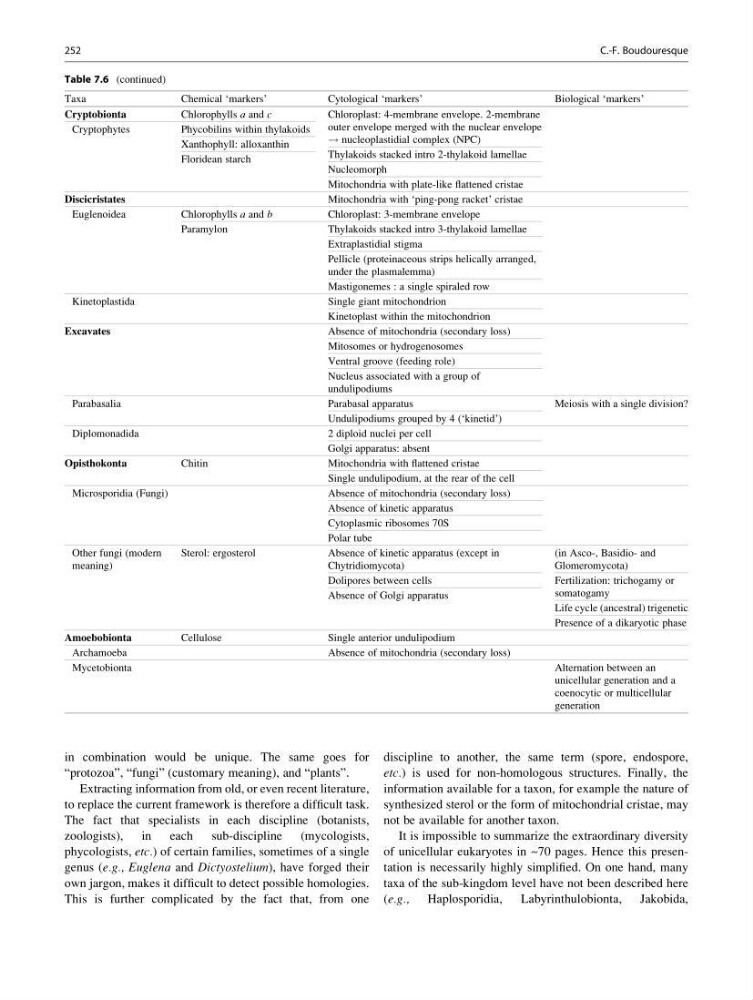
Table 7.6 (continued)
Taxa
Chemical ‘markers’
Cytological ‘markers’
Biological ‘markers’
Cryptobionta
Chlorophylls a and c
Chloroplast: 4-membrane envelope. 2-membrane
outer envelope merged with the nuclear envelope
! nucleoplastidial complex (NPC)
Cryptophytes
Phycobilins within thylakoids
Xanthophyll: alloxanthin
Thylakoids stacked intro 2-thylakoid lamellae
Floridean starch
Nucleomorph
Mitochondria with plate-like flattened cristae
Discicristates
Mitochondria with ‘ping-pong racket’ cristae
Euglenoidea
Chlorophylls a and b
Chloroplast: 3-membrane envelope
Paramylon
Thylakoids stacked intro 3-thylakoid lamellae
Extraplastidial stigma
Pellicle (proteinaceous strips helically arranged,
under the plasmalemma)
Mastigonemes : a single spiraled row
Kinetoplastida
Single giant mitochondrion
Kinetoplast within the mitochondrion
Excavates
Absence of mitochondria (secondary loss)
Mitosomes or hydrogenosomes
Ventral groove (feeding role)
Nucleus associated with a group of
undulipodiums
Parabasalia
Parabasal apparatus
Meiosis with a single division?
Undulipodiums grouped by 4 (‘kinetid’)
Diplomonadida
2 diploid nuclei per cell
Golgi apparatus: absent
Opisthokonta
Chitin
Mitochondria with flattened cristae
Single undulipodium, at the rear of the cell
Microsporidia (Fungi)
Absence of mitochondria (secondary loss)
Absence of kinetic apparatus
Cytoplasmic ribosomes 70S
Polar tube
Other fungi (modern
meaning)
Sterol: ergosterol
Absence of kinetic apparatus (except in
Chytridiomycota)
(in Asco-, Basidio- and
Glomeromycota)
Dolipores between cells
Fertilization: trichogamy or
somatogamy
Absence of Golgi apparatus
Life cycle (ancestral) trigenetic
Presence of a dikaryotic phase
Amoebobionta
Cellulose
Single anterior undulipodium
Archamoeba
Absence of mitochondria (secondary loss)
Mycetobionta
Alternation between an
unicellular generation and a
coenocytic or multicellular
generation
252
C.-F. Boudouresque
“protozoa”, “fungi” (customary meaning), and “plants”.
Extracting information from old, or even recent literature,
to replace the current framework is therefore a difficult task.
The fact that specialists in each discipline (botanists,
zoologists), in each sub-discipline (mycologists,
phycologists, etc.) of certain families, sometimes of a single
genus (e.g., Euglena and Dictyostelium), have forged their
own jargon, makes it difficult to detect possible homologies.
This is further complicated by the fact that, from one
discipline to another, the same term (spore, endospore,
etc.) is used for non-homologous structures. Finally, the
information available for a taxon, for example the nature of
synthesized sterol or the form of mitochondrial cristae, may
not be available for another taxon.
It is impossible to summarize the extraordinary diversity
of unicellular eukaryotes in ~70 pages. Hence this presentation is necessarily highly simplified. On one hand, many
taxa of the sub-kingdom level have not been described here
(e.g., Haplosporidia, Labyrinthulobionta, Jakobida,
Table 7.6 (continued)
Taxa
Chemical ‘markers’
Cytological ‘markers’
Biological ‘markers’
Cryptobionta
Chlorophylls a and c
Chloroplast: 4-membrane envelope. 2-membrane
outer envelope merged with the nuclear envelope
! nucleoplastidial complex (NPC)
Cryptophytes
Phycobilins within thylakoids
Xanthophyll: alloxanthin
Thylakoids stacked intro 2-thylakoid lamellae
Floridean starch
Nucleomorph
Mitochondria with plate-like flattened cristae
Discicristates
Mitochondria with ‘ping-pong racket’ cristae
Euglenoidea
Chlorophylls a and b
Chloroplast: 3-membrane envelope
Paramylon
Thylakoids stacked intro 3-thylakoid lamellae
Extraplastidial stigma
Pellicle (proteinaceous strips helically arranged,
under the plasmalemma)
Mastigonemes : a single spiraled row
Kinetoplastida
Single giant mitochondrion
Kinetoplast within the mitochondrion
Excavates
Absence of mitochondria (secondary loss)
Mitosomes or hydrogenosomes
Ventral groove (feeding role)
Nucleus associated with a group of
undulipodiums
Parabasalia
Parabasal apparatus
Meiosis with a single division?
Undulipodiums grouped by 4 (‘kinetid’)
Diplomonadida
2 diploid nuclei per cell
Golgi apparatus: absent
Opisthokonta
Chitin
Mitochondria with flattened cristae
Single undulipodium, at the rear of the cell
Microsporidia (Fungi)
Absence of mitochondria (secondary loss)
Absence of kinetic apparatus
Cytoplasmic ribosomes 70S
Polar tube
Other fungi (modern
meaning)
Sterol: ergosterol
Absence of kinetic apparatus (except in
Chytridiomycota)
(in Asco-, Basidio- and
Glomeromycota)
Dolipores between cells
Fertilization: trichogamy or
somatogamy
Absence of Golgi apparatus
Life cycle (ancestral) trigenetic
Presence of a dikaryotic phase
Amoebobionta
Cellulose
Single anterior undulipodium
Archamoeba
Absence of mitochondria (secondary loss)
Mycetobionta
Alternation between an
unicellular generation and a
coenocytic or multicellular
generation
252
C.-F. Boudouresque