

A characteristic of Mycetobionta is the alternation
between one or two generations of uninucleated unicellular
populations (amoeboid cells or with undulipodiums) and
one generation of multinucleated (coenocytic) or multicellular populations. From this point of view, Mycetobionta
provide an extraordinary model for the study of the emergence of multicellularity in eukaryotes. The absence of
undulipodiums in Dictyostelium is a derivative character.
The cell wall, when it exists, is made of cellulose (Eichinger
et al. 2005).
In Fuligo septica (“tin flower”), the life cycle has two
generations (digenetic) and two phases (diphasic: haploid
and diploid phases). The haploid gametogens are unicellular
and uninucleated; depending on environmental conditions
where they live, they have the form of amoeboid cells or
of cells with two undulipodia (Fig. 7.59). The diploid
sporogens are present in the form of a multinucleated coenocyte on which sporocysts form, the site of meiosis, which
gives haploid spores (Lecointre and Le Guyader 2006).
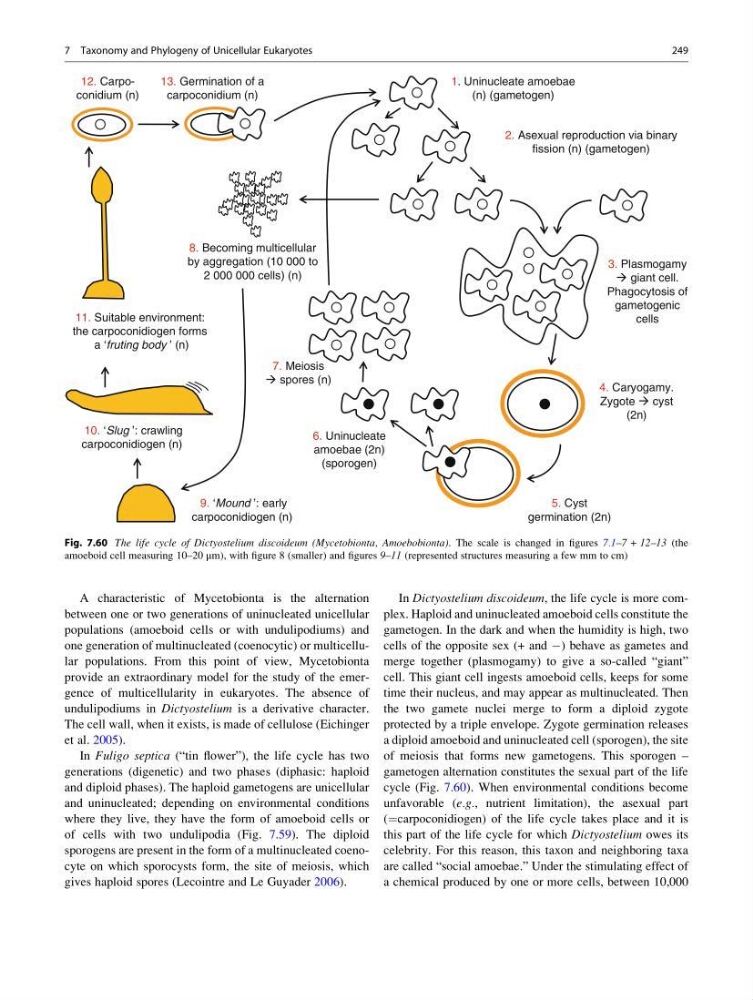
In Dictyostelium discoideum, the life cycle is more complex. Haploid and uninucleated amoeboid cells constitute the
gametogen. In the dark and when the humidity is high, two
cells of the opposite sex (+ and À) behave as gametes and
merge together (plasmogamy) to give a so-called “giant”
cell. This giant cell ingests amoeboid cells, keeps for some
time their nucleus, and may appear as multinucleated. Then
the two gamete nuclei merge to form a diploid zygote
protected by a triple envelope. Zygote germination releases
a diploid amoeboid and uninucleated cell (sporogen), the site
of meiosis that forms new gametogens. This sporogen –
gametogen alternation constitutes the sexual part of the life
cycle (Fig. 7.60). When environmental conditions become
unfavorable (e.g., nutrient limitation), the asexual part
(¼carpoconidiogen) of the life cycle takes place and it is
this part of the life cycle for which Dictyostelium owes its
celebrity. For this reason, this taxon and neighboring taxa
are called “social amoebae.” Under the stimulating effect of
a chemical produced by one or more cells, between 10,000
1. Uninucleate amoebae
(n) (gametogen)
2. Asexual reproduction via binary
fission (n) (gametogen)
3. Plasmogamy
giant cell.
Phagocytosis of
gametogenic
cells
4. Caryogamy.
Zygote
cyst
(2n)
5. Cyst
germination (2n)
6. Uninucleate
amoebae (2n)
(sporogen)
7. Meiosis
spores (n)
8. Becoming multicellular
by aggregation (10 000 to
2 000 000 cells) (n)
9. ‘Mound ’: early
carpoconidiogen (n)
10. ‘Slug ’: crawling
carpoconidiogen (n)
11. Suitable environment:
the carpoconidiogen forms
a ‘fruting body ’ (n)
12. Carpoconidium (n)
13. Germination of a
carpoconidium (n)
Fig. 7.60 The life cycle of Dictyostelium discoideum (Mycetobionta, Amoebobionta). The scale is changed in figures 7.1–7 + 12–13 (the
amoeboid cell measuring 10–20 μm), with figure 8 (smaller) and figures 9–11 (represented structures measuring a few mm to cm)
7 Taxonomy and Phylogeny of Unicellular Eukaryotes
249
between one or two generations of uninucleated unicellular
populations (amoeboid cells or with undulipodiums) and
one generation of multinucleated (coenocytic) or multicellular populations. From this point of view, Mycetobionta
provide an extraordinary model for the study of the emergence of multicellularity in eukaryotes. The absence of
undulipodiums in Dictyostelium is a derivative character.
The cell wall, when it exists, is made of cellulose (Eichinger
et al. 2005).
In Fuligo septica (“tin flower”), the life cycle has two
generations (digenetic) and two phases (diphasic: haploid
and diploid phases). The haploid gametogens are unicellular
and uninucleated; depending on environmental conditions
where they live, they have the form of amoeboid cells or
of cells with two undulipodia (Fig. 7.59). The diploid
sporogens are present in the form of a multinucleated coenocyte on which sporocysts form, the site of meiosis, which
gives haploid spores (Lecointre and Le Guyader 2006).
In Dictyostelium discoideum, the life cycle is more complex. Haploid and uninucleated amoeboid cells constitute the
gametogen. In the dark and when the humidity is high, two
cells of the opposite sex (+ and À) behave as gametes and
merge together (plasmogamy) to give a so-called “giant”
cell. This giant cell ingests amoeboid cells, keeps for some
time their nucleus, and may appear as multinucleated. Then
the two gamete nuclei merge to form a diploid zygote
protected by a triple envelope. Zygote germination releases
a diploid amoeboid and uninucleated cell (sporogen), the site
of meiosis that forms new gametogens. This sporogen –
gametogen alternation constitutes the sexual part of the life
cycle (Fig. 7.60). When environmental conditions become
unfavorable (e.g., nutrient limitation), the asexual part
(¼carpoconidiogen) of the life cycle takes place and it is
this part of the life cycle for which Dictyostelium owes its
celebrity. For this reason, this taxon and neighboring taxa
are called “social amoebae.” Under the stimulating effect of
a chemical produced by one or more cells, between 10,000
1. Uninucleate amoebae
(n) (gametogen)
2. Asexual reproduction via binary
fission (n) (gametogen)
3. Plasmogamy
giant cell.
Phagocytosis of
gametogenic
cells
4. Caryogamy.
Zygote
cyst
(2n)
5. Cyst
germination (2n)
6. Uninucleate
amoebae (2n)
(sporogen)
7. Meiosis
spores (n)
8. Becoming multicellular
by aggregation (10 000 to
2 000 000 cells) (n)
9. ‘Mound ’: early
carpoconidiogen (n)
10. ‘Slug ’: crawling
carpoconidiogen (n)
11. Suitable environment:
the carpoconidiogen forms
a ‘fruting body ’ (n)
12. Carpoconidium (n)
13. Germination of a
carpoconidium (n)
Fig. 7.60 The life cycle of Dictyostelium discoideum (Mycetobionta, Amoebobionta). The scale is changed in figures 7.1–7 + 12–13 (the
amoeboid cell measuring 10–20 μm), with figure 8 (smaller) and figures 9–11 (represented structures measuring a few mm to cm)
7 Taxonomy and Phylogeny of Unicellular Eukaryotes
249