

The Amoebobionta constitute a monophyletic group
of organisms that are closer to Opisthokonta than to
Archaeplastida and other eukaryotes (Baldauf and Doolittle
1997; Baldauf et al. 2000; Nicolaev et al. 2004; Eichinger
et al. 2005). Amoebobionta and Opisthokonta are included
in the group of Unikonta (cf. Sect. 7.4), characterized by a
single undulipodium (as in Opisthokonta) but located on
the front of the cell (as in Bikonta). However, this
undulipodium may be secondarily split, in Mycetobionta.
Within Amoebobionta, we can distinguish Archamoebae,
Mycetobionta, and Lobosa (or Lobosea); the latter seems
to be paraphyletic (Fig. 7.58; Lecointre and Le Guyader
2006; Smirnov et al. 2009).
The cell wall, when present, consists of cellulose.
Mitochondria, when present, have flattened cristae, as in
Opisthokonta.
7.15.2 Archamoeba
The Archamoebae are always unicellular cells with amoeboid shape. Mitochondria have often been lost secondarily.
However, mitosomes in Entamoeba histolytica are remnants
of mitochondria (Embley and Martin 2006). This species has
lost many genes but has also gained others by HGT (horizontal gene transfer) from bacteria (Loftus et al. 2005).
Entamoeba histolytica is a parasite of the digestive tract
of humans; it causes diarrhea that can be lethal. Polymyxa
palustris is common on the floor of mangroves and plays an
important role in the passage of bacteria to micropredators
and from there to the rest of the food web (Liao et al. 2009).
7.15.3 Mycetobionta
The Mycetobionta (¼Mycetozoa) have long been placed
in the polyphyletic group of “fungi” (customary meaning),
specifically in the Myxomycetes which are also polyphyletic
(Chadefaud 1960).
Spore
(magnified) (n)
Production and release of spores
by the sporocyst
Meiosis: 2n
n
Spore germination
gametogen
(amoeboid ou with
2 undulipodiums,
depending on the
environment)
Unicellular, uninucleated and
2-undulipodium gametogen (n)
Amoeboid
gametes (n)
Gametes with
undulipodiums (n)
Fusion
zygote (2n)
Sporocyst (2n)
Unicellular,
uninucleated
and amoeboid
gametogen (n)
Syncytial
sporogen
(multinucleated,
2n)
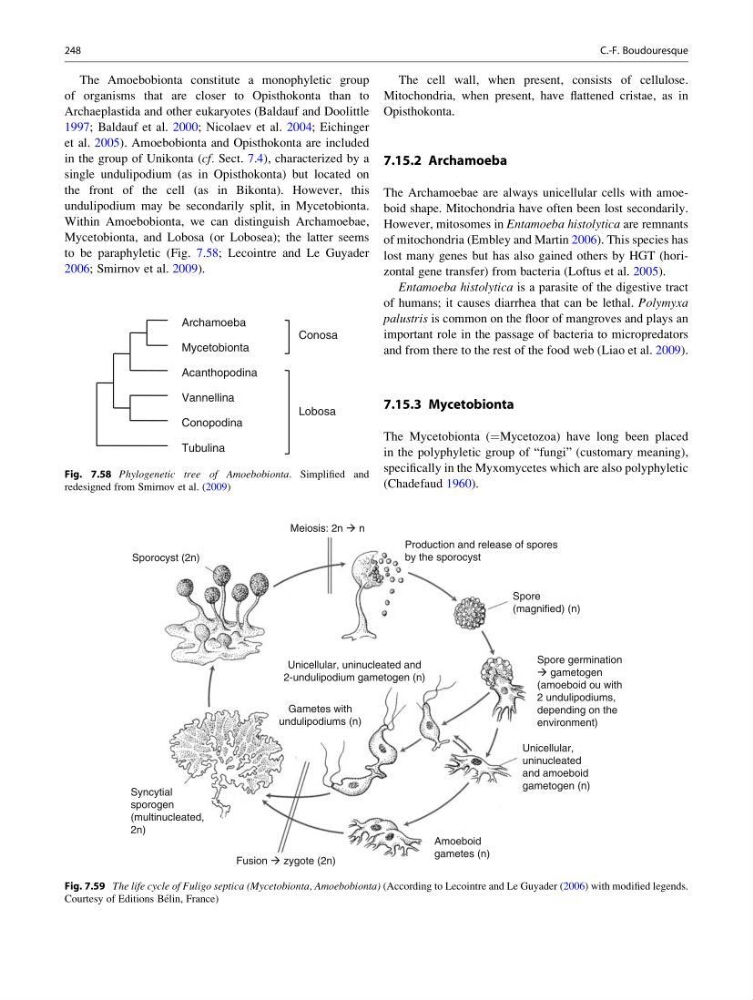
Fig. 7.59 The life cycle of Fuligo septica (Mycetobionta, Amoebobionta) (According to Lecointre and Le Guyader (2006) with modified legends.
Courtesy of Editions Be ´lin, France)
Tubulina
Conopodina
Vannellina
Acanthopodina
Mycetobionta
Archamoeba
Lobosa
Conosa
Fig. 7.58 Phylogenetic tree of Amoebobionta. Simplified and
redesigned from Smirnov et al. (2009)
248
C.-F. Boudouresque
of organisms that are closer to Opisthokonta than to
Archaeplastida and other eukaryotes (Baldauf and Doolittle
1997; Baldauf et al. 2000; Nicolaev et al. 2004; Eichinger
et al. 2005). Amoebobionta and Opisthokonta are included
in the group of Unikonta (cf. Sect. 7.4), characterized by a
single undulipodium (as in Opisthokonta) but located on
the front of the cell (as in Bikonta). However, this
undulipodium may be secondarily split, in Mycetobionta.
Within Amoebobionta, we can distinguish Archamoebae,
Mycetobionta, and Lobosa (or Lobosea); the latter seems
to be paraphyletic (Fig. 7.58; Lecointre and Le Guyader
2006; Smirnov et al. 2009).
The cell wall, when present, consists of cellulose.
Mitochondria, when present, have flattened cristae, as in
Opisthokonta.
7.15.2 Archamoeba
The Archamoebae are always unicellular cells with amoeboid shape. Mitochondria have often been lost secondarily.
However, mitosomes in Entamoeba histolytica are remnants
of mitochondria (Embley and Martin 2006). This species has
lost many genes but has also gained others by HGT (horizontal gene transfer) from bacteria (Loftus et al. 2005).
Entamoeba histolytica is a parasite of the digestive tract
of humans; it causes diarrhea that can be lethal. Polymyxa
palustris is common on the floor of mangroves and plays an
important role in the passage of bacteria to micropredators
and from there to the rest of the food web (Liao et al. 2009).
7.15.3 Mycetobionta
The Mycetobionta (¼Mycetozoa) have long been placed
in the polyphyletic group of “fungi” (customary meaning),
specifically in the Myxomycetes which are also polyphyletic
(Chadefaud 1960).
Spore
(magnified) (n)
Production and release of spores
by the sporocyst
Meiosis: 2n
n
Spore germination
gametogen
(amoeboid ou with
2 undulipodiums,
depending on the
environment)
Unicellular, uninucleated and
2-undulipodium gametogen (n)
Amoeboid
gametes (n)
Gametes with
undulipodiums (n)
Fusion
zygote (2n)
Sporocyst (2n)
Unicellular,
uninucleated
and amoeboid
gametogen (n)
Syncytial
sporogen
(multinucleated,
2n)
Fig. 7.59 The life cycle of Fuligo septica (Mycetobionta, Amoebobionta) (According to Lecointre and Le Guyader (2006) with modified legends.
Courtesy of Editions Be ´lin, France)
Tubulina
Conopodina
Vannellina
Acanthopodina
Mycetobionta
Archamoeba
Lobosa
Conosa
Fig. 7.58 Phylogenetic tree of Amoebobionta. Simplified and
redesigned from Smirnov et al. (2009)
248
C.-F. Boudouresque