

Fungi are capable of using nutrients in organic forms
(e.g., amino acids, nucleotides) and of solubilizing
nutrients present in insoluble forms. Finally, fungal
filaments connected to the roots explore a larger volume
of soil compared to the root system alone. As a consequence, plants in undisturbed ecosystems are highly
dependent upon their fungal partners for their supply of
N and P.
2. Auxins and other growth regulators:
3. By either antibiosis or by efficiently competing with the
soil microflora, mycorrhizal fungi protect their host
plants against soil borne pathogens.
4. Finally, especially Basidiomycota species protect calcifuge Embryophyta species from an excessive influx of
calcium.
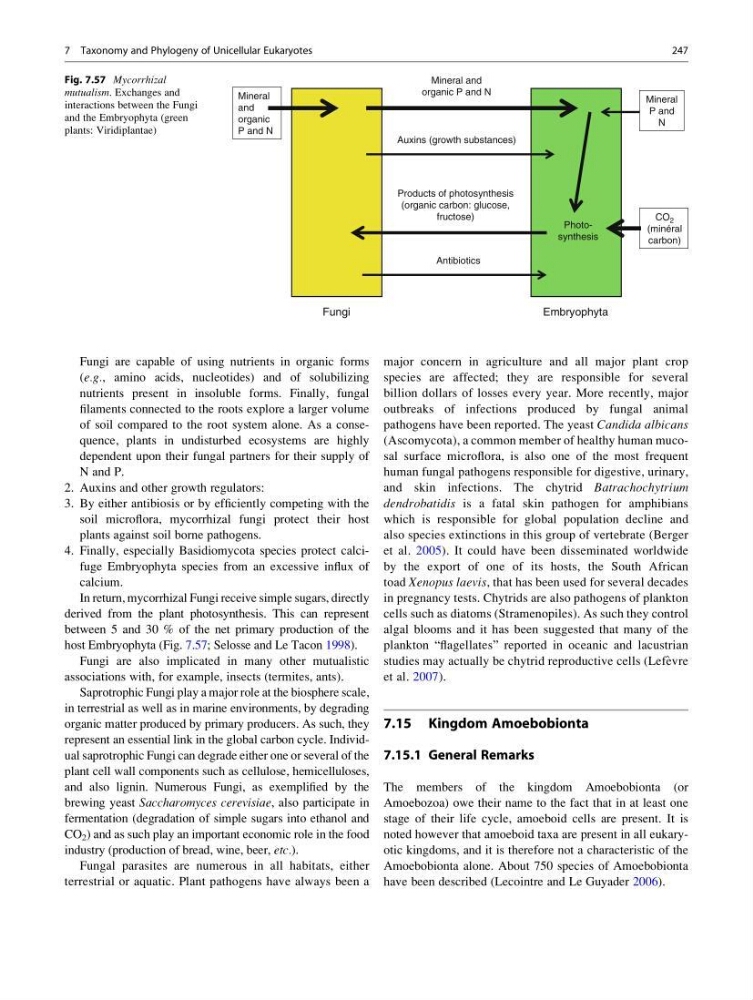
In return, mycorrhizal Fungi receive simple sugars, directly
derived from the plant photosynthesis. This can represent
between 5 and 30 % of the net primary production of the
host Embryophyta (Fig. 7.57; Selosse and Le Tacon 1998).
Fungi are also implicated in many other mutualistic
associations with, for example, insects (termites, ants).
Saprotrophic Fungi play a major role at the biosphere scale,
in terrestrial as well as in marine environments, by degrading
organic matter produced by primary producers. As such, they
represent an essential link in the global carbon cycle. Individual saprotrophic Fungi can degrade either one or several of the
plant cell wall components such as cellulose, hemicelluloses,
and also lignin. Numerous Fungi, as exemplified by the
brewing yeast Saccharomyces cerevisiae, also participate in
fermentation (degradation of simple sugars into ethanol and
CO 2 ) and as such play an important economic role in the food
industry (production of bread, wine, beer, etc.).
Fungal parasites are numerous in all habitats, either
terrestrial or aquatic. Plant pathogens have always been a
major concern in agriculture and all major plant crop
species are affected; they are responsible for several
billion dollars of losses every year. More recently, major
outbreaks of infections produced by fungal animal
pathogens have been reported. The yeast Candida albicans
(Ascomycota), a common member of healthy human mucosal surface microflora, is also one of the most frequent
human fungal pathogens responsible for digestive, urinary,
and skin infections. The chytrid Batrachochytrium
dendrobatidis is a fatal skin pathogen for amphibians
which is responsible for global population decline and
also species extinctions in this group of vertebrate (Berger
et al. 2005). It could have been disseminated worldwide
by the export of one of its hosts, the South African
toad Xenopus laevis, that has been used for several decades
in pregnancy tests. Chytrids are also pathogens of plankton
cells such as diatoms (Stramenopiles). As such they control
algal blooms and it has been suggested that many of the
plankton “flagellates” reported in oceanic and lacustrian
studies may actually be chytrid reproductive cells (Lefe `vre
et al. 2007).
7.15 Kingdom Amoebobionta
7.15.1 General Remarks
The members of the kingdom Amoebobionta (or
Amoebozoa) owe their name to the fact that in at least one
stage of their life cycle, amoeboid cells are present. It is
noted however that amoeboid taxa are present in all eukaryotic kingdoms, and it is therefore not a characteristic of the
Amoebobionta alone. About 750 species of Amoebobionta
have been described (Lecointre and Le Guyader 2006).
Fungi
Embryophyta
Mineral
and
organic
P and N
Mineral and
organic P and N
Auxins (growth substances)
Products of photosynthesis
(organic carbon: glucose,
fructose)
Mineral
P and
N
CO 2
(minéral
carbon)
Photosynthesis
Antibiotics
Fig. 7.57 Mycorrhizal
mutualism. Exchanges and
interactions between the Fungi
and the Embryophyta (green
plants: Viridiplantae)
7 Taxonomy and Phylogeny of Unicellular Eukaryotes
247
(e.g., amino acids, nucleotides) and of solubilizing
nutrients present in insoluble forms. Finally, fungal
filaments connected to the roots explore a larger volume
of soil compared to the root system alone. As a consequence, plants in undisturbed ecosystems are highly
dependent upon their fungal partners for their supply of
N and P.
2. Auxins and other growth regulators:
3. By either antibiosis or by efficiently competing with the
soil microflora, mycorrhizal fungi protect their host
plants against soil borne pathogens.
4. Finally, especially Basidiomycota species protect calcifuge Embryophyta species from an excessive influx of
calcium.
In return, mycorrhizal Fungi receive simple sugars, directly
derived from the plant photosynthesis. This can represent
between 5 and 30 % of the net primary production of the
host Embryophyta (Fig. 7.57; Selosse and Le Tacon 1998).
Fungi are also implicated in many other mutualistic
associations with, for example, insects (termites, ants).
Saprotrophic Fungi play a major role at the biosphere scale,
in terrestrial as well as in marine environments, by degrading
organic matter produced by primary producers. As such, they
represent an essential link in the global carbon cycle. Individual saprotrophic Fungi can degrade either one or several of the
plant cell wall components such as cellulose, hemicelluloses,
and also lignin. Numerous Fungi, as exemplified by the
brewing yeast Saccharomyces cerevisiae, also participate in
fermentation (degradation of simple sugars into ethanol and
CO 2 ) and as such play an important economic role in the food
industry (production of bread, wine, beer, etc.).
Fungal parasites are numerous in all habitats, either
terrestrial or aquatic. Plant pathogens have always been a
major concern in agriculture and all major plant crop
species are affected; they are responsible for several
billion dollars of losses every year. More recently, major
outbreaks of infections produced by fungal animal
pathogens have been reported. The yeast Candida albicans
(Ascomycota), a common member of healthy human mucosal surface microflora, is also one of the most frequent
human fungal pathogens responsible for digestive, urinary,
and skin infections. The chytrid Batrachochytrium
dendrobatidis is a fatal skin pathogen for amphibians
which is responsible for global population decline and
also species extinctions in this group of vertebrate (Berger
et al. 2005). It could have been disseminated worldwide
by the export of one of its hosts, the South African
toad Xenopus laevis, that has been used for several decades
in pregnancy tests. Chytrids are also pathogens of plankton
cells such as diatoms (Stramenopiles). As such they control
algal blooms and it has been suggested that many of the
plankton “flagellates” reported in oceanic and lacustrian
studies may actually be chytrid reproductive cells (Lefe `vre
et al. 2007).
7.15 Kingdom Amoebobionta
7.15.1 General Remarks
The members of the kingdom Amoebobionta (or
Amoebozoa) owe their name to the fact that in at least one
stage of their life cycle, amoeboid cells are present. It is
noted however that amoeboid taxa are present in all eukaryotic kingdoms, and it is therefore not a characteristic of the
Amoebobionta alone. About 750 species of Amoebobionta
have been described (Lecointre and Le Guyader 2006).
Fungi
Embryophyta
Mineral
and
organic
P and N
Mineral and
organic P and N
Auxins (growth substances)
Products of photosynthesis
(organic carbon: glucose,
fructose)
Mineral
P and
N
CO 2
(minéral
carbon)
Photosynthesis
Antibiotics
Fig. 7.57 Mycorrhizal
mutualism. Exchanges and
interactions between the Fungi
and the Embryophyta (green
plants: Viridiplantae)
7 Taxonomy and Phylogeny of Unicellular Eukaryotes
247