

Although not phagotrophic, about 200 fungal species (from
the “Zygomycota,” Ascomycota and Basidiomycota) prey on
Metazoa, in general on nematodes. Nematodes are trapped in
constricting rings formed by filaments (“hyphae”). Filaments
subsequently penetrate the nematode body and digest it from
the inside. Predatory fungi play an important role in soils. Such
Fungi were already present in the Cretacean, more than
100 Ma ago (Raven et al. 2000; Schmidt et al. 2007).
The lichen mutualistic association could be more ancient
as it has seemingly been observed in samples from the
600 Ma-old Chinese deposit of Doushantuo (Yuan et al.
2005). Lichens play an important role in extreme environment and in the initial stages of successions on land. The
mycorrhizal mutualism is also very ancient; at least 400 Maold (Selosse and Le Tacon 1998). It associates the roots of
most Embryophyta (land plants) with filaments from
Basidiomycota, Ascomycota, or Glomeromycota (Bruns
2006; James et al. 2006). This association is called “mycorrhiza.” Within mycorrhizas, the Fungi provides its partner
plant with the following:
1. Mineral nutrients, such as for example nitrogen and
phosphorus: This could seem surprising as plant roots
possess the (theoretical) capacity to acquire these
nutrients by themselves. Compared to plant roots, Fungi
display a better scavenging activity toward many soil
nutrients and continue to assimilate them when their
concentrations become extremely low. Furthermore,
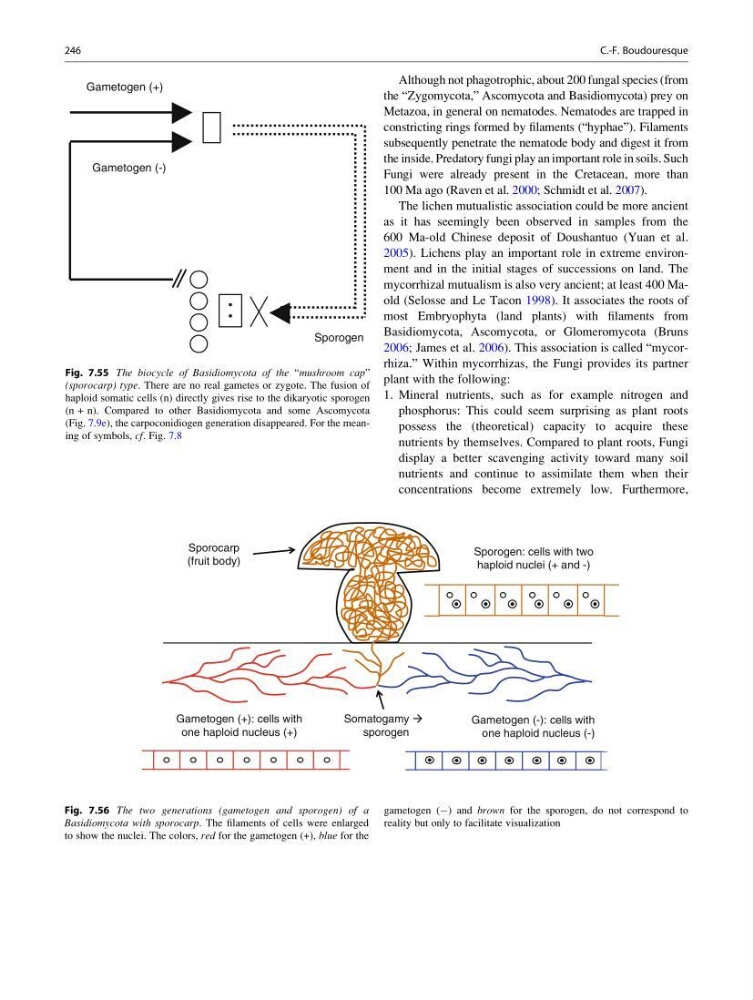
Gametogen (+): cells with
one haploid nucleus (+)
Gametogen (-): cells with
one haploid nucleus (-)
Somatogamy
sporogen
Sporocarp
(fruit body)
Sporogen: cells with two
haploid nuclei (+ and -)
Fig. 7.56 The two generations (gametogen and sporogen) of a
Basidiomycota with sporocarp. The filaments of cells were enlarged
to show the nuclei. The colors, red for the gametogen (+), blue for the
gametogen (À) and brown for the sporogen, do not correspond to
reality but only to facilitate visualization
Sporogen
Gametogen (+)
Gametogen (-)
Fig. 7.55 The biocycle of Basidiomycota of the “mushroom cap”
(sporocarp) type. There are no real gametes or zygote. The fusion of
haploid somatic cells (n) directly gives rise to the dikaryotic sporogen
(n + n). Compared to other Basidiomycota and some Ascomycota
(Fig. 7.9e), the carpoconidiogen generation disappeared. For the meaning of symbols, cf. Fig. 7.8
246
C.-F. Boudouresque
the “Zygomycota,” Ascomycota and Basidiomycota) prey on
Metazoa, in general on nematodes. Nematodes are trapped in
constricting rings formed by filaments (“hyphae”). Filaments
subsequently penetrate the nematode body and digest it from
the inside. Predatory fungi play an important role in soils. Such
Fungi were already present in the Cretacean, more than
100 Ma ago (Raven et al. 2000; Schmidt et al. 2007).
The lichen mutualistic association could be more ancient
as it has seemingly been observed in samples from the
600 Ma-old Chinese deposit of Doushantuo (Yuan et al.
2005). Lichens play an important role in extreme environment and in the initial stages of successions on land. The
mycorrhizal mutualism is also very ancient; at least 400 Maold (Selosse and Le Tacon 1998). It associates the roots of
most Embryophyta (land plants) with filaments from
Basidiomycota, Ascomycota, or Glomeromycota (Bruns
2006; James et al. 2006). This association is called “mycorrhiza.” Within mycorrhizas, the Fungi provides its partner
plant with the following:
1. Mineral nutrients, such as for example nitrogen and
phosphorus: This could seem surprising as plant roots
possess the (theoretical) capacity to acquire these
nutrients by themselves. Compared to plant roots, Fungi
display a better scavenging activity toward many soil
nutrients and continue to assimilate them when their
concentrations become extremely low. Furthermore,
Gametogen (+): cells with
one haploid nucleus (+)
Gametogen (-): cells with
one haploid nucleus (-)
Somatogamy
sporogen
Sporocarp
(fruit body)
Sporogen: cells with two
haploid nuclei (+ and -)
Fig. 7.56 The two generations (gametogen and sporogen) of a
Basidiomycota with sporocarp. The filaments of cells were enlarged
to show the nuclei. The colors, red for the gametogen (+), blue for the
gametogen (À) and brown for the sporogen, do not correspond to
reality but only to facilitate visualization
Sporogen
Gametogen (+)
Gametogen (-)
Fig. 7.55 The biocycle of Basidiomycota of the “mushroom cap”
(sporocarp) type. There are no real gametes or zygote. The fusion of
haploid somatic cells (n) directly gives rise to the dikaryotic sporogen
(n + n). Compared to other Basidiomycota and some Ascomycota
(Fig. 7.9e), the carpoconidiogen generation disappeared. For the meaning of symbols, cf. Fig. 7.8
246
C.-F. Boudouresque