

Fungi could actually exceed 1,500,000 (Bruns 2006; Mueller
and Schmit 2007).
A majority of the Fungi are multicellular. Some species
are however unicellular such as Nuclearia simplex which
branches at the base of the fungal tree of life (Steenkamp
et al. 2006). Other unicellular species, named yeasts, as
illustrated by Saccharomyces cerevisiae, derive from multicellular taxa (Raven et al. 2000). Some fungal species
are also characterized by a coenocytic vegetative stage
(Chytridiomycota). Inclusion of the Fungi in the field of
microbiology, though most of them are multicellular and
macroscopic, results from the fact that they share with bacteria numerous functional roles in the degradation of organic
matter, soil biology, or in many diseases.
The vegetative stage of multicellular fungal species is
constituted of branched filaments. These filaments are called
by traditional botanists as “hyphae.” They can agglomerate
to form a sort of tissue called plectenchyme. This is the case
in lichens, stable mutualistic associations between a fungal
species (belonging to the Ascomycota with few cases in the
Basidiomycota) and a photosynthetic partner. This latter
belongs most of the time to the Chlorobionta in the classes
Trebouxiophyceae
(Trebouxia),
Trentepohliophyceae
(Trentepohlia), or Chlorophyceae (Coccomyxa), but also to
the Cyanobacteria. Mushroom sporocarps*, picked and
eaten by fungal collectors, are also made of agglomerated
filaments forming a plectenchyme.
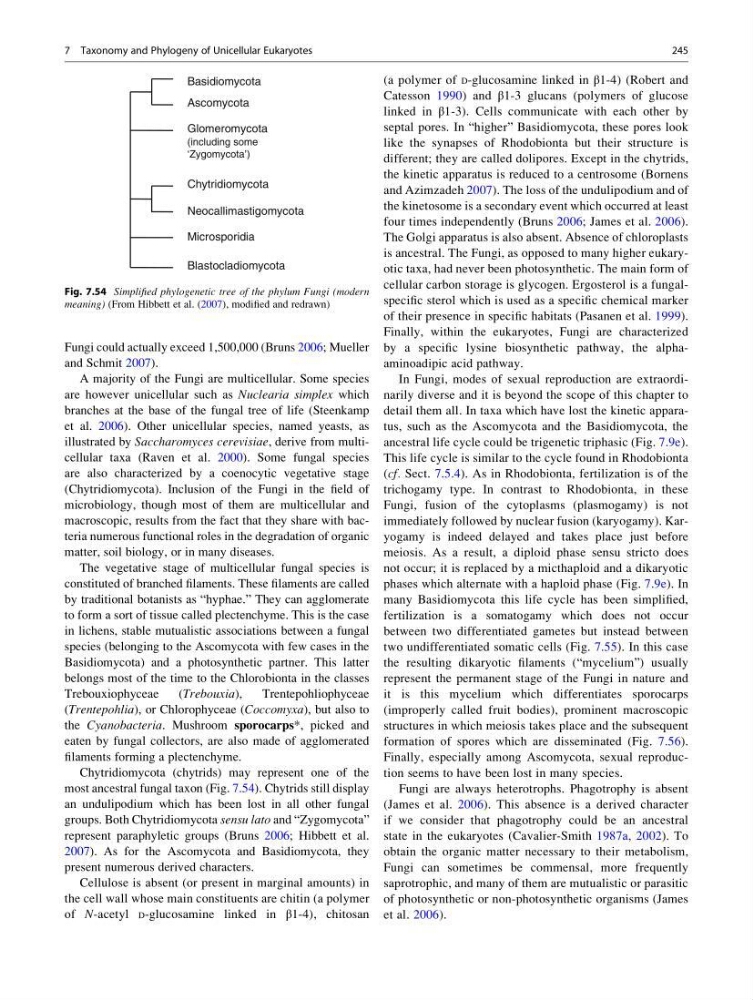
Chytridiomycota (chytrids) may represent one of the
most ancestral fungal taxon (Fig. 7.54). Chytrids still display
an undulipodium which has been lost in all other fungal
groups. Both Chytridiomycota sensu lato and “Zygomycota”
represent paraphyletic groups (Bruns 2006; Hibbett et al.
2007). As for the Ascomycota and Basidiomycota, they
present numerous derived characters.
Cellulose is absent (or present in marginal amounts) in
the cell wall whose main constituents are chitin (a polymer
of N-acetyl D-glucosamine linked in β1-4), chitosan
(a polymer of D-glucosamine linked in β1-4) (Robert and
Catesson 1990) and β1-3 glucans (polymers of glucose
linked in β1-3). Cells communicate with each other by
septal pores. In “higher” Basidiomycota, these pores look
like the synapses of Rhodobionta but their structure is
different; they are called dolipores. Except in the chytrids,
the kinetic apparatus is reduced to a centrosome (Bornens
and Azimzadeh 2007). The loss of the undulipodium and of
the kinetosome is a secondary event which occurred at least
four times independently (Bruns 2006; James et al. 2006).
The Golgi apparatus is also absent. Absence of chloroplasts
is ancestral. The Fungi, as opposed to many higher eukaryotic taxa, had never been photosynthetic. The main form of
cellular carbon storage is glycogen. Ergosterol is a fungalspecific sterol which is used as a specific chemical marker
of their presence in specific habitats (Pasanen et al. 1999).
Finally, within the eukaryotes, Fungi are characterized
by a specific lysine biosynthetic pathway, the alphaaminoadipic acid pathway.
In Fungi, modes of sexual reproduction are extraordinarily diverse and it is beyond the scope of this chapter to
detail them all. In taxa which have lost the kinetic apparatus, such as the Ascomycota and the Basidiomycota, the
ancestral life cycle could be trigenetic triphasic (Fig. 7.9e).
This life cycle is similar to the cycle found in Rhodobionta
(cf. Sect. 7.5.4). As in Rhodobionta, fertilization is of the
trichogamy type. In contrast to Rhodobionta, in these
Fungi, fusion of the cytoplasms (plasmogamy) is not
immediately followed by nuclear fusion (karyogamy). Karyogamy is indeed delayed and takes place just before
meiosis. As a result, a diploid phase sensu stricto does
not occur; it is replaced by a micthaploid and a dikaryotic
phases which alternate with a haploid phase (Fig. 7.9e). In
many Basidiomycota this life cycle has been simplified,
fertilization is a somatogamy which does not occur
between two differentiated gametes but instead between
two undifferentiated somatic cells (Fig. 7.55). In this case
the resulting dikaryotic filaments (“mycelium”) usually
represent the permanent stage of the Fungi in nature and
it is this mycelium which differentiates sporocarps
(improperly called fruit bodies), prominent macroscopic
structures in which meiosis takes place and the subsequent
formation of spores which are disseminated (Fig. 7.56).
Finally, especially among Ascomycota, sexual reproduction seems to have been lost in many species.
Fungi are always heterotrophs. Phagotrophy is absent
(James et al. 2006). This absence is a derived character
if we consider that phagotrophy could be an ancestral
state in the eukaryotes (Cavalier-Smith 1987a, 2002). To
obtain the organic matter necessary to their metabolism,
Fungi can sometimes be commensal, more frequently
saprotrophic, and many of them are mutualistic or parasitic
of photosynthetic or non-photosynthetic organisms (James
et al. 2006).
Microsporidia
Chytridiomycota
Glomeromycota
(including some
‘Zygomycota’)
Ascomycota
Basidiomycota
Neocallimastigomycota
Blastocladiomycota
Fig. 7.54 Simplified phylogenetic tree of the phylum Fungi (modern
meaning) (From Hibbett et al. (2007), modified and redrawn)
7 Taxonomy and Phylogeny of Unicellular Eukaryotes
245
and Schmit 2007).
A majority of the Fungi are multicellular. Some species
are however unicellular such as Nuclearia simplex which
branches at the base of the fungal tree of life (Steenkamp
et al. 2006). Other unicellular species, named yeasts, as
illustrated by Saccharomyces cerevisiae, derive from multicellular taxa (Raven et al. 2000). Some fungal species
are also characterized by a coenocytic vegetative stage
(Chytridiomycota). Inclusion of the Fungi in the field of
microbiology, though most of them are multicellular and
macroscopic, results from the fact that they share with bacteria numerous functional roles in the degradation of organic
matter, soil biology, or in many diseases.
The vegetative stage of multicellular fungal species is
constituted of branched filaments. These filaments are called
by traditional botanists as “hyphae.” They can agglomerate
to form a sort of tissue called plectenchyme. This is the case
in lichens, stable mutualistic associations between a fungal
species (belonging to the Ascomycota with few cases in the
Basidiomycota) and a photosynthetic partner. This latter
belongs most of the time to the Chlorobionta in the classes
Trebouxiophyceae
(Trebouxia),
Trentepohliophyceae
(Trentepohlia), or Chlorophyceae (Coccomyxa), but also to
the Cyanobacteria. Mushroom sporocarps*, picked and
eaten by fungal collectors, are also made of agglomerated
filaments forming a plectenchyme.
Chytridiomycota (chytrids) may represent one of the
most ancestral fungal taxon (Fig. 7.54). Chytrids still display
an undulipodium which has been lost in all other fungal
groups. Both Chytridiomycota sensu lato and “Zygomycota”
represent paraphyletic groups (Bruns 2006; Hibbett et al.
2007). As for the Ascomycota and Basidiomycota, they
present numerous derived characters.
Cellulose is absent (or present in marginal amounts) in
the cell wall whose main constituents are chitin (a polymer
of N-acetyl D-glucosamine linked in β1-4), chitosan
(a polymer of D-glucosamine linked in β1-4) (Robert and
Catesson 1990) and β1-3 glucans (polymers of glucose
linked in β1-3). Cells communicate with each other by
septal pores. In “higher” Basidiomycota, these pores look
like the synapses of Rhodobionta but their structure is
different; they are called dolipores. Except in the chytrids,
the kinetic apparatus is reduced to a centrosome (Bornens
and Azimzadeh 2007). The loss of the undulipodium and of
the kinetosome is a secondary event which occurred at least
four times independently (Bruns 2006; James et al. 2006).
The Golgi apparatus is also absent. Absence of chloroplasts
is ancestral. The Fungi, as opposed to many higher eukaryotic taxa, had never been photosynthetic. The main form of
cellular carbon storage is glycogen. Ergosterol is a fungalspecific sterol which is used as a specific chemical marker
of their presence in specific habitats (Pasanen et al. 1999).
Finally, within the eukaryotes, Fungi are characterized
by a specific lysine biosynthetic pathway, the alphaaminoadipic acid pathway.
In Fungi, modes of sexual reproduction are extraordinarily diverse and it is beyond the scope of this chapter to
detail them all. In taxa which have lost the kinetic apparatus, such as the Ascomycota and the Basidiomycota, the
ancestral life cycle could be trigenetic triphasic (Fig. 7.9e).
This life cycle is similar to the cycle found in Rhodobionta
(cf. Sect. 7.5.4). As in Rhodobionta, fertilization is of the
trichogamy type. In contrast to Rhodobionta, in these
Fungi, fusion of the cytoplasms (plasmogamy) is not
immediately followed by nuclear fusion (karyogamy). Karyogamy is indeed delayed and takes place just before
meiosis. As a result, a diploid phase sensu stricto does
not occur; it is replaced by a micthaploid and a dikaryotic
phases which alternate with a haploid phase (Fig. 7.9e). In
many Basidiomycota this life cycle has been simplified,
fertilization is a somatogamy which does not occur
between two differentiated gametes but instead between
two undifferentiated somatic cells (Fig. 7.55). In this case
the resulting dikaryotic filaments (“mycelium”) usually
represent the permanent stage of the Fungi in nature and
it is this mycelium which differentiates sporocarps
(improperly called fruit bodies), prominent macroscopic
structures in which meiosis takes place and the subsequent
formation of spores which are disseminated (Fig. 7.56).
Finally, especially among Ascomycota, sexual reproduction seems to have been lost in many species.
Fungi are always heterotrophs. Phagotrophy is absent
(James et al. 2006). This absence is a derived character
if we consider that phagotrophy could be an ancestral
state in the eukaryotes (Cavalier-Smith 1987a, 2002). To
obtain the organic matter necessary to their metabolism,
Fungi can sometimes be commensal, more frequently
saprotrophic, and many of them are mutualistic or parasitic
of photosynthetic or non-photosynthetic organisms (James
et al. 2006).
Microsporidia
Chytridiomycota
Glomeromycota
(including some
‘Zygomycota’)
Ascomycota
Basidiomycota
Neocallimastigomycota
Blastocladiomycota
Fig. 7.54 Simplified phylogenetic tree of the phylum Fungi (modern
meaning) (From Hibbett et al. (2007), modified and redrawn)
7 Taxonomy and Phylogeny of Unicellular Eukaryotes
245