

from photosynthesis is a glucose polymer close to the laminarin, with short chains, β-1,3 bonds, and a few β-1,6 bonds;
it is stored within the cytoplasm (de Reviers 2003).
Mitochondria have tubular cristae (Fig. 7.46).
The kinetic apparatus consists of two anterior undulipodiums and a haptonema, a peg-like organelle attached
near the undulipodiums and unique to the taxon. The first
undulipodium can be covered with non-tubular and very
thin mastigonemes, arranged around the axoneme. The
second is generally naked (Leadbeater 1989) (Fig. 7.46).
The structure of the haptonema is very different from
that of undulipodiums: in cross section, instead of the classical undulipodial “9 + 2” structure, it has 5–8 irregularly
arranged microtubules (Fig. 7.47). The role of the
haptonema would be obstacle detection, attachment to the
substrate, food (including prey) capture, and transport, in the
process of phagocytosis, to the posterior part of the cell,
where food is ingested (de Reviers 2003; Andersen 2004).
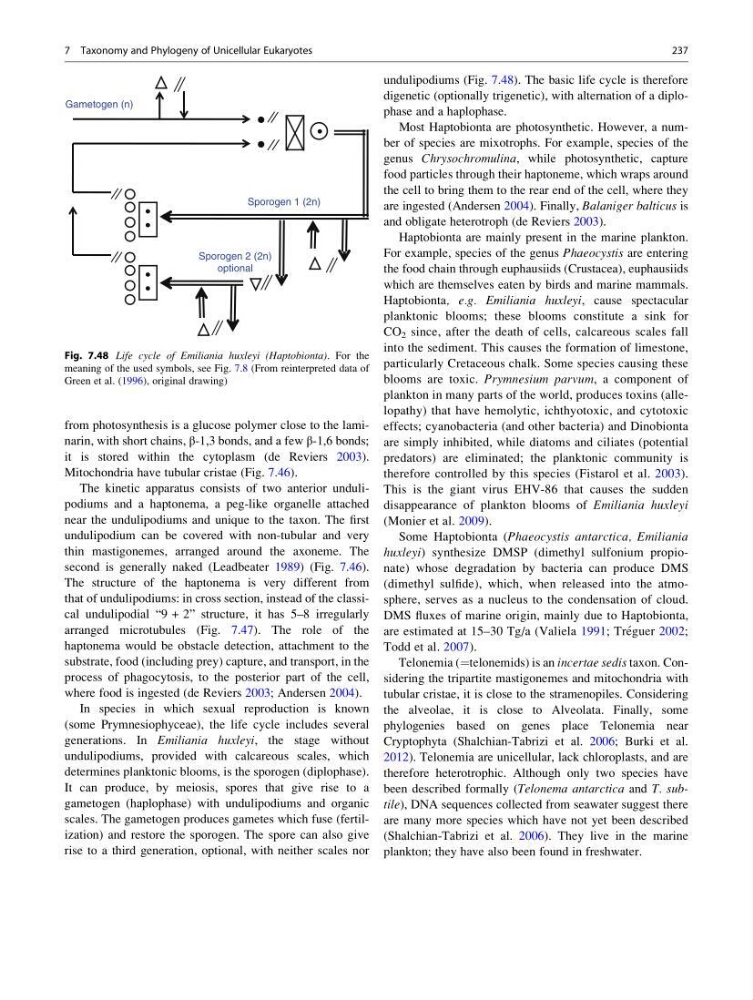
In species in which sexual reproduction is known
(some Prymnesiophyceae), the life cycle includes several
generations. In Emiliania huxleyi, the stage without
undulipodiums, provided with calcareous scales, which
determines planktonic blooms, is the sporogen (diplophase).
It can produce, by meiosis, spores that give rise to a
gametogen (haplophase) with undulipodiums and organic
scales. The gametogen produces gametes which fuse (fertilization) and restore the sporogen. The spore can also give
rise to a third generation, optional, with neither scales nor
undulipodiums (Fig. 7.48). The basic life cycle is therefore
digenetic (optionally trigenetic), with alternation of a diplophase and a haplophase.
Most Haptobionta are photosynthetic. However, a number of species are mixotrophs. For example, species of the
genus Chrysochromulina, while photosynthetic, capture
food particles through their haptoneme, which wraps around
the cell to bring them to the rear end of the cell, where they
are ingested (Andersen 2004). Finally, Balaniger balticus is
and obligate heterotroph (de Reviers 2003).
Haptobionta are mainly present in the marine plankton.
For example, species of the genus Phaeocystis are entering
the food chain through euphausiids (Crustacea), euphausiids
which are themselves eaten by birds and marine mammals.
Haptobionta, e.g. Emiliania huxleyi, cause spectacular
planktonic blooms; these blooms constitute a sink for
CO 2 since, after the death of cells, calcareous scales fall
into the sediment. This causes the formation of limestone,
particularly Cretaceous chalk. Some species causing these
blooms are toxic. Prymnesium parvum, a component of
plankton in many parts of the world, produces toxins (allelopathy) that have hemolytic, ichthyotoxic, and cytotoxic
effects; cyanobacteria (and other bacteria) and Dinobionta
are simply inhibited, while diatoms and ciliates (potential
predators) are eliminated; the planktonic community is
therefore controlled by this species (Fistarol et al. 2003).
This is the giant virus EHV-86 that causes the sudden
disappearance of plankton blooms of Emiliania huxleyi
(Monier et al. 2009).
Some Haptobionta (Phaeocystis antarctica, Emiliania
huxleyi) synthesize DMSP (dimethyl sulfonium propionate) whose degradation by bacteria can produce DMS
(dimethyl sulfide), which, when released into the atmosphere, serves as a nucleus to the condensation of cloud.
DMS fluxes of marine origin, mainly due to Haptobionta,
are estimated at 15–30 Tg/a (Valiela 1991; Tre ´guer 2002;
Todd et al. 2007).
Telonemia (¼telonemids) is an incertae sedis taxon. Considering the tripartite mastigonemes and mitochondria with
tubular cristae, it is close to the stramenopiles. Considering
the alveolae, it is close to Alveolata. Finally, some
phylogenies based on genes place Telonemia near
Cryptophyta (Shalchian-Tabrizi et al. 2006; Burki et al.
2012). Telonemia are unicellular, lack chloroplasts, and are
therefore heterotrophic. Although only two species have
been described formally (Telonema antarctica and T. subtile), DNA sequences collected from seawater suggest there
are many more species which have not yet been described
(Shalchian-Tabrizi et al. 2006). They live in the marine
plankton; they have also been found in freshwater.
Gametogen (n)
Sporogen 1 (2n)
Sporogen 2 (2n)
optional
Fig. 7.48 Life cycle of Emiliania huxleyi (Haptobionta). For the
meaning of the used symbols, see Fig. 7.8 (From reinterpreted data of
Green et al. (1996), original drawing)
7 Taxonomy and Phylogeny of Unicellular Eukaryotes
237
it is stored within the cytoplasm (de Reviers 2003).
Mitochondria have tubular cristae (Fig. 7.46).
The kinetic apparatus consists of two anterior undulipodiums and a haptonema, a peg-like organelle attached
near the undulipodiums and unique to the taxon. The first
undulipodium can be covered with non-tubular and very
thin mastigonemes, arranged around the axoneme. The
second is generally naked (Leadbeater 1989) (Fig. 7.46).
The structure of the haptonema is very different from
that of undulipodiums: in cross section, instead of the classical undulipodial “9 + 2” structure, it has 5–8 irregularly
arranged microtubules (Fig. 7.47). The role of the
haptonema would be obstacle detection, attachment to the
substrate, food (including prey) capture, and transport, in the
process of phagocytosis, to the posterior part of the cell,
where food is ingested (de Reviers 2003; Andersen 2004).
In species in which sexual reproduction is known
(some Prymnesiophyceae), the life cycle includes several
generations. In Emiliania huxleyi, the stage without
undulipodiums, provided with calcareous scales, which
determines planktonic blooms, is the sporogen (diplophase).
It can produce, by meiosis, spores that give rise to a
gametogen (haplophase) with undulipodiums and organic
scales. The gametogen produces gametes which fuse (fertilization) and restore the sporogen. The spore can also give
rise to a third generation, optional, with neither scales nor
undulipodiums (Fig. 7.48). The basic life cycle is therefore
digenetic (optionally trigenetic), with alternation of a diplophase and a haplophase.
Most Haptobionta are photosynthetic. However, a number of species are mixotrophs. For example, species of the
genus Chrysochromulina, while photosynthetic, capture
food particles through their haptoneme, which wraps around
the cell to bring them to the rear end of the cell, where they
are ingested (Andersen 2004). Finally, Balaniger balticus is
and obligate heterotroph (de Reviers 2003).
Haptobionta are mainly present in the marine plankton.
For example, species of the genus Phaeocystis are entering
the food chain through euphausiids (Crustacea), euphausiids
which are themselves eaten by birds and marine mammals.
Haptobionta, e.g. Emiliania huxleyi, cause spectacular
planktonic blooms; these blooms constitute a sink for
CO 2 since, after the death of cells, calcareous scales fall
into the sediment. This causes the formation of limestone,
particularly Cretaceous chalk. Some species causing these
blooms are toxic. Prymnesium parvum, a component of
plankton in many parts of the world, produces toxins (allelopathy) that have hemolytic, ichthyotoxic, and cytotoxic
effects; cyanobacteria (and other bacteria) and Dinobionta
are simply inhibited, while diatoms and ciliates (potential
predators) are eliminated; the planktonic community is
therefore controlled by this species (Fistarol et al. 2003).
This is the giant virus EHV-86 that causes the sudden
disappearance of plankton blooms of Emiliania huxleyi
(Monier et al. 2009).
Some Haptobionta (Phaeocystis antarctica, Emiliania
huxleyi) synthesize DMSP (dimethyl sulfonium propionate) whose degradation by bacteria can produce DMS
(dimethyl sulfide), which, when released into the atmosphere, serves as a nucleus to the condensation of cloud.
DMS fluxes of marine origin, mainly due to Haptobionta,
are estimated at 15–30 Tg/a (Valiela 1991; Tre ´guer 2002;
Todd et al. 2007).
Telonemia (¼telonemids) is an incertae sedis taxon. Considering the tripartite mastigonemes and mitochondria with
tubular cristae, it is close to the stramenopiles. Considering
the alveolae, it is close to Alveolata. Finally, some
phylogenies based on genes place Telonemia near
Cryptophyta (Shalchian-Tabrizi et al. 2006; Burki et al.
2012). Telonemia are unicellular, lack chloroplasts, and are
therefore heterotrophic. Although only two species have
been described formally (Telonema antarctica and T. subtile), DNA sequences collected from seawater suggest there
are many more species which have not yet been described
(Shalchian-Tabrizi et al. 2006). They live in the marine
plankton; they have also been found in freshwater.
Gametogen (n)
Sporogen 1 (2n)
Sporogen 2 (2n)
optional
Fig. 7.48 Life cycle of Emiliania huxleyi (Haptobionta). For the
meaning of the used symbols, see Fig. 7.8 (From reinterpreted data of
Green et al. (1996), original drawing)
7 Taxonomy and Phylogeny of Unicellular Eukaryotes
237