

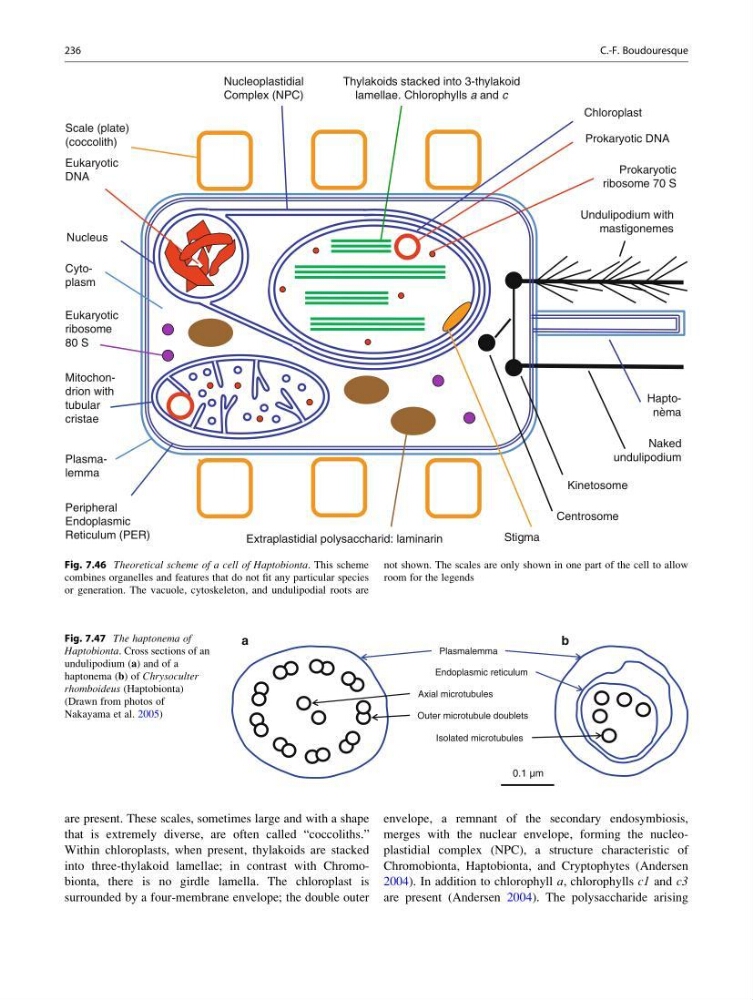
are present. These scales, sometimes large and with a shape
that is extremely diverse, are often called “coccoliths.”
Within chloroplasts, when present, thylakoids are stacked
into three-thylakoid lamellae; in contrast with Chromobionta, there is no girdle lamella. The chloroplast is
surrounded by a four-membrane envelope; the double outer
envelope, a remnant of the secondary endosymbiosis,
merges with the nuclear envelope, forming the nucleoplastidial complex (NPC), a structure characteristic of
Chromobionta, Haptobionta, and Cryptophytes (Andersen
2004). In addition to chlorophyll a, chlorophylls c1 and c3
are present (Andersen 2004). The polysaccharide arising
Plasmalemma
Nucleus
Eukaryotic
DNA
Cytoplasm
Mitochondrion with
tubular
cristae
Eukaryotic
ribosome
80 S
Chloroplast
Nucleoplastidial
Complex (NPC)
Prokaryotic DNA
Prokaryotic
ribosome 70 S
Stigma
Centrosome
Kinetosome
Naked
undulipodium
Undulipodium with
mastigonemes
Extraplastidial polysaccharid: laminarin
Peripheral
Endoplasmic
Reticulum (PER)
Scale (plate)
(coccolith)
Haptonèma
Thylakoids stacked into 3-thylakoid
lamellae. Chlorophylls a and c
Fig. 7.46 Theoretical scheme of a cell of Haptobionta. This scheme
combines organelles and features that do not fit any particular species
or generation. The vacuole, cytoskeleton, and undulipodial roots are
not shown. The scales are only shown in one part of the cell to allow
room for the legends
0.1 μm
a
b
Plasmalemma
Endoplasmic reticulum
Outer microtubule doublets
Axial microtubules
Isolated microtubules
Fig. 7.47 The haptonema of
Haptobionta. Cross sections of an
undulipodium (a) and of a
haptonema (b) of Chrysoculter
rhomboideus (Haptobionta)
(Drawn from photos of
Nakayama et al. 2005)
236
C.-F. Boudouresque
that is extremely diverse, are often called “coccoliths.”
Within chloroplasts, when present, thylakoids are stacked
into three-thylakoid lamellae; in contrast with Chromobionta, there is no girdle lamella. The chloroplast is
surrounded by a four-membrane envelope; the double outer
envelope, a remnant of the secondary endosymbiosis,
merges with the nuclear envelope, forming the nucleoplastidial complex (NPC), a structure characteristic of
Chromobionta, Haptobionta, and Cryptophytes (Andersen
2004). In addition to chlorophyll a, chlorophylls c1 and c3
are present (Andersen 2004). The polysaccharide arising
Plasmalemma
Nucleus
Eukaryotic
DNA
Cytoplasm
Mitochondrion with
tubular
cristae
Eukaryotic
ribosome
80 S
Chloroplast
Nucleoplastidial
Complex (NPC)
Prokaryotic DNA
Prokaryotic
ribosome 70 S
Stigma
Centrosome
Kinetosome
Naked
undulipodium
Undulipodium with
mastigonemes
Extraplastidial polysaccharid: laminarin
Peripheral
Endoplasmic
Reticulum (PER)
Scale (plate)
(coccolith)
Haptonèma
Thylakoids stacked into 3-thylakoid
lamellae. Chlorophylls a and c
Fig. 7.46 Theoretical scheme of a cell of Haptobionta. This scheme
combines organelles and features that do not fit any particular species
or generation. The vacuole, cytoskeleton, and undulipodial roots are
not shown. The scales are only shown in one part of the cell to allow
room for the legends
0.1 μm
a
b
Plasmalemma
Endoplasmic reticulum
Outer microtubule doublets
Axial microtubules
Isolated microtubules
Fig. 7.47 The haptonema of
Haptobionta. Cross sections of an
undulipodium (a) and of a
haptonema (b) of Chrysoculter
rhomboideus (Haptobionta)
(Drawn from photos of
Nakayama et al. 2005)
236
C.-F. Boudouresque