

illumination. However, many species are mixotrophic: while
possessing photosynthesis, they are saprotrophic and/or
predatory. For example, Dinobryon (Chrysophyceae) can
ingest three bacteria every 5 min, this prey representing
~50 % of its carbon supply (Bird and Kalff 1986).
Synchroma grande (Synchromophyceae) captures, with its
pseudopodia, bacteria and diatoms (Horn et al. 2007). A
strain of the diatom Melosira nummuloides (Coscinodiscophyceae) can grow without light using various amino
acids, which explains its success in polluted waters (McLean
et al. 1981). Finally, some species have lost photosynthesis
and are therefore obligate heterotrophs. This is the case for
example of the genus Spumella (Chrysophyceae) and of
Heterosigma nitzschia (Bacillariophyceae). Bolidomonas
mediterraneus (Bolidophyceae) and Picophagus flagellatus
(Chrysophyceae) are active predators and grazers, the latter
including in its diet mainly Prochlorococcus, a cyanobacterium very abundant in the marine plankton.
Chromobionta are thriving in all continental and marine
habitats, more especially in aquatic ones, both pelagic and
benthic. Diatoms account for over 40 % of the net primary
production of the world ocean (Falkowski et al. 2004;
Sinninghe-Damste ´ et al. 2004). Some taxa of Chrysophyceae
and diatoms live on moist soils and mosses. For example, a
diatom, Orthoseira gremmenii, lives on the mosses of freshwater seeps at Gough Island, in the South Atlantic Ocean
(Van de Vijver and Kopalova 2008).
7.10 Haptobionta
Haptobionta
30 (¼Haptophytes, Haptophyta, Haptophyceae,
Coccolithophorida, coccolithophores, coccolithophorids
31 )
are unicellular organisms. About 500 species have been
described, which are divided into two classes, Pavlovophyceae and Prymnesiophyceae. The position of
Haptobionta in the eukaryotic tree (Fig. 7.1) is still very
uncertain (Bhattacharya et al. 2003; Andersen 2004;
Nakayama et al. 2005; Cuvelier et al. 2008). The oldest
fossils date from 300 Ma, but it was only 180 Ma ago that
the abundance of Haptobionta became conspicuous
(Lecointre and Le Guyader 2006).
Haptobionta do not have a cell wall (de Reviers 2003).
Below the plasmalemma (cytoplasmic membrane), a
peripheral envelope of endoplasmic reticulum (Peripheral
Endoplasmic Reticulum, PER) runs around the cell. This
envelope is characteristic of the taxon. Above the plasmalemma, in Prymnesiophyceae, scales (generally calcareous)
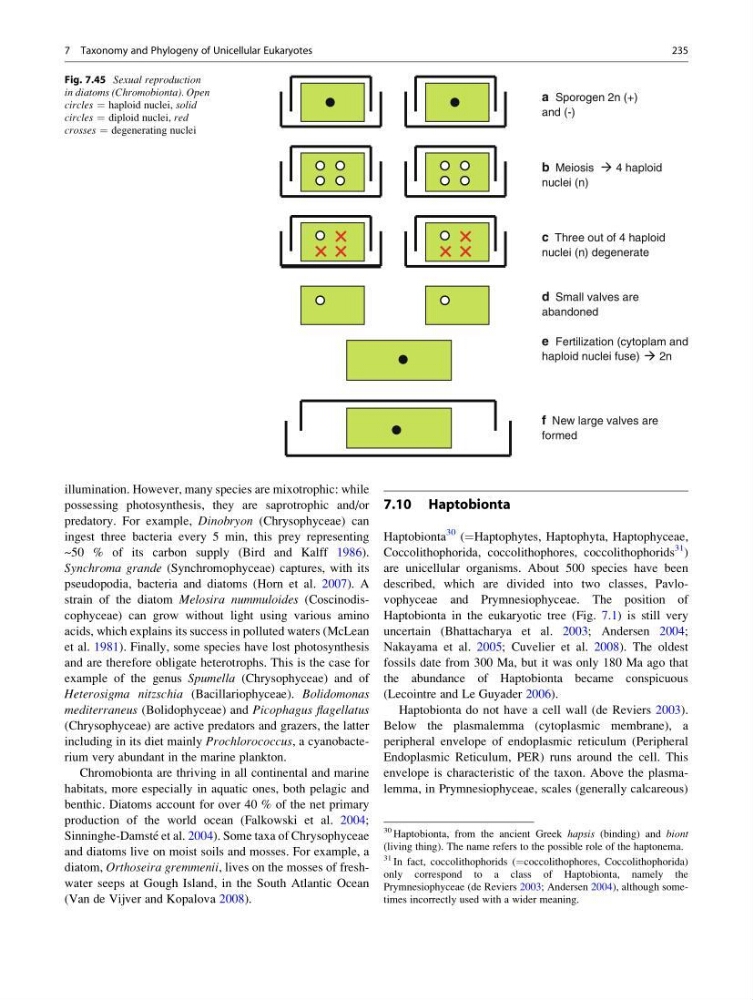
a Sporogen 2n (+)
and (-)
b Meiosis
4 haploid
nuclei (n)
c Three out of 4 haploid
nuclei (n) degenerate
d Small valves are
abandoned
e Fertilization (cytoplam and
haploid nuclei fuse)
2n
f New large valves are
formed
Fig. 7.45 Sexual reproduction
in diatoms (Chromobionta). Open
circles ¼ haploid nuclei, solid
circles ¼ diploid nuclei, red
crosses ¼ degenerating nuclei
30 Haptobionta, from the ancient Greek hapsis (binding) and biont
(living thing). The name refers to the possible role of the haptonema.
31 In fact, coccolithophorids (¼coccolithophores, Coccolithophorida)
only correspond to a class of Haptobionta, namely the
Prymnesiophyceae (de Reviers 2003; Andersen 2004), although sometimes incorrectly used with a wider meaning.
7 Taxonomy and Phylogeny of Unicellular Eukaryotes
235
possessing photosynthesis, they are saprotrophic and/or
predatory. For example, Dinobryon (Chrysophyceae) can
ingest three bacteria every 5 min, this prey representing
~50 % of its carbon supply (Bird and Kalff 1986).
Synchroma grande (Synchromophyceae) captures, with its
pseudopodia, bacteria and diatoms (Horn et al. 2007). A
strain of the diatom Melosira nummuloides (Coscinodiscophyceae) can grow without light using various amino
acids, which explains its success in polluted waters (McLean
et al. 1981). Finally, some species have lost photosynthesis
and are therefore obligate heterotrophs. This is the case for
example of the genus Spumella (Chrysophyceae) and of
Heterosigma nitzschia (Bacillariophyceae). Bolidomonas
mediterraneus (Bolidophyceae) and Picophagus flagellatus
(Chrysophyceae) are active predators and grazers, the latter
including in its diet mainly Prochlorococcus, a cyanobacterium very abundant in the marine plankton.
Chromobionta are thriving in all continental and marine
habitats, more especially in aquatic ones, both pelagic and
benthic. Diatoms account for over 40 % of the net primary
production of the world ocean (Falkowski et al. 2004;
Sinninghe-Damste ´ et al. 2004). Some taxa of Chrysophyceae
and diatoms live on moist soils and mosses. For example, a
diatom, Orthoseira gremmenii, lives on the mosses of freshwater seeps at Gough Island, in the South Atlantic Ocean
(Van de Vijver and Kopalova 2008).
7.10 Haptobionta
Haptobionta
30 (¼Haptophytes, Haptophyta, Haptophyceae,
Coccolithophorida, coccolithophores, coccolithophorids
31 )
are unicellular organisms. About 500 species have been
described, which are divided into two classes, Pavlovophyceae and Prymnesiophyceae. The position of
Haptobionta in the eukaryotic tree (Fig. 7.1) is still very
uncertain (Bhattacharya et al. 2003; Andersen 2004;
Nakayama et al. 2005; Cuvelier et al. 2008). The oldest
fossils date from 300 Ma, but it was only 180 Ma ago that
the abundance of Haptobionta became conspicuous
(Lecointre and Le Guyader 2006).
Haptobionta do not have a cell wall (de Reviers 2003).
Below the plasmalemma (cytoplasmic membrane), a
peripheral envelope of endoplasmic reticulum (Peripheral
Endoplasmic Reticulum, PER) runs around the cell. This
envelope is characteristic of the taxon. Above the plasmalemma, in Prymnesiophyceae, scales (generally calcareous)
a Sporogen 2n (+)
and (-)
b Meiosis
4 haploid
nuclei (n)
c Three out of 4 haploid
nuclei (n) degenerate
d Small valves are
abandoned
e Fertilization (cytoplam and
haploid nuclei fuse)
2n
f New large valves are
formed
Fig. 7.45 Sexual reproduction
in diatoms (Chromobionta). Open
circles ¼ haploid nuclei, solid
circles ¼ diploid nuclei, red
crosses ¼ degenerating nuclei
30 Haptobionta, from the ancient Greek hapsis (binding) and biont
(living thing). The name refers to the possible role of the haptonema.
31 In fact, coccolithophorids (¼coccolithophores, Coccolithophorida)
only correspond to a class of Haptobionta, namely the
Prymnesiophyceae (de Reviers 2003; Andersen 2004), although sometimes incorrectly used with a wider meaning.
7 Taxonomy and Phylogeny of Unicellular Eukaryotes
235