

The chloroplast, when present, is surrounded by a fourmembrane envelope. The double outer envelope, a remnant
of the secondary endosymbiosis, merged with the nuclear
envelope, forming the nucleoplastidial complex (NPC), a
structure characteristic of Chromobionta and Haptobionta
(Andersen 2004). The thylakoids are stacked into threethylakoid lamellae; there is a lamella, termed the girdle
lamella, also composed of three thylakoids, that runs around
the whole periphery of the chloroplast, parallel to and
just beneath the chloroplast envelope. In addition to the
chlorophyll a, Chromobionta have chlorophyll c (except
for Eustigmatophyceae): c1 + c2 (Bacillariophyceae,
Chrysophyceae,
Dictyochophyceae,
Pelagophyceae,
Phaeophyceae, Pinguiophyceae, Raphidophyceae, and
Xanthophyceae),
c2 + c3
(Bacillariophyceae
and
Bolidophyceae),
c1
(Synurophyceae),
and
c2
(Synchromophyceae) (Jeffrey 1989; Andersen 2004; Horn
et al. 2007). Carotenoid pigments (carotenes, xanthophylls)
are very abundant, so that their own color usually masks that
of chlorophyll; four dozen or so carotenoid pigments, including fucoxanthin, have been reported (Bjornland and LiaaenJensen 1989). The polysaccharides arising from photosynthesis are chrysolaminarin (a polymer of glucose, with β-1,3
bonds and some β-1,6 bonds) or laminarin (a
chrysolaminarin whose some chains can end with a mannitol
molecule) (de Reviers 2003); chrysolaminarin and laminarin
are stored within the cytoplasm. Mannitol, a hexaalcool, is
an important storage compound, mainly in Phaeophyceae.
The main sterol is fucosterol. Polymers of phloroglucinol
(1,3,5-tri-hydroxy-benzene) are phenolic compounds
restricted to the Phaeophyceae and a few other taxa; they
are stored in organelles named physodes. Physodes and
phloroglucinols play a structural role in the formation of
the cell wall; in addition, they have a role in antiherbivory
defense, photoprotection against UV, and heavy metal
sequestration (Pellegrini 1974; McInnes et al. 1984;
Schoenwaelder 2002). Mitochondria have tubular cristae
(Fig. 7.43).
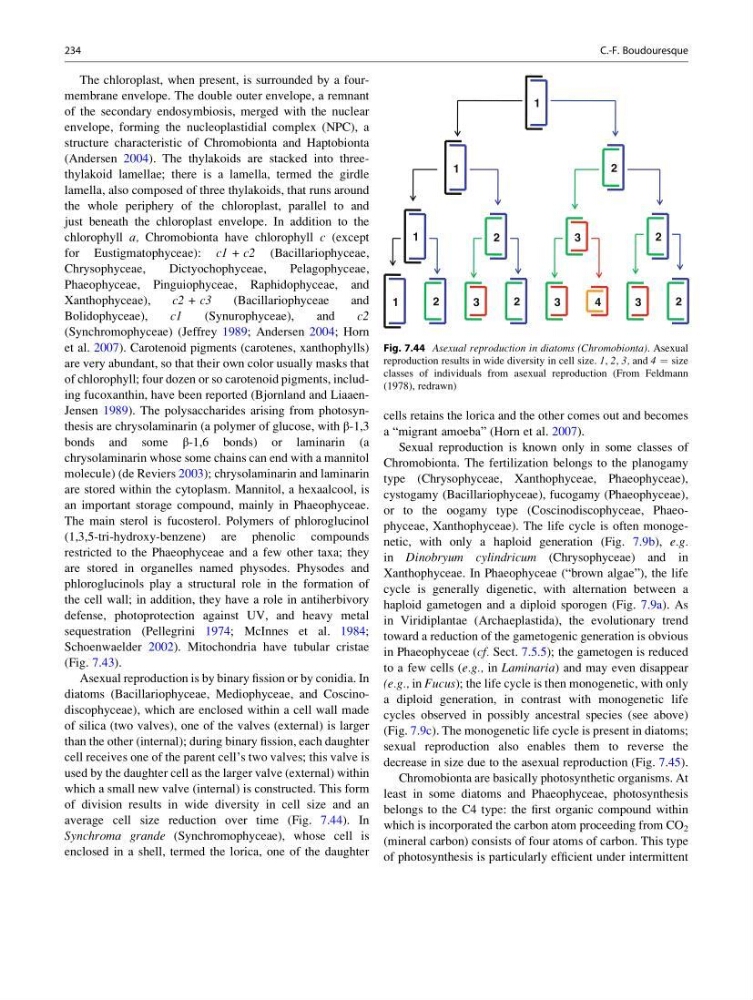
Asexual reproduction is by binary fission or by conidia. In
diatoms (Bacillariophyceae, Mediophyceae, and Coscinodiscophyceae), which are enclosed within a cell wall made
of silica (two valves), one of the valves (external) is larger
than the other (internal); during binary fission, each daughter
cell receives one of the parent cell’s two valves; this valve is
used by the daughter cell as the larger valve (external) within
which a small new valve (internal) is constructed. This form
of division results in wide diversity in cell size and an
average cell size reduction over time (Fig. 7.44). In
Synchroma grande (Synchromophyceae), whose cell is
enclosed in a shell, termed the lorica, one of the daughter
cells retains the lorica and the other comes out and becomes
a “migrant amoeba” (Horn et al. 2007).
Sexual reproduction is known only in some classes of
Chromobionta. The fertilization belongs to the planogamy
type (Chrysophyceae, Xanthophyceae, Phaeophyceae),
cystogamy (Bacillariophyceae), fucogamy (Phaeophyceae),
or to the oogamy type (Coscinodiscophyceae, Phaeophyceae, Xanthophyceae). The life cycle is often monogenetic, with only a haploid generation (Fig. 7.9b), e.g.
in Dinobryum cylindricum (Chrysophyceae) and in
Xanthophyceae. In Phaeophyceae (“brown algae”), the life
cycle is generally digenetic, with alternation between a
haploid gametogen and a diploid sporogen (Fig. 7.9a). As
in Viridiplantae (Archaeplastida), the evolutionary trend
toward a reduction of the gametogenic generation is obvious
in Phaeophyceae (cf. Sect. 7.5.5); the gametogen is reduced
to a few cells (e.g., in Laminaria) and may even disappear
(e.g., in Fucus); the life cycle is then monogenetic, with only
a diploid generation, in contrast with monogenetic life
cycles observed in possibly ancestral species (see above)
(Fig. 7.9c). The monogenetic life cycle is present in diatoms;
sexual reproduction also enables them to reverse the
decrease in size due to the asexual reproduction (Fig. 7.45).
Chromobionta are basically photosynthetic organisms. At
least in some diatoms and Phaeophyceae, photosynthesis
belongs to the C4 type: the first organic compound within
which is incorporated the carbon atom proceeding from CO 2
(mineral carbon) consists of four atoms of carbon. This type
of photosynthesis is particularly efficient under intermittent
1
1
1
1
2
2
2
2
2
2
3
3
3
3
4
Fig. 7.44 Asexual reproduction in diatoms (Chromobionta). Asexual
reproduction results in wide diversity in cell size. 1, 2, 3, and 4 ¼ size
classes of individuals from asexual reproduction (From Feldmann
(1978), redrawn)
234
C.-F. Boudouresque
of the secondary endosymbiosis, merged with the nuclear
envelope, forming the nucleoplastidial complex (NPC), a
structure characteristic of Chromobionta and Haptobionta
(Andersen 2004). The thylakoids are stacked into threethylakoid lamellae; there is a lamella, termed the girdle
lamella, also composed of three thylakoids, that runs around
the whole periphery of the chloroplast, parallel to and
just beneath the chloroplast envelope. In addition to the
chlorophyll a, Chromobionta have chlorophyll c (except
for Eustigmatophyceae): c1 + c2 (Bacillariophyceae,
Chrysophyceae,
Dictyochophyceae,
Pelagophyceae,
Phaeophyceae, Pinguiophyceae, Raphidophyceae, and
Xanthophyceae),
c2 + c3
(Bacillariophyceae
and
Bolidophyceae),
c1
(Synurophyceae),
and
c2
(Synchromophyceae) (Jeffrey 1989; Andersen 2004; Horn
et al. 2007). Carotenoid pigments (carotenes, xanthophylls)
are very abundant, so that their own color usually masks that
of chlorophyll; four dozen or so carotenoid pigments, including fucoxanthin, have been reported (Bjornland and LiaaenJensen 1989). The polysaccharides arising from photosynthesis are chrysolaminarin (a polymer of glucose, with β-1,3
bonds and some β-1,6 bonds) or laminarin (a
chrysolaminarin whose some chains can end with a mannitol
molecule) (de Reviers 2003); chrysolaminarin and laminarin
are stored within the cytoplasm. Mannitol, a hexaalcool, is
an important storage compound, mainly in Phaeophyceae.
The main sterol is fucosterol. Polymers of phloroglucinol
(1,3,5-tri-hydroxy-benzene) are phenolic compounds
restricted to the Phaeophyceae and a few other taxa; they
are stored in organelles named physodes. Physodes and
phloroglucinols play a structural role in the formation of
the cell wall; in addition, they have a role in antiherbivory
defense, photoprotection against UV, and heavy metal
sequestration (Pellegrini 1974; McInnes et al. 1984;
Schoenwaelder 2002). Mitochondria have tubular cristae
(Fig. 7.43).
Asexual reproduction is by binary fission or by conidia. In
diatoms (Bacillariophyceae, Mediophyceae, and Coscinodiscophyceae), which are enclosed within a cell wall made
of silica (two valves), one of the valves (external) is larger
than the other (internal); during binary fission, each daughter
cell receives one of the parent cell’s two valves; this valve is
used by the daughter cell as the larger valve (external) within
which a small new valve (internal) is constructed. This form
of division results in wide diversity in cell size and an
average cell size reduction over time (Fig. 7.44). In
Synchroma grande (Synchromophyceae), whose cell is
enclosed in a shell, termed the lorica, one of the daughter
cells retains the lorica and the other comes out and becomes
a “migrant amoeba” (Horn et al. 2007).
Sexual reproduction is known only in some classes of
Chromobionta. The fertilization belongs to the planogamy
type (Chrysophyceae, Xanthophyceae, Phaeophyceae),
cystogamy (Bacillariophyceae), fucogamy (Phaeophyceae),
or to the oogamy type (Coscinodiscophyceae, Phaeophyceae, Xanthophyceae). The life cycle is often monogenetic, with only a haploid generation (Fig. 7.9b), e.g.
in Dinobryum cylindricum (Chrysophyceae) and in
Xanthophyceae. In Phaeophyceae (“brown algae”), the life
cycle is generally digenetic, with alternation between a
haploid gametogen and a diploid sporogen (Fig. 7.9a). As
in Viridiplantae (Archaeplastida), the evolutionary trend
toward a reduction of the gametogenic generation is obvious
in Phaeophyceae (cf. Sect. 7.5.5); the gametogen is reduced
to a few cells (e.g., in Laminaria) and may even disappear
(e.g., in Fucus); the life cycle is then monogenetic, with only
a diploid generation, in contrast with monogenetic life
cycles observed in possibly ancestral species (see above)
(Fig. 7.9c). The monogenetic life cycle is present in diatoms;
sexual reproduction also enables them to reverse the
decrease in size due to the asexual reproduction (Fig. 7.45).
Chromobionta are basically photosynthetic organisms. At
least in some diatoms and Phaeophyceae, photosynthesis
belongs to the C4 type: the first organic compound within
which is incorporated the carbon atom proceeding from CO 2
(mineral carbon) consists of four atoms of carbon. This type
of photosynthesis is particularly efficient under intermittent
1
1
1
1
2
2
2
2
2
2
3
3
3
3
4
Fig. 7.44 Asexual reproduction in diatoms (Chromobionta). Asexual
reproduction results in wide diversity in cell size. 1, 2, 3, and 4 ¼ size
classes of individuals from asexual reproduction (From Feldmann
(1978), redrawn)
234
C.-F. Boudouresque