

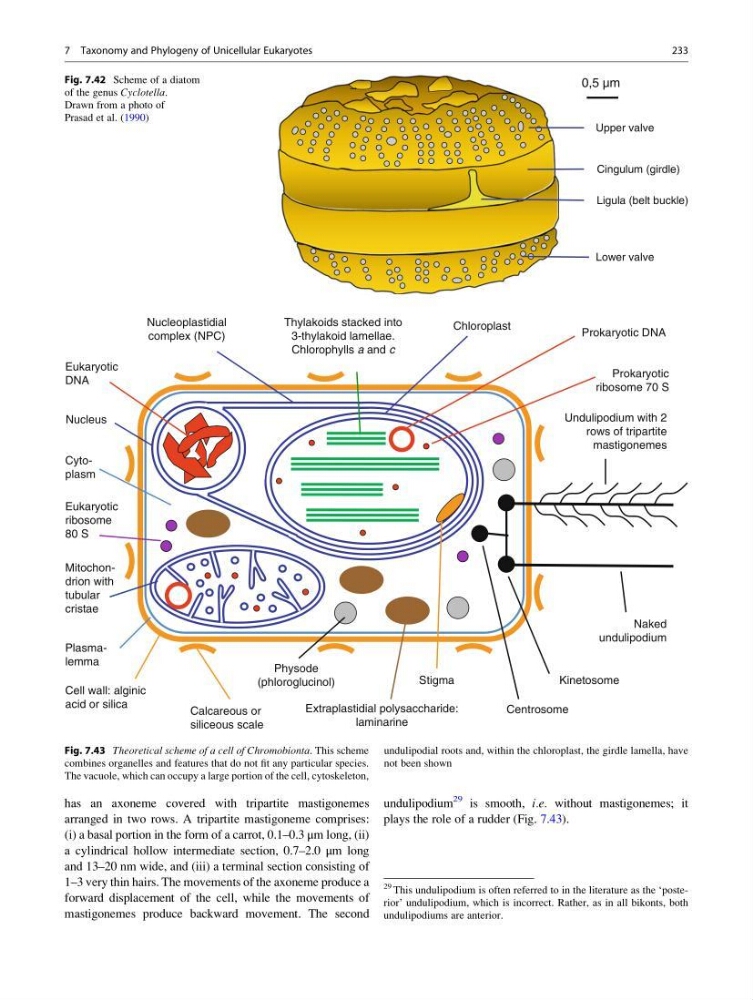
has an axoneme covered with tripartite mastigonemes
arranged in two rows. A tripartite mastigoneme comprises:
(i) a basal portion in the form of a carrot, 0.1–0.3 μm long, (ii)
a cylindrical hollow intermediate section, 0.7–2.0 μm long
and 13–20 nm wide, and (iii) a terminal section consisting of
1–3 very thin hairs. The movements of the axoneme produce a
forward displacement of the cell, while the movements of
mastigonemes produce backward movement. The second
undulipodium
29 is smooth, i.e. without mastigonemes; it
plays the role of a rudder (Fig. 7.43).
Cell wall: alginic
acid or silica
Plasmalemma
Nucleus
Eukaryotic
DNA
Cytoplasm
Mitochondrion with
tubular
cristae
Eukaryotic
ribosome
80 S
Chloroplast
Nucleoplastidial
complex (NPC)
Thylakoids stacked into
3-thylakoid lamellae.
Chlorophylls a and c
Prokaryotic DNA
Prokaryotic
ribosome 70 S
Stigma
Centrosome
Kinetosome
Naked
undulipodium
Physode
(phloroglucinol)
Undulipodium with 2
rows of tripartite
mastigonemes
Extraplastidial polysaccharide:
laminarine
Calcareous or
siliceous scale
Fig. 7.43 Theoretical scheme of a cell of Chromobionta. This scheme
combines organelles and features that do not fit any particular species.
The vacuole, which can occupy a large portion of the cell, cytoskeleton,
undulipodial roots and, within the chloroplast, the girdle lamella, have
not been shown
0,5 μm
Upper valve
Lower valve
Cingulum (girdle)
Ligula (belt buckle)
Fig. 7.42 Scheme of a diatom
of the genus Cyclotella.
Drawn from a photo of
Prasad et al. (1990)
29 This undulipodium is often referred to in the literature as the ‘posterior’ undulipodium, which is incorrect. Rather, as in all bikonts, both
undulipodiums are anterior.
7 Taxonomy and Phylogeny of Unicellular Eukaryotes
233
arranged in two rows. A tripartite mastigoneme comprises:
(i) a basal portion in the form of a carrot, 0.1–0.3 μm long, (ii)
a cylindrical hollow intermediate section, 0.7–2.0 μm long
and 13–20 nm wide, and (iii) a terminal section consisting of
1–3 very thin hairs. The movements of the axoneme produce a
forward displacement of the cell, while the movements of
mastigonemes produce backward movement. The second
undulipodium
29 is smooth, i.e. without mastigonemes; it
plays the role of a rudder (Fig. 7.43).
Cell wall: alginic
acid or silica
Plasmalemma
Nucleus
Eukaryotic
DNA
Cytoplasm
Mitochondrion with
tubular
cristae
Eukaryotic
ribosome
80 S
Chloroplast
Nucleoplastidial
complex (NPC)
Thylakoids stacked into
3-thylakoid lamellae.
Chlorophylls a and c
Prokaryotic DNA
Prokaryotic
ribosome 70 S
Stigma
Centrosome
Kinetosome
Naked
undulipodium
Physode
(phloroglucinol)
Undulipodium with 2
rows of tripartite
mastigonemes
Extraplastidial polysaccharide:
laminarine
Calcareous or
siliceous scale
Fig. 7.43 Theoretical scheme of a cell of Chromobionta. This scheme
combines organelles and features that do not fit any particular species.
The vacuole, which can occupy a large portion of the cell, cytoskeleton,
undulipodial roots and, within the chloroplast, the girdle lamella, have
not been shown
0,5 μm
Upper valve
Lower valve
Cingulum (girdle)
Ligula (belt buckle)
Fig. 7.42 Scheme of a diatom
of the genus Cyclotella.
Drawn from a photo of
Prasad et al. (1990)
29 This undulipodium is often referred to in the literature as the ‘posterior’ undulipodium, which is incorrect. Rather, as in all bikonts, both
undulipodiums are anterior.
7 Taxonomy and Phylogeny of Unicellular Eukaryotes
233