

7.11 Cryptobionta
Here, we call Cryptobionta
32 the group consisting of
Cryptophyta, Katablepharida, and possibly Biliphyta
(Fig. 7.1). According to Andersen (2004), they are the sister
group of the Chromalveolata (i.e. Alveolata, Stramenopiles,
and Haptobionta), while Burki et al. (2012) consider that
they are the sister group of Archaeplastida (Fig. 7.1). In fact,
the position of Cryptobionta in the eukaryotic tree remains
unclear (incertae sedis).
Cryptophyta (¼Cryptista, Cryptophyceae, Cryptomonadea, cryptomonads) are unicellular organisms. They encompass about 200 species (Lecointre and Le Guyader 2006).
A major originality of Cryptophyta, which acquired
photosynthesis through a secondary endosymbiosis with
Rhodobionta, is having retained a considerable number of
remnants of this event: not only the chloroplast itself,
but also a second two-membrane envelope around the chloroplast, the nucleomorph (the rest of the Rhodobionta
nucleus), mitochondria with plate-like flat cristae (a characteristic feature in Archaeplastida) and even photosynthetic
pigments (phycobilins) and polysaccharides arising from
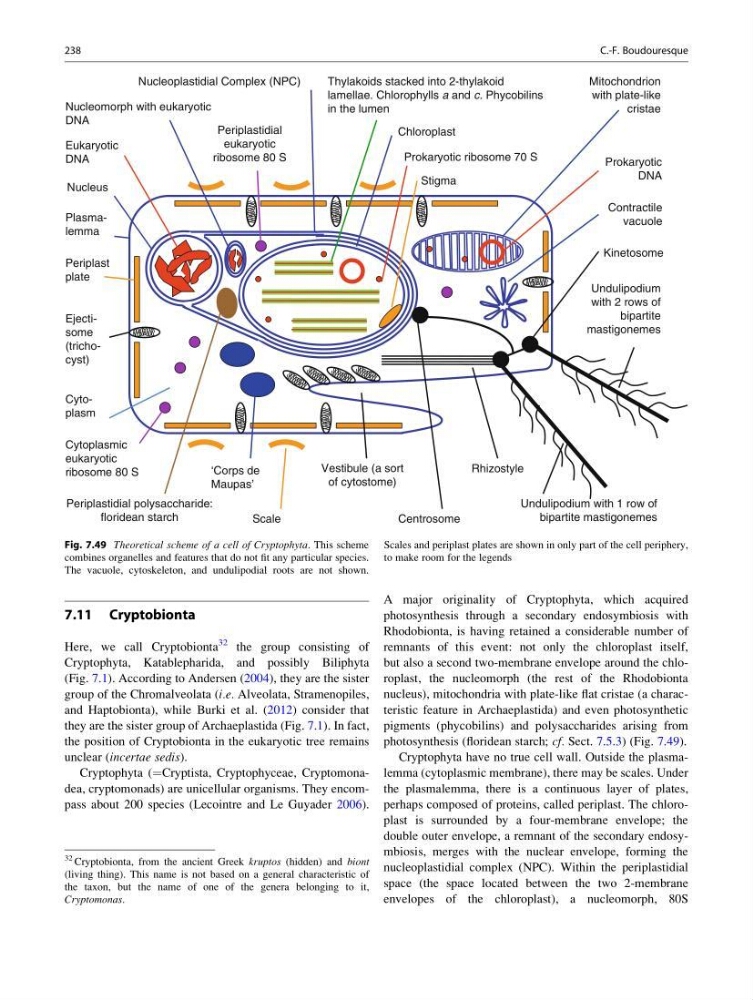
photosynthesis (floridean starch; cf. Sect. 7.5.3) (Fig. 7.49).
Cryptophyta have no true cell wall. Outside the plasmalemma (cytoplasmic membrane), there may be scales. Under
the plasmalemma, there is a continuous layer of plates,
perhaps composed of proteins, called periplast. The chloroplast is surrounded by a four-membrane envelope; the
double outer envelope, a remnant of the secondary endosymbiosis, merges with the nuclear envelope, forming the
nucleoplastidial complex (NPC). Within the periplastidial
space (the space located between the two 2-membrane
envelopes of the chloroplast), a nucleomorph, 80S
Plasmalemma
Nucleus
Eukaryotic
DNA
Periplast
plate
‘Corps de
Maupas’
Cytoplasmic
eukaryotic
ribosome 80 S
Cytoplasm
Periplastidial polysaccharide:
floridean starch
Nucleomorph with eukaryotic
DNA
Nucleoplastidial Complex (NPC)
Periplastidial
eukaryotic
ribosome 80 S
Scale
Ejectisome
(trichocyst)
Mitochondrion
with plate-like
cristae
Chloroplast
Prokaryotic
DNA
Prokaryotic ribosome 70 S
Thylakoids stacked into 2-thylakoid
lamellae. Chlorophylls a and c. Phycobilins
in the lumen
Stigma
Contractile
vacuole
Undulipodium
with 2 rows of
bipartite
mastigonemes
Undulipodium with 1 row of
bipartite mastigonemes
Centrosome
Kinetosome
Rhizostyle
Vestibule (a sort
of cytostome)
Fig. 7.49 Theoretical scheme of a cell of Cryptophyta. This scheme
combines organelles and features that do not fit any particular species.
The vacuole, cytoskeleton, and undulipodial roots are not shown.
Scales and periplast plates are shown in only part of the cell periphery,
to make room for the legends
32 Cryptobionta, from the ancient Greek kruptos (hidden) and biont
(living thing). This name is not based on a general characteristic of
the taxon, but the name of one of the genera belonging to it,
Cryptomonas.
238
C.-F. Boudouresque
Here, we call Cryptobionta
32 the group consisting of
Cryptophyta, Katablepharida, and possibly Biliphyta
(Fig. 7.1). According to Andersen (2004), they are the sister
group of the Chromalveolata (i.e. Alveolata, Stramenopiles,
and Haptobionta), while Burki et al. (2012) consider that
they are the sister group of Archaeplastida (Fig. 7.1). In fact,
the position of Cryptobionta in the eukaryotic tree remains
unclear (incertae sedis).
Cryptophyta (¼Cryptista, Cryptophyceae, Cryptomonadea, cryptomonads) are unicellular organisms. They encompass about 200 species (Lecointre and Le Guyader 2006).
A major originality of Cryptophyta, which acquired
photosynthesis through a secondary endosymbiosis with
Rhodobionta, is having retained a considerable number of
remnants of this event: not only the chloroplast itself,
but also a second two-membrane envelope around the chloroplast, the nucleomorph (the rest of the Rhodobionta
nucleus), mitochondria with plate-like flat cristae (a characteristic feature in Archaeplastida) and even photosynthetic
pigments (phycobilins) and polysaccharides arising from
photosynthesis (floridean starch; cf. Sect. 7.5.3) (Fig. 7.49).
Cryptophyta have no true cell wall. Outside the plasmalemma (cytoplasmic membrane), there may be scales. Under
the plasmalemma, there is a continuous layer of plates,
perhaps composed of proteins, called periplast. The chloroplast is surrounded by a four-membrane envelope; the
double outer envelope, a remnant of the secondary endosymbiosis, merges with the nuclear envelope, forming the
nucleoplastidial complex (NPC). Within the periplastidial
space (the space located between the two 2-membrane
envelopes of the chloroplast), a nucleomorph, 80S
Plasmalemma
Nucleus
Eukaryotic
DNA
Periplast
plate
‘Corps de
Maupas’
Cytoplasmic
eukaryotic
ribosome 80 S
Cytoplasm
Periplastidial polysaccharide:
floridean starch
Nucleomorph with eukaryotic
DNA
Nucleoplastidial Complex (NPC)
Periplastidial
eukaryotic
ribosome 80 S
Scale
Ejectisome
(trichocyst)
Mitochondrion
with plate-like
cristae
Chloroplast
Prokaryotic
DNA
Prokaryotic ribosome 70 S
Thylakoids stacked into 2-thylakoid
lamellae. Chlorophylls a and c. Phycobilins
in the lumen
Stigma
Contractile
vacuole
Undulipodium
with 2 rows of
bipartite
mastigonemes
Undulipodium with 1 row of
bipartite mastigonemes
Centrosome
Kinetosome
Rhizostyle
Vestibule (a sort
of cytostome)
Fig. 7.49 Theoretical scheme of a cell of Cryptophyta. This scheme
combines organelles and features that do not fit any particular species.
The vacuole, cytoskeleton, and undulipodial roots are not shown.
Scales and periplast plates are shown in only part of the cell periphery,
to make room for the legends
32 Cryptobionta, from the ancient Greek kruptos (hidden) and biont
(living thing). This name is not based on a general characteristic of
the taxon, but the name of one of the genera belonging to it,
Cryptomonas.
238
C.-F. Boudouresque