

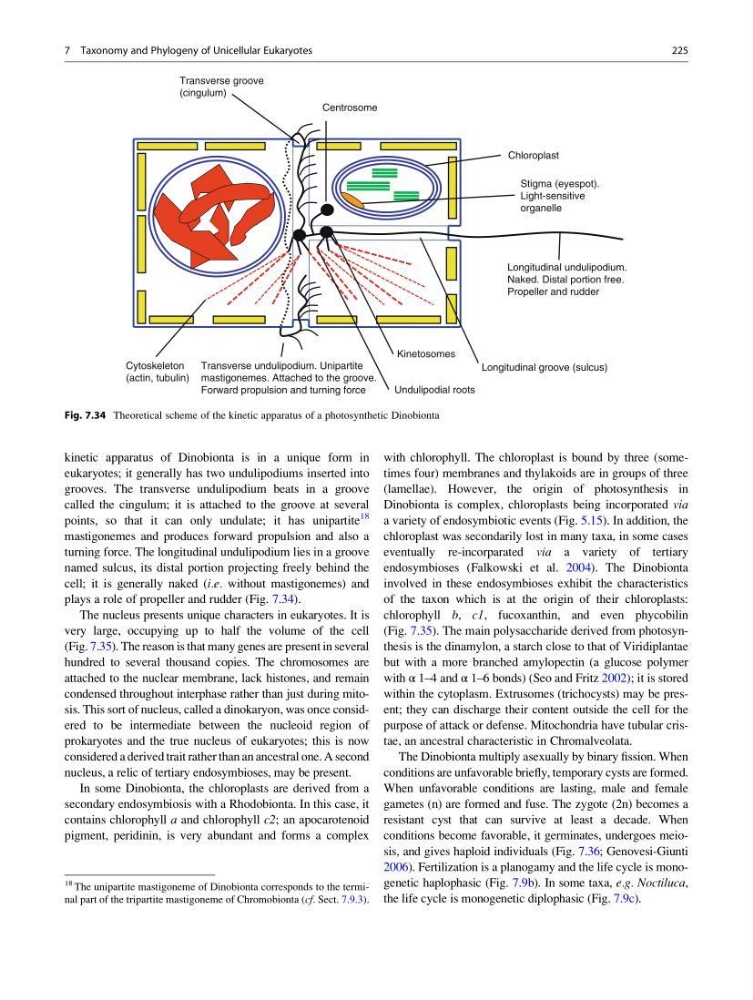
kinetic apparatus of Dinobionta is in a unique form in
eukaryotes; it generally has two undulipodiums inserted into
grooves. The transverse undulipodium beats in a groove
called the cingulum; it is attached to the groove at several
points, so that it can only undulate; it has unipartite
18
mastigonemes and produces forward propulsion and also a
turning force. The longitudinal undulipodium lies in a groove
named sulcus, its distal portion projecting freely behind the
cell; it is generally naked (i.e. without mastigonemes) and
plays a role of propeller and rudder (Fig. 7.34).
The nucleus presents unique characters in eukaryotes. It is
very large, occupying up to half the volume of the cell
(Fig. 7.35). The reason is that many genes are present in several
hundred to several thousand copies. The chromosomes are
attached to the nuclear membrane, lack histones, and remain
condensed throughout interphase rather than just during mitosis. This sort of nucleus, called a dinokaryon, was once considered to be intermediate between the nucleoid region of
prokaryotes and the true nucleus of eukaryotes; this is now
considered a derived trait rather than an ancestral one. A second
nucleus, a relic of tertiary endosymbioses, may be present.
In some Dinobionta, the chloroplasts are derived from a
secondary endosymbiosis with a Rhodobionta. In this case, it
contains chlorophyll a and chlorophyll c2; an apocarotenoid
pigment, peridinin, is very abundant and forms a complex
with chlorophyll. The chloroplast is bound by three (sometimes four) membranes and thylakoids are in groups of three
(lamellae). However, the origin of photosynthesis in
Dinobionta is complex, chloroplasts being incorporated via
a variety of endosymbiotic events (Fig. 5.15). In addition, the
chloroplast was secondarily lost in many taxa, in some cases
eventually re-incorparated via a variety of tertiary
endosymbioses (Falkowski et al. 2004). The Dinobionta
involved in these endosymbioses exhibit the characteristics
of the taxon which is at the origin of their chloroplasts:
chlorophyll b, c1, fucoxanthin, and even phycobilin
(Fig. 7.35). The main polysaccharide derived from photosynthesis is the dinamylon, a starch close to that of Viridiplantae
but with a more branched amylopectin (a glucose polymer
with α 1–4 and α 1–6 bonds) (Seo and Fritz 2002); it is stored
within the cytoplasm. Extrusomes (trichocysts) may be present; they can discharge their content outside the cell for the
purpose of attack or defense. Mitochondria have tubular cristae, an ancestral characteristic in Chromalveolata.
The Dinobionta multiply asexually by binary fission. When
conditions are unfavorable briefly, temporary cysts are formed.
When unfavorable conditions are lasting, male and female
gametes (n) are formed and fuse. The zygote (2n) becomes a
resistant cyst that can survive at least a decade. When
conditions become favorable, it germinates, undergoes meiosis, and gives haploid individuals (Fig. 7.36; Genovesi-Giunti
2006). Fertilization is a planogamy and the life cycle is monogenetic haplophasic (Fig. 7.9b). In some taxa, e.g. Noctiluca,
the life cycle is monogenetic diplophasic (Fig. 7.9c).
Cytoskeleton
(actin, tubulin)
Stigma (eyespot).
Light-sensitive
organelle
Chloroplast
Centrosome
Undulipodial roots
Kinetosomes
Longitudinal undulipodium.
Naked. Distal portion free.
Propeller and rudder
Transverse undulipodium. Unipartite
mastigonemes. Attached to the groove.
Forward propulsion and turning force
Longitudinal groove (sulcus)
Transverse groove
(cingulum)
Fig. 7.34 Theoretical scheme of the kinetic apparatus of a photosynthetic Dinobionta
18 The unipartite mastigoneme of Dinobionta corresponds to the terminal part of the tripartite mastigoneme of Chromobionta (cf. Sect. 7.9.3).
7 Taxonomy and Phylogeny of Unicellular Eukaryotes
225
eukaryotes; it generally has two undulipodiums inserted into
grooves. The transverse undulipodium beats in a groove
called the cingulum; it is attached to the groove at several
points, so that it can only undulate; it has unipartite
18
mastigonemes and produces forward propulsion and also a
turning force. The longitudinal undulipodium lies in a groove
named sulcus, its distal portion projecting freely behind the
cell; it is generally naked (i.e. without mastigonemes) and
plays a role of propeller and rudder (Fig. 7.34).
The nucleus presents unique characters in eukaryotes. It is
very large, occupying up to half the volume of the cell
(Fig. 7.35). The reason is that many genes are present in several
hundred to several thousand copies. The chromosomes are
attached to the nuclear membrane, lack histones, and remain
condensed throughout interphase rather than just during mitosis. This sort of nucleus, called a dinokaryon, was once considered to be intermediate between the nucleoid region of
prokaryotes and the true nucleus of eukaryotes; this is now
considered a derived trait rather than an ancestral one. A second
nucleus, a relic of tertiary endosymbioses, may be present.
In some Dinobionta, the chloroplasts are derived from a
secondary endosymbiosis with a Rhodobionta. In this case, it
contains chlorophyll a and chlorophyll c2; an apocarotenoid
pigment, peridinin, is very abundant and forms a complex
with chlorophyll. The chloroplast is bound by three (sometimes four) membranes and thylakoids are in groups of three
(lamellae). However, the origin of photosynthesis in
Dinobionta is complex, chloroplasts being incorporated via
a variety of endosymbiotic events (Fig. 5.15). In addition, the
chloroplast was secondarily lost in many taxa, in some cases
eventually re-incorparated via a variety of tertiary
endosymbioses (Falkowski et al. 2004). The Dinobionta
involved in these endosymbioses exhibit the characteristics
of the taxon which is at the origin of their chloroplasts:
chlorophyll b, c1, fucoxanthin, and even phycobilin
(Fig. 7.35). The main polysaccharide derived from photosynthesis is the dinamylon, a starch close to that of Viridiplantae
but with a more branched amylopectin (a glucose polymer
with α 1–4 and α 1–6 bonds) (Seo and Fritz 2002); it is stored
within the cytoplasm. Extrusomes (trichocysts) may be present; they can discharge their content outside the cell for the
purpose of attack or defense. Mitochondria have tubular cristae, an ancestral characteristic in Chromalveolata.
The Dinobionta multiply asexually by binary fission. When
conditions are unfavorable briefly, temporary cysts are formed.
When unfavorable conditions are lasting, male and female
gametes (n) are formed and fuse. The zygote (2n) becomes a
resistant cyst that can survive at least a decade. When
conditions become favorable, it germinates, undergoes meiosis, and gives haploid individuals (Fig. 7.36; Genovesi-Giunti
2006). Fertilization is a planogamy and the life cycle is monogenetic haplophasic (Fig. 7.9b). In some taxa, e.g. Noctiluca,
the life cycle is monogenetic diplophasic (Fig. 7.9c).
Cytoskeleton
(actin, tubulin)
Stigma (eyespot).
Light-sensitive
organelle
Chloroplast
Centrosome
Undulipodial roots
Kinetosomes
Longitudinal undulipodium.
Naked. Distal portion free.
Propeller and rudder
Transverse undulipodium. Unipartite
mastigonemes. Attached to the groove.
Forward propulsion and turning force
Longitudinal groove (sulcus)
Transverse groove
(cingulum)
Fig. 7.34 Theoretical scheme of the kinetic apparatus of a photosynthetic Dinobionta
18 The unipartite mastigoneme of Dinobionta corresponds to the terminal part of the tripartite mastigoneme of Chromobionta (cf. Sect. 7.9.3).
7 Taxonomy and Phylogeny of Unicellular Eukaryotes
225