

with a single diploid generation; however, the final division
of the nucleus originating from meiosis, corresponding to a
spore, can be regarded as the remnant of the haploid generation (gametogen). In this case, the biocycle could be
interpreted as digenetic (Fig. 7.32).
Ciliates are generally heterotrophic organisms. They
are predators of bacteria, unicellular eukaryotes (including
other ciliates) and larvae of some “invertebrates.”
16
Ichthyophthirius multifilis is a parasite of freshwater teleosts,
which is the main pathogen worldwide (Jousson et al. 2007).
Ciliates can also use dead organic matter. Some species of
ciliates host in their cytoplasm photosynthetic organisms
(probably mutualistic symbionts) such as Cyanobacteria,
Chlorobionta, and Cryptophyta. In some cases, ciliates
recover chloroplasts (kleptoplasty) and possibly the nucleus
(karyoklepty) of their prey (cf. Sect. 5.4.4). All intermediates
between strict heterotrophy and mandatory mixotrophy exist
(Smith and Hansen 2007).
Continental habitats (fresh and brackish water, soil) harbor more ciliate species than marine habitats. In the marine
environment, ciliates are important not only through the
blooms they determine (e.g., Myrionecta rubra) but also as
a link in the food web between the bacterial level and the
micro-metazoans (zooplankton) level.
7.8.3 Dinobionta
The Dinobionta,
17 sensu stricto or sensu lato, are also
named Dinophyceae, Dinophyta, Dinozoa, Dinoflagellates,
Dinoflagellida, and Peridinians. The above names are either
synonyms, or nested sets, or correspond to taxa whose limits
vary according to the authors. Here, the term “Dinobionta” is
used sensu lato. Most Dinobionta are unicellular. However,
some colonial species, or intermediate between the colonial
and the multicellular state, have been described, for example
Haplozoon axiothellae (Fig. 5.6e; Leander et al. 2002). The
Dinobionta have long been considered as intermediate
between prokaryotes and eukaryotes, due to a number of
special characteristics of their nucleus (Herzog et al. 1984);
these characters are actually not ancestral but derived
characters. The age of Dinobionta is controversial. For some
authors, on the basis of fossils that may belong to the ancestors
of Dinobionta, although there is no indication they had photosynthesis, they were already present 540–420 Ma ago
(Lecointre and Le Guyader 2006). For others, the acquisition
of photosynthesis by secondary or tertiary endosymbiosis is
much more recent: 225–250 Ma ago (Fig. 5.15; Kokinos et al.
1998; Falkowski et al. 2004). The Dinobionta seem to have
dominated the marine plankton until about 65 Ma, when they
were partially supplanted by diatoms (Falkowski et al. 2004).
More than 2,000 living species have been described so far.
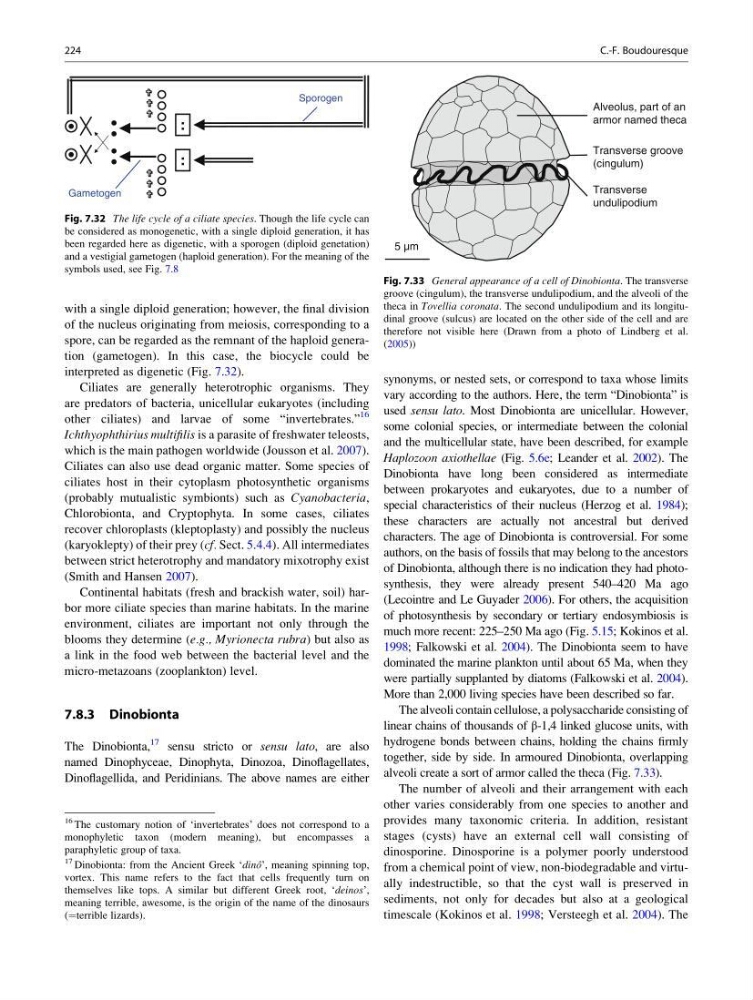
The alveoli contain cellulose, a polysaccharide consisting of
linear chains of thousands of β-1,4 linked glucose units, with
hydrogene bonds between chains, holding the chains firmly
together, side by side. In armoured Dinobionta, overlapping
alveoli create a sort of armor called the theca (Fig. 7.33).
The number of alveoli and their arrangement with each
other varies considerably from one species to another and
provides many taxonomic criteria. In addition, resistant
stages (cysts) have an external cell wall consisting of
dinosporine. Dinosporine is a polymer poorly understood
from a chemical point of view, non-biodegradable and virtually indestructible, so that the cyst wall is preserved in
sediments, not only for decades but also at a geological
timescale (Kokinos et al. 1998; Versteegh et al. 2004). The
5 μm
Alveolus, part of an
armor named theca
Transverse groove
(cingulum)
Transverse
undulipodium
Fig. 7.33 General appearance of a cell of Dinobionta. The transverse
groove (cingulum), the transverse undulipodium, and the alveoli of the
theca in Tovellia coronata. The second undulipodium and its longitudinal groove (sulcus) are located on the other side of the cell and are
therefore not visible here (Drawn from a photo of Lindberg et al.
(2005))
:
:
Sporogen
Gametogen
Fig. 7.32 The life cycle of a ciliate species. Though the life cycle can
be considered as monogenetic, with a single diploid generation, it has
been regarded here as digenetic, with a sporogen (diploid genetation)
and a vestigial gametogen (haploid generation). For the meaning of the
symbols used, see Fig. 7.8
16 The customary notion of ‘invertebrates’ does not correspond to a
monophyletic taxon (modern meaning), but encompasses a
paraphyletic group of taxa.
17 Dinobionta: from the Ancient Greek ‘dino ˆ’, meaning spinning top,
vortex. This name refers to the fact that cells frequently turn on
themselves like tops. A similar but different Greek root, ‘deinos’,
meaning terrible, awesome, is the origin of the name of the dinosaurs
(¼terrible lizards).
224
C.-F. Boudouresque
of the nucleus originating from meiosis, corresponding to a
spore, can be regarded as the remnant of the haploid generation (gametogen). In this case, the biocycle could be
interpreted as digenetic (Fig. 7.32).
Ciliates are generally heterotrophic organisms. They
are predators of bacteria, unicellular eukaryotes (including
other ciliates) and larvae of some “invertebrates.”
16
Ichthyophthirius multifilis is a parasite of freshwater teleosts,
which is the main pathogen worldwide (Jousson et al. 2007).
Ciliates can also use dead organic matter. Some species of
ciliates host in their cytoplasm photosynthetic organisms
(probably mutualistic symbionts) such as Cyanobacteria,
Chlorobionta, and Cryptophyta. In some cases, ciliates
recover chloroplasts (kleptoplasty) and possibly the nucleus
(karyoklepty) of their prey (cf. Sect. 5.4.4). All intermediates
between strict heterotrophy and mandatory mixotrophy exist
(Smith and Hansen 2007).
Continental habitats (fresh and brackish water, soil) harbor more ciliate species than marine habitats. In the marine
environment, ciliates are important not only through the
blooms they determine (e.g., Myrionecta rubra) but also as
a link in the food web between the bacterial level and the
micro-metazoans (zooplankton) level.
7.8.3 Dinobionta
The Dinobionta,
17 sensu stricto or sensu lato, are also
named Dinophyceae, Dinophyta, Dinozoa, Dinoflagellates,
Dinoflagellida, and Peridinians. The above names are either
synonyms, or nested sets, or correspond to taxa whose limits
vary according to the authors. Here, the term “Dinobionta” is
used sensu lato. Most Dinobionta are unicellular. However,
some colonial species, or intermediate between the colonial
and the multicellular state, have been described, for example
Haplozoon axiothellae (Fig. 5.6e; Leander et al. 2002). The
Dinobionta have long been considered as intermediate
between prokaryotes and eukaryotes, due to a number of
special characteristics of their nucleus (Herzog et al. 1984);
these characters are actually not ancestral but derived
characters. The age of Dinobionta is controversial. For some
authors, on the basis of fossils that may belong to the ancestors
of Dinobionta, although there is no indication they had photosynthesis, they were already present 540–420 Ma ago
(Lecointre and Le Guyader 2006). For others, the acquisition
of photosynthesis by secondary or tertiary endosymbiosis is
much more recent: 225–250 Ma ago (Fig. 5.15; Kokinos et al.
1998; Falkowski et al. 2004). The Dinobionta seem to have
dominated the marine plankton until about 65 Ma, when they
were partially supplanted by diatoms (Falkowski et al. 2004).
More than 2,000 living species have been described so far.
The alveoli contain cellulose, a polysaccharide consisting of
linear chains of thousands of β-1,4 linked glucose units, with
hydrogene bonds between chains, holding the chains firmly
together, side by side. In armoured Dinobionta, overlapping
alveoli create a sort of armor called the theca (Fig. 7.33).
The number of alveoli and their arrangement with each
other varies considerably from one species to another and
provides many taxonomic criteria. In addition, resistant
stages (cysts) have an external cell wall consisting of
dinosporine. Dinosporine is a polymer poorly understood
from a chemical point of view, non-biodegradable and virtually indestructible, so that the cyst wall is preserved in
sediments, not only for decades but also at a geological
timescale (Kokinos et al. 1998; Versteegh et al. 2004). The
5 μm
Alveolus, part of an
armor named theca
Transverse groove
(cingulum)
Transverse
undulipodium
Fig. 7.33 General appearance of a cell of Dinobionta. The transverse
groove (cingulum), the transverse undulipodium, and the alveoli of the
theca in Tovellia coronata. The second undulipodium and its longitudinal groove (sulcus) are located on the other side of the cell and are
therefore not visible here (Drawn from a photo of Lindberg et al.
(2005))
:
:
Sporogen
Gametogen
Fig. 7.32 The life cycle of a ciliate species. Though the life cycle can
be considered as monogenetic, with a single diploid generation, it has
been regarded here as digenetic, with a sporogen (diploid genetation)
and a vestigial gametogen (haploid generation). For the meaning of the
symbols used, see Fig. 7.8
16 The customary notion of ‘invertebrates’ does not correspond to a
monophyletic taxon (modern meaning), but encompasses a
paraphyletic group of taxa.
17 Dinobionta: from the Ancient Greek ‘dino ˆ’, meaning spinning top,
vortex. This name refers to the fact that cells frequently turn on
themselves like tops. A similar but different Greek root, ‘deinos’,
meaning terrible, awesome, is the origin of the name of the dinosaurs
(¼terrible lizards).
224
C.-F. Boudouresque