

Two mating
individuals
The macronuclei
disappear
3 micronuclei
desintegrate
Meiosis
4 micronuclei n
Mitosis
small
and large
micronuclei
Exchange of the small
(male) micronuclei
Fertilization
2n
Separation, formation of macronuclei
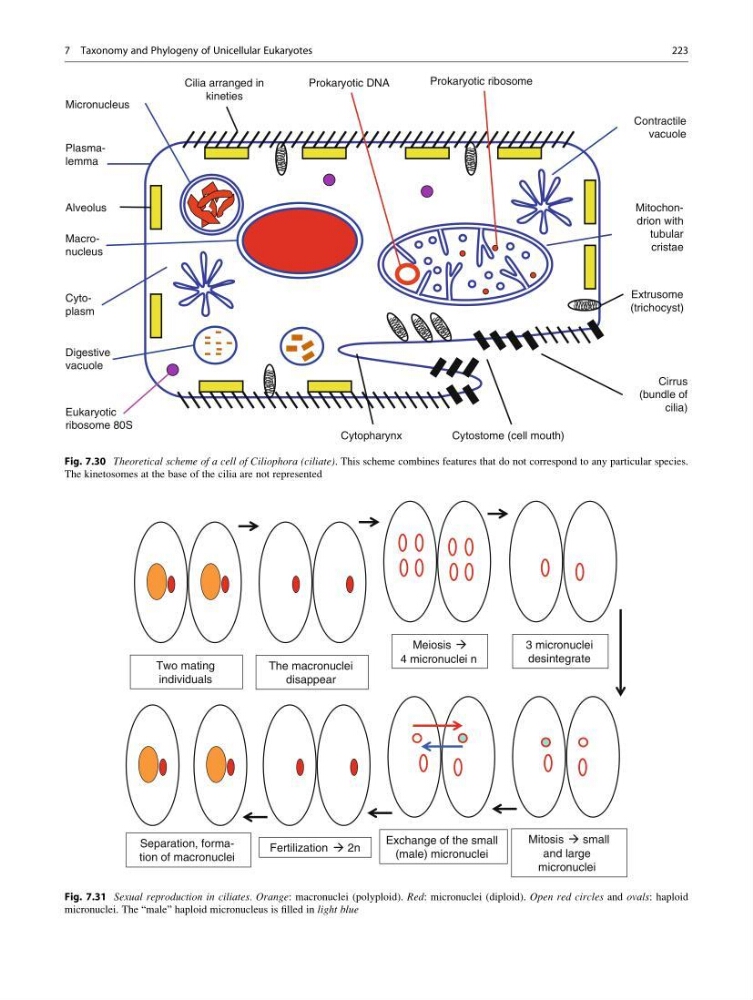
Fig. 7.31 Sexual reproduction in ciliates. Orange: macronuclei (polyploid). Red: micronuclei (diploid). Open red circles and ovals: haploid
micronuclei. The “male” haploid micronucleus is filled in light blue
Micronucleus
Alveolus
Macronucleus
Digestive
vacuole
Eukaryotic
ribosome 80S
Cytopharynx
Cytostome (cell mouth)
Cirrus
(bundle of
cilia)
Mitochondrion with
tubular
cristae
Prokaryotic ribosome
Contractile
vacuole
Prokaryotic DNA
Cilia arranged in
kineties
Plasmalemma
Cytoplasm
Extrusome
(trichocyst)
Fig. 7.30 Theoretical scheme of a cell of Ciliophora (ciliate). This scheme combines features that do not correspond to any particular species.
The kinetosomes at the base of the cilia are not represented
7 Taxonomy and Phylogeny of Unicellular Eukaryotes
223
individuals
The macronuclei
disappear
3 micronuclei
desintegrate
Meiosis
4 micronuclei n
Mitosis
small
and large
micronuclei
Exchange of the small
(male) micronuclei
Fertilization
2n
Separation, formation of macronuclei
Fig. 7.31 Sexual reproduction in ciliates. Orange: macronuclei (polyploid). Red: micronuclei (diploid). Open red circles and ovals: haploid
micronuclei. The “male” haploid micronucleus is filled in light blue
Micronucleus
Alveolus
Macronucleus
Digestive
vacuole
Eukaryotic
ribosome 80S
Cytopharynx
Cytostome (cell mouth)
Cirrus
(bundle of
cilia)
Mitochondrion with
tubular
cristae
Prokaryotic ribosome
Contractile
vacuole
Prokaryotic DNA
Cilia arranged in
kineties
Plasmalemma
Cytoplasm
Extrusome
(trichocyst)
Fig. 7.30 Theoretical scheme of a cell of Ciliophora (ciliate). This scheme combines features that do not correspond to any particular species.
The kinetosomes at the base of the cilia are not represented
7 Taxonomy and Phylogeny of Unicellular Eukaryotes
223