

from the world ocean (Groisillier et al. 2006), suggesting
that they play a major role in the control of unicellular
plankton (Miller et al. 2012).
7.8.2 Ciliophora
The Ciliates (¼ciliata, Ciliophora) are unicellular, with cells
that can be large (up to 2 mm in length). More than 10,000
species have been described. The oldest fossils date from
580 Ma in the Doushantuo formation in China. At the genetic
level, a striking feature is that the codons that code usually for
“stop” in the “universal” genetic code can code for amino
acids; in some species, UAA and UAG code for glutamine; in
others, UGA codes for cysteine or tryptophan. These are
derived, not ancestral, characters (Kim et al. 2005).
Ciliates are named after their coating of hundreds or
thousands of cilia (relatively short undulipodiums) arranged
in longitudinal rows called kineties. Cilia play a role in the
movement and capture food. In some taxa, thick round
bundles of cilia, called cirri, act like “legs” and enable the
organism to “walk” over a surface (Fig. 7.30). Alveoli are
present under the plasmalemma (cytoplasmic membrane)
and are packed against it to form a pellicle maintaining the
cell shape. Trichocysts (extrusomes) are membrane-bound
structures which can discharge their content outside the cell
for the purpose of attack or defense. Unlike most eukaryotes,
ciliates have two different sorts of nuclei, generally a small
micronucleus and a large macronucleus. However, there
may be several micronuclei or macronuclei (Gu ¨lkiz S ¸ enler
and Yildiz 2003; Hansen and Fenchel 2006). The micronucleus is the true nucleus; it is diploid, with chromosomes,
serves as the germ line nucleus but does not express its genes
and it is involved in sexual reproduction. In contrast, the
macronucleus is polyploid (many copies of the
chromosomes), undergoes direct division without mitosis,
and controls the non-reproductive cell functions, such as
metabolism. Many species have a “cell mouth” (cytostome),
a part of the cell specialized for phagocytosis, with a
cytopharynx through which food is ingested and included
within a digestive vacuole (Fig. 7.30). Contractile vacuoles
collect water and expel it from the cell to maintain osmotic
pressure. Mitochondria have tubular cristae, a shared
character in ciliates; however, some ciliates have no
mitochondria, but double-membraned hydrogenosomes
(probably derived from mitochondria), which produce adenosine triphosphate (ATP) fermentatively (Dyall et al. 2004).
Ciliates reproduce asexually by binary fission. During
fission, the micronucleus undergoes mitosis and the macronucleus elongates and splits in half; the cell then divides into
two, and each new cell has a copy of the micronucleus and
the macronucleus. When conditions are unfavorable, some
species produce resistant cysts. The sexual reproduction is a
kind of cystogamy (¼conjugation). Mating cells meet and
form a bridge between them; the macronuclei disappear
while the diploid micronuclei undergo meiosis producing
four haploid micronuclei; three of these micronuclei disintegrate, while the fourth undergoes mitosis, producing two
micronuclei, one of them being smaller than the other; the
two cells exchange over the bridge the smaller micronuclei,
which play the role of male gametes; in each cell, the small
and large micronuclei fuse. Subsequently, a macronucleus is
formed from micronuclei through a complex process
(Fig. 7.31). The life cycle can be considered as monogenetic,
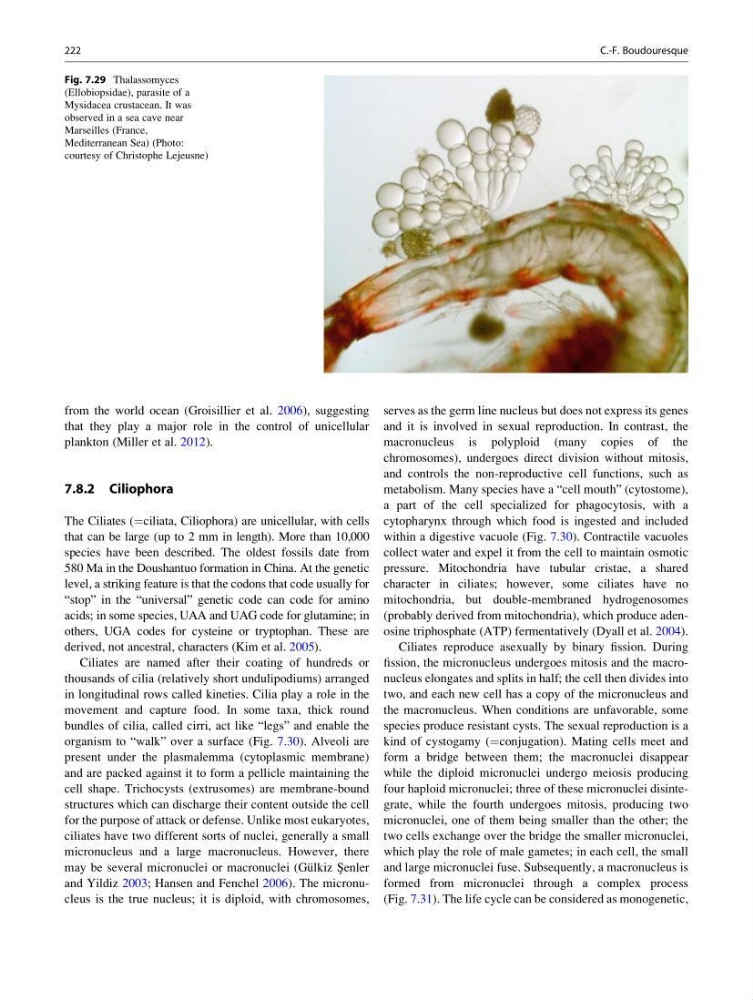
Fig. 7.29 Thalassomyces
(Ellobiopsidae), parasite of a
Mysidacea crustacean. It was
observed in a sea cave near
Marseilles (France,
Mediterranean Sea) (Photo:
courtesy of Christophe Lejeusne)
222
C.-F. Boudouresque
that they play a major role in the control of unicellular
plankton (Miller et al. 2012).
7.8.2 Ciliophora
The Ciliates (¼ciliata, Ciliophora) are unicellular, with cells
that can be large (up to 2 mm in length). More than 10,000
species have been described. The oldest fossils date from
580 Ma in the Doushantuo formation in China. At the genetic
level, a striking feature is that the codons that code usually for
“stop” in the “universal” genetic code can code for amino
acids; in some species, UAA and UAG code for glutamine; in
others, UGA codes for cysteine or tryptophan. These are
derived, not ancestral, characters (Kim et al. 2005).
Ciliates are named after their coating of hundreds or
thousands of cilia (relatively short undulipodiums) arranged
in longitudinal rows called kineties. Cilia play a role in the
movement and capture food. In some taxa, thick round
bundles of cilia, called cirri, act like “legs” and enable the
organism to “walk” over a surface (Fig. 7.30). Alveoli are
present under the plasmalemma (cytoplasmic membrane)
and are packed against it to form a pellicle maintaining the
cell shape. Trichocysts (extrusomes) are membrane-bound
structures which can discharge their content outside the cell
for the purpose of attack or defense. Unlike most eukaryotes,
ciliates have two different sorts of nuclei, generally a small
micronucleus and a large macronucleus. However, there
may be several micronuclei or macronuclei (Gu ¨lkiz S ¸ enler
and Yildiz 2003; Hansen and Fenchel 2006). The micronucleus is the true nucleus; it is diploid, with chromosomes,
serves as the germ line nucleus but does not express its genes
and it is involved in sexual reproduction. In contrast, the
macronucleus is polyploid (many copies of the
chromosomes), undergoes direct division without mitosis,
and controls the non-reproductive cell functions, such as
metabolism. Many species have a “cell mouth” (cytostome),
a part of the cell specialized for phagocytosis, with a
cytopharynx through which food is ingested and included
within a digestive vacuole (Fig. 7.30). Contractile vacuoles
collect water and expel it from the cell to maintain osmotic
pressure. Mitochondria have tubular cristae, a shared
character in ciliates; however, some ciliates have no
mitochondria, but double-membraned hydrogenosomes
(probably derived from mitochondria), which produce adenosine triphosphate (ATP) fermentatively (Dyall et al. 2004).
Ciliates reproduce asexually by binary fission. During
fission, the micronucleus undergoes mitosis and the macronucleus elongates and splits in half; the cell then divides into
two, and each new cell has a copy of the micronucleus and
the macronucleus. When conditions are unfavorable, some
species produce resistant cysts. The sexual reproduction is a
kind of cystogamy (¼conjugation). Mating cells meet and
form a bridge between them; the macronuclei disappear
while the diploid micronuclei undergo meiosis producing
four haploid micronuclei; three of these micronuclei disintegrate, while the fourth undergoes mitosis, producing two
micronuclei, one of them being smaller than the other; the
two cells exchange over the bridge the smaller micronuclei,
which play the role of male gametes; in each cell, the small
and large micronuclei fuse. Subsequently, a macronucleus is
formed from micronuclei through a complex process
(Fig. 7.31). The life cycle can be considered as monogenetic,
Fig. 7.29 Thalassomyces
(Ellobiopsidae), parasite of a
Mysidacea crustacean. It was
observed in a sea cave near
Marseilles (France,
Mediterranean Sea) (Photo:
courtesy of Christophe Lejeusne)
222
C.-F. Boudouresque