

f Resistant cyst
g Germination of the
resistant cyst
h Meiosis
4 spores
a Asexual reproduction
(binary fission)
b
Temporary
cyst
c Male
gamete
c Female
gamate
d Fertilization
e Zygote
i Spores
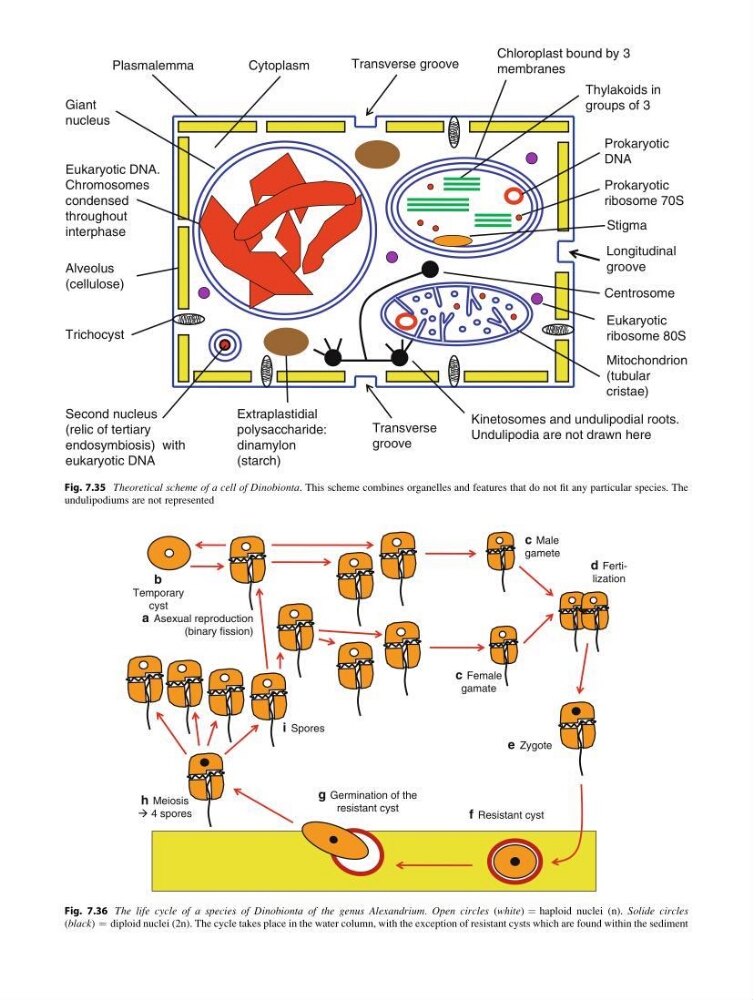
Fig. 7.36 The life cycle of a species of Dinobionta of the genus Alexandrium. Open circles (white) ¼ haploid nuclei (n). Solide circles
(black) ¼ diploid nuclei (2n). The cycle takes place in the water column, with the exception of resistant cysts which are found within the sediment
Giant
nucleus
Eukaryotic DNA.
Chromosomes
condensed
throughout
interphase
Plasmalemma
Alveolus
(cellulose)
Mitochondrion
(tubular
cristae)
Cytoplasm
Chloroplast bound by 3
membranes
Thylakoids in
groups of 3
Prokaryotic
DNA
Prokaryotic
ribosome 70S
Stigma
Eukaryotic
ribosome 80S
Trichocyst
Kinetosomes and undulipodial roots.
Undulipodia are not drawn here
Centrosome
Longitudinal
groove
Transverse groove
Transverse
groove
Second nucleus
(relic of tertiary
endosymbiosis) with
eukaryotic DNA
Extraplastidial
polysaccharide:
dinamylon
(starch)
Fig. 7.35 Theoretical scheme of a cell of Dinobionta. This scheme combines organelles and features that do not fit any particular species. The
undulipodiums are not represented
g Germination of the
resistant cyst
h Meiosis
4 spores
a Asexual reproduction
(binary fission)
b
Temporary
cyst
c Male
gamete
c Female
gamate
d Fertilization
e Zygote
i Spores
Fig. 7.36 The life cycle of a species of Dinobionta of the genus Alexandrium. Open circles (white) ¼ haploid nuclei (n). Solide circles
(black) ¼ diploid nuclei (2n). The cycle takes place in the water column, with the exception of resistant cysts which are found within the sediment
Giant
nucleus
Eukaryotic DNA.
Chromosomes
condensed
throughout
interphase
Plasmalemma
Alveolus
(cellulose)
Mitochondrion
(tubular
cristae)
Cytoplasm
Chloroplast bound by 3
membranes
Thylakoids in
groups of 3
Prokaryotic
DNA
Prokaryotic
ribosome 70S
Stigma
Eukaryotic
ribosome 80S
Trichocyst
Kinetosomes and undulipodial roots.
Undulipodia are not drawn here
Centrosome
Longitudinal
groove
Transverse groove
Transverse
groove
Second nucleus
(relic of tertiary
endosymbiosis) with
eukaryotic DNA
Extraplastidial
polysaccharide:
dinamylon
(starch)
Fig. 7.35 Theoretical scheme of a cell of Dinobionta. This scheme combines organelles and features that do not fit any particular species. The
undulipodiums are not represented