

sponge spicules; its body morphology strongly converges
with that of the carnivorous sponges (Maldonado et al.
2013). The external surface of the test may bear spines,
especially in planktonic species. Openings in the test, including those between chambers, are called apertures. The test
diameter ranges between 20 μm and up to 7 cm
(Parafusulina), 9 cm (Loftusia), 11 cm (Camerina), and
19 cm (Neusina) (Le Calvez 1953).
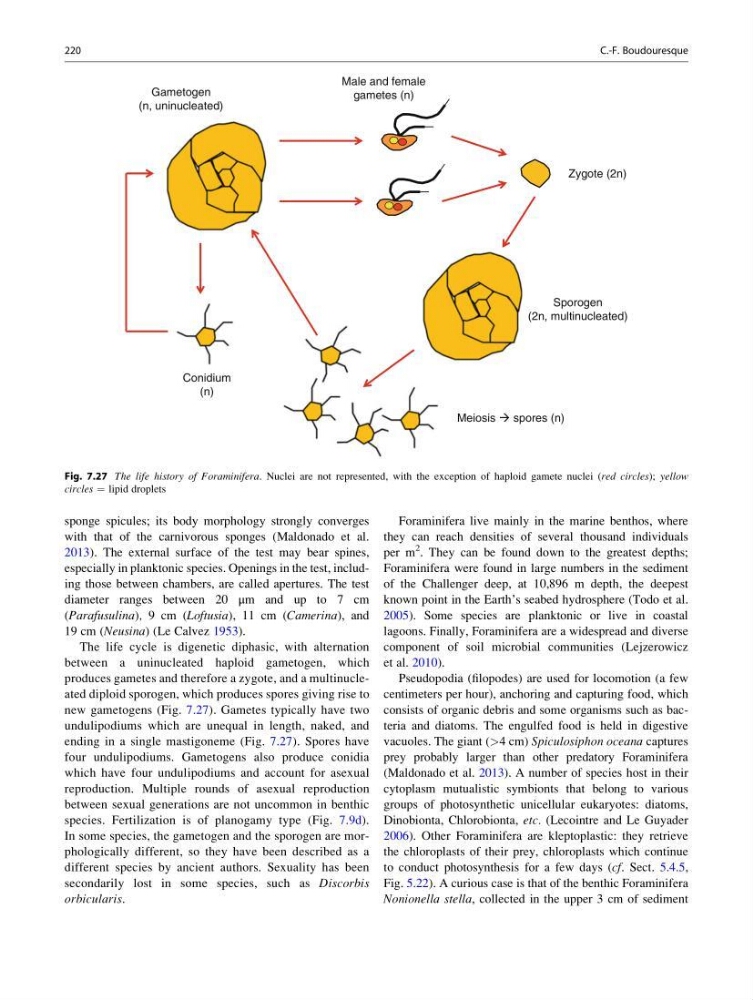
The life cycle is digenetic diphasic, with alternation
between a uninucleated haploid gametogen, which
produces gametes and therefore a zygote, and a multinucleated diploid sporogen, which produces spores giving rise to
new gametogens (Fig. 7.27). Gametes typically have two
undulipodiums which are unequal in length, naked, and
ending in a single mastigoneme (Fig. 7.27). Spores have
four undulipodiums. Gametogens also produce conidia
which have four undulipodiums and account for asexual
reproduction. Multiple rounds of asexual reproduction
between sexual generations are not uncommon in benthic
species. Fertilization is of planogamy type (Fig. 7.9d).
In some species, the gametogen and the sporogen are morphologically different, so they have been described as a
different species by ancient authors. Sexuality has been
secondarily lost in some species, such as Discorbis
orbicularis.
Foraminifera live mainly in the marine benthos, where
they can reach densities of several thousand individuals
per m
2 . They can be found down to the greatest depths;
Foraminifera were found in large numbers in the sediment
of the Challenger deep, at 10,896 m depth, the deepest
known point in the Earth’s seabed hydrosphere (Todo et al.
2005). Some species are planktonic or live in coastal
lagoons. Finally, Foraminifera are a widespread and diverse
component of soil microbial communities (Lejzerowicz
et al. 2010).
Pseudopodia (filopodes) are used for locomotion (a few
centimeters per hour), anchoring and capturing food, which
consists of organic debris and some organisms such as bacteria and diatoms. The engulfed food is held in digestive
vacuoles. The giant (>4 cm) Spiculosiphon oceana captures
prey probably larger than other predatory Foraminifera
(Maldonado et al. 2013). A number of species host in their
cytoplasm mutualistic symbionts that belong to various
groups of photosynthetic unicellular eukaryotes: diatoms,
Dinobionta, Chlorobionta, etc. (Lecointre and Le Guyader
2006). Other Foraminifera are kleptoplastic: they retrieve
the chloroplasts of their prey, chloroplasts which continue
to conduct photosynthesis for a few days (cf. Sect. 5.4.5,
Fig. 5.22). A curious case is that of the benthic Foraminifera
Nonionella stella, collected in the upper 3 cm of sediment
Gametogen
(n, uninucleated)
Male and female
gametes (n)
Zygote (2n)
Sporogen
(2n, multinucleated)
Meiosis
spores (n)
Conidium
(n)
Fig. 7.27 The life history of Foraminifera. Nuclei are not represented, with the exception of haploid gamete nuclei (red circles); yellow
circles ¼ lipid droplets
220
C.-F. Boudouresque
with that of the carnivorous sponges (Maldonado et al.
2013). The external surface of the test may bear spines,
especially in planktonic species. Openings in the test, including those between chambers, are called apertures. The test
diameter ranges between 20 μm and up to 7 cm
(Parafusulina), 9 cm (Loftusia), 11 cm (Camerina), and
19 cm (Neusina) (Le Calvez 1953).
The life cycle is digenetic diphasic, with alternation
between a uninucleated haploid gametogen, which
produces gametes and therefore a zygote, and a multinucleated diploid sporogen, which produces spores giving rise to
new gametogens (Fig. 7.27). Gametes typically have two
undulipodiums which are unequal in length, naked, and
ending in a single mastigoneme (Fig. 7.27). Spores have
four undulipodiums. Gametogens also produce conidia
which have four undulipodiums and account for asexual
reproduction. Multiple rounds of asexual reproduction
between sexual generations are not uncommon in benthic
species. Fertilization is of planogamy type (Fig. 7.9d).
In some species, the gametogen and the sporogen are morphologically different, so they have been described as a
different species by ancient authors. Sexuality has been
secondarily lost in some species, such as Discorbis
orbicularis.
Foraminifera live mainly in the marine benthos, where
they can reach densities of several thousand individuals
per m
2 . They can be found down to the greatest depths;
Foraminifera were found in large numbers in the sediment
of the Challenger deep, at 10,896 m depth, the deepest
known point in the Earth’s seabed hydrosphere (Todo et al.
2005). Some species are planktonic or live in coastal
lagoons. Finally, Foraminifera are a widespread and diverse
component of soil microbial communities (Lejzerowicz
et al. 2010).
Pseudopodia (filopodes) are used for locomotion (a few
centimeters per hour), anchoring and capturing food, which
consists of organic debris and some organisms such as bacteria and diatoms. The engulfed food is held in digestive
vacuoles. The giant (>4 cm) Spiculosiphon oceana captures
prey probably larger than other predatory Foraminifera
(Maldonado et al. 2013). A number of species host in their
cytoplasm mutualistic symbionts that belong to various
groups of photosynthetic unicellular eukaryotes: diatoms,
Dinobionta, Chlorobionta, etc. (Lecointre and Le Guyader
2006). Other Foraminifera are kleptoplastic: they retrieve
the chloroplasts of their prey, chloroplasts which continue
to conduct photosynthesis for a few days (cf. Sect. 5.4.5,
Fig. 5.22). A curious case is that of the benthic Foraminifera
Nonionella stella, collected in the upper 3 cm of sediment
Gametogen
(n, uninucleated)
Male and female
gametes (n)
Zygote (2n)
Sporogen
(2n, multinucleated)
Meiosis
spores (n)
Conidium
(n)
Fig. 7.27 The life history of Foraminifera. Nuclei are not represented, with the exception of haploid gamete nuclei (red circles); yellow
circles ¼ lipid droplets
220
C.-F. Boudouresque