

viruses which cause serious diseases in cultivated plants
(Braselton 2009). Phagomyxa bellerocheae and P. odontellae
are parasites of marine diatoms (Schnepf et al. 2000).
7.6.5 Foraminifera
Foraminifera
14 are unicellular. They have the form of
amoebae with thin pseudopodia (filopodes). They are
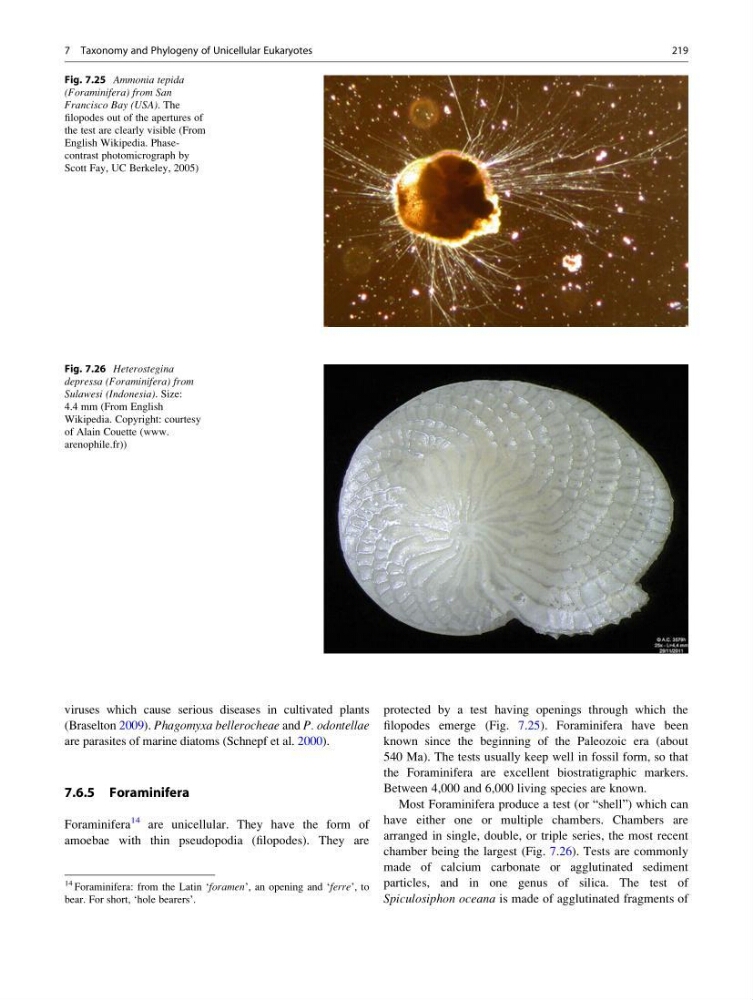
protected by a test having openings through which the
filopodes emerge (Fig. 7.25). Foraminifera have been
known since the beginning of the Paleozoic era (about
540 Ma). The tests usually keep well in fossil form, so that
the Foraminifera are excellent biostratigraphic markers.
Between 4,000 and 6,000 living species are known.
Most Foraminifera produce a test (or “shell”) which can
have either one or multiple chambers. Chambers are
arranged in single, double, or triple series, the most recent
chamber being the largest (Fig. 7.26). Tests are commonly
made of calcium carbonate or agglutinated sediment
particles, and in one genus of silica. The test of
Spiculosiphon oceana is made of agglutinated fragments of
Fig. 7.25 Ammonia tepida
(Foraminifera) from San
Francisco Bay (USA). The
filopodes out of the apertures of
the test are clearly visible (From
English Wikipedia. Phasecontrast photomicrograph by
Scott Fay, UC Berkeley, 2005)
Fig. 7.26 Heterostegina
depressa (Foraminifera) from
Sulawesi (Indonesia). Size:
4.4 mm (From English
Wikipedia. Copyright: courtesy
of Alain Couette (www.
arenophile.fr))
14 Foraminifera: from the Latin ‘foramen’, an opening and ‘ferre’, to
bear. For short, ‘hole bearers’.
7 Taxonomy and Phylogeny of Unicellular Eukaryotes
219
(Braselton 2009). Phagomyxa bellerocheae and P. odontellae
are parasites of marine diatoms (Schnepf et al. 2000).
7.6.5 Foraminifera
Foraminifera
14 are unicellular. They have the form of
amoebae with thin pseudopodia (filopodes). They are
protected by a test having openings through which the
filopodes emerge (Fig. 7.25). Foraminifera have been
known since the beginning of the Paleozoic era (about
540 Ma). The tests usually keep well in fossil form, so that
the Foraminifera are excellent biostratigraphic markers.
Between 4,000 and 6,000 living species are known.
Most Foraminifera produce a test (or “shell”) which can
have either one or multiple chambers. Chambers are
arranged in single, double, or triple series, the most recent
chamber being the largest (Fig. 7.26). Tests are commonly
made of calcium carbonate or agglutinated sediment
particles, and in one genus of silica. The test of
Spiculosiphon oceana is made of agglutinated fragments of
Fig. 7.25 Ammonia tepida
(Foraminifera) from San
Francisco Bay (USA). The
filopodes out of the apertures of
the test are clearly visible (From
English Wikipedia. Phasecontrast photomicrograph by
Scott Fay, UC Berkeley, 2005)
Fig. 7.26 Heterostegina
depressa (Foraminifera) from
Sulawesi (Indonesia). Size:
4.4 mm (From English
Wikipedia. Copyright: courtesy
of Alain Couette (www.
arenophile.fr))
14 Foraminifera: from the Latin ‘foramen’, an opening and ‘ferre’, to
bear. For short, ‘hole bearers’.
7 Taxonomy and Phylogeny of Unicellular Eukaryotes
219