

the cytoplasmic continuity is blocked by the pit plug, while
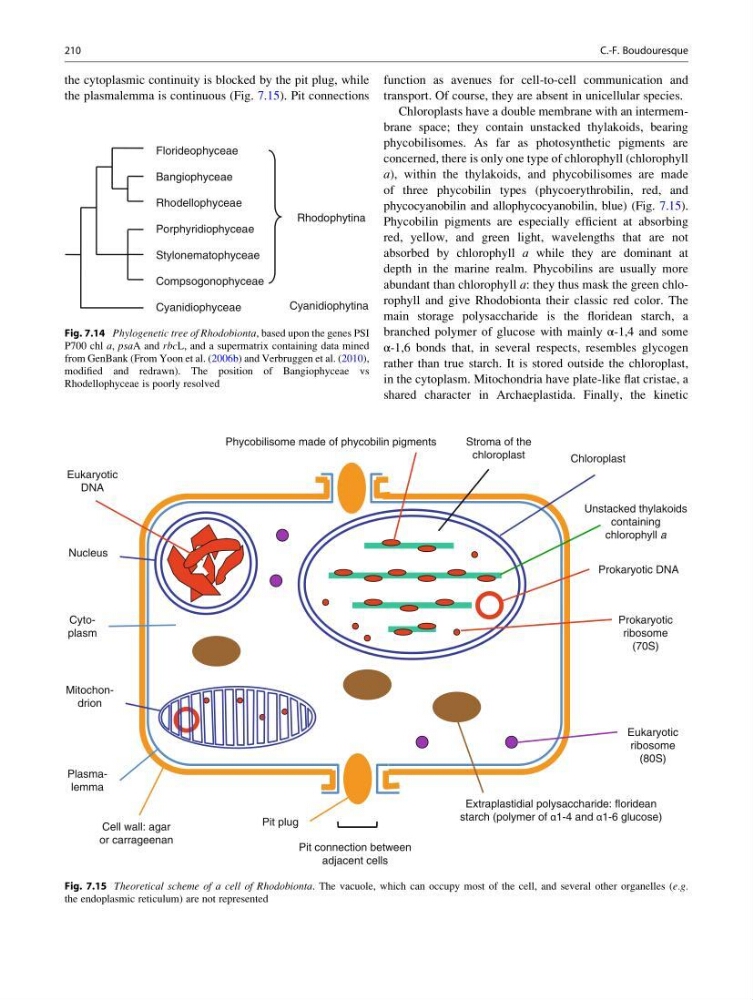
the plasmalemma is continuous (Fig. 7.15). Pit connections
function as avenues for cell-to-cell communication and
transport. Of course, they are absent in unicellular species.
Chloroplasts have a double membrane with an intermembrane space; they contain unstacked thylakoids, bearing
phycobilisomes. As far as photosynthetic pigments are
concerned, there is only one type of chlorophyll (chlorophyll
a), within the thylakoids, and phycobilisomes are made
of three phycobilin types (phycoerythrobilin, red, and
phycocyanobilin and allophycocyanobilin, blue) (Fig. 7.15).
Phycobilin pigments are especially efficient at absorbing
red, yellow, and green light, wavelengths that are not
absorbed by chlorophyll a while they are dominant at
depth in the marine realm. Phycobilins are usually more
abundant than chlorophyll a: they thus mask the green chlorophyll and give Rhodobionta their classic red color. The
main storage polysaccharide is the floridean starch, a
branched polymer of glucose with mainly α-1,4 and some
α-1,6 bonds that, in several respects, resembles glycogen
rather than true starch. It is stored outside the chloroplast,
in the cytoplasm. Mitochondria have plate-like flat cristae, a
shared character in Archaeplastida. Finally, the kinetic
Florideophyceae
Bangiophyceae
Rhodellophyceae
Porphyridiophyceae
Stylonematophyceae
Compsogonophyceae
Cyanidiophyceae
Rhodophytina
Cyanidiophytina
Fig. 7.14 Phylogenetic tree of Rhodobionta, based upon the genes PSI
P700 chl a, psaA and rbcL, and a supermatrix containing data mined
from GenBank (From Yoon et al. (2006b) and Verbruggen et al. (2010),
modified and redrawn). The position of Bangiophyceae vs
Rhodellophyceae is poorly resolved
Cell wall: agar
or carrageenan
Pit connection between
adjacent cells
Nucleus
Eukaryotic
DNA
Plasmalemma
Cytoplasm
Mitochondrion
Chloroplast
Unstacked thylakoids
containing
chlorophyll a
Phycobilisome made of phycobilin pigments
Prokaryotic DNA
Prokaryotic
ribosome
(70S)
Eukaryotic
ribosome
(80S)
Extraplastidial polysaccharide: floridean
starch (polymer of α1-4 and α1-6 glucose)
Pit plug
Stroma of the
chloroplast
Fig. 7.15 Theoretical scheme of a cell of Rhodobionta. The vacuole, which can occupy most of the cell, and several other organelles (e.g.
the endoplasmic reticulum) are not represented
210
C.-F. Boudouresque
the plasmalemma is continuous (Fig. 7.15). Pit connections
function as avenues for cell-to-cell communication and
transport. Of course, they are absent in unicellular species.
Chloroplasts have a double membrane with an intermembrane space; they contain unstacked thylakoids, bearing
phycobilisomes. As far as photosynthetic pigments are
concerned, there is only one type of chlorophyll (chlorophyll
a), within the thylakoids, and phycobilisomes are made
of three phycobilin types (phycoerythrobilin, red, and
phycocyanobilin and allophycocyanobilin, blue) (Fig. 7.15).
Phycobilin pigments are especially efficient at absorbing
red, yellow, and green light, wavelengths that are not
absorbed by chlorophyll a while they are dominant at
depth in the marine realm. Phycobilins are usually more
abundant than chlorophyll a: they thus mask the green chlorophyll and give Rhodobionta their classic red color. The
main storage polysaccharide is the floridean starch, a
branched polymer of glucose with mainly α-1,4 and some
α-1,6 bonds that, in several respects, resembles glycogen
rather than true starch. It is stored outside the chloroplast,
in the cytoplasm. Mitochondria have plate-like flat cristae, a
shared character in Archaeplastida. Finally, the kinetic
Florideophyceae
Bangiophyceae
Rhodellophyceae
Porphyridiophyceae
Stylonematophyceae
Compsogonophyceae
Cyanidiophyceae
Rhodophytina
Cyanidiophytina
Fig. 7.14 Phylogenetic tree of Rhodobionta, based upon the genes PSI
P700 chl a, psaA and rbcL, and a supermatrix containing data mined
from GenBank (From Yoon et al. (2006b) and Verbruggen et al. (2010),
modified and redrawn). The position of Bangiophyceae vs
Rhodellophyceae is poorly resolved
Cell wall: agar
or carrageenan
Pit connection between
adjacent cells
Nucleus
Eukaryotic
DNA
Plasmalemma
Cytoplasm
Mitochondrion
Chloroplast
Unstacked thylakoids
containing
chlorophyll a
Phycobilisome made of phycobilin pigments
Prokaryotic DNA
Prokaryotic
ribosome
(70S)
Eukaryotic
ribosome
(80S)
Extraplastidial polysaccharide: floridean
starch (polymer of α1-4 and α1-6 glucose)
Pit plug
Stroma of the
chloroplast
Fig. 7.15 Theoretical scheme of a cell of Rhodobionta. The vacuole, which can occupy most of the cell, and several other organelles (e.g.
the endoplasmic reticulum) are not represented
210
C.-F. Boudouresque