

apparatus (undulipodiums, kinetosomes, undulipodial roots,
centriole) is lacking; this may be due to a secondary loss
(Fig. 7.15).
In Rhodobionta, the way of glycerol storage is unique.
Unlike other taxa, in which glycerol is combined with
fatty acids, producing glycerides, it is combined with
sugars (! heterosides) (Feldmann and Feldmann 1945).
Floridoside (¼α-D-galacto-pyranosyl-(1–2)-glycerol; combination of one galactose and one glycerol molecules) is
the most common heteroside, often the main reserve product
in the cell; it constitutes a reliable marker of Rhodobionta.
Other heterosides can be present, e.g., digeneaside (¼α-Dmanno-pyranosyl-(1–2)-glyce ´rate) and isofloridoside. In
Erythrolobus coxiae (Porphyridiophyceae), floridoside and
digeneaside are present simultaneously (Scott et al. 2006).
The low lipid content, in most Rhodobionta, may be a
consequence of this particular pathway of glycerol storage.
Halogenated compounds (chlorine and especially bromine)
are relatively abundant, which constitutes another characteristic of Rhodobionta; Br+, sometimes Cl+, can take the place
of H+ in the metabolism, resulting in e.g. bromoperoxydases
and chloroperoxydases. Bromine is also present in defense
compounds against herbivores. Finally and unexpectedly,
the main sterol in Rhodobionta is cholesterol, a sterol that
the general public associates more readily with animals
rather than with “algae” (Bert et al. 1991).
In species with sexual reproduction, the typical life cycle is
trigenetic and diphasic (Fig. 7.9d) and the fertilization is a
trichogamy (Florideophyceae) or a protrichogamy
(Bangiophyceae and Compsogonophyceae) (Fig. 7.6). In all
cases, reproduction via conidia also occurs. In unicellular
Rhodobionta, only the asexual reproduction has been observed,
via binary fission and/or formation of conidia (often incorrectly
named “endospores”); however, sexual reproduction does
exist, as genetic recombination has been observed in Galdieria,
Cyanidiophyceae (Yoon et al. 2006a, b).
Most Rhodobionta thrive in the marine realm. However,
a few freshwater species are known. Multicellular species
are benthic (living in close relationship with the bottom)
while most unicellular species, such as Rhodosorus,
Porphyridium. Erythrolobus and Rhodella, are pelagic (living in the water column). Species of the genera Cyanidium,
Cyanodioschyzon, and Galdieria dwell in thermoacidic
continental environments (pH ¼ 0.5 to 6.0). Galdieria and
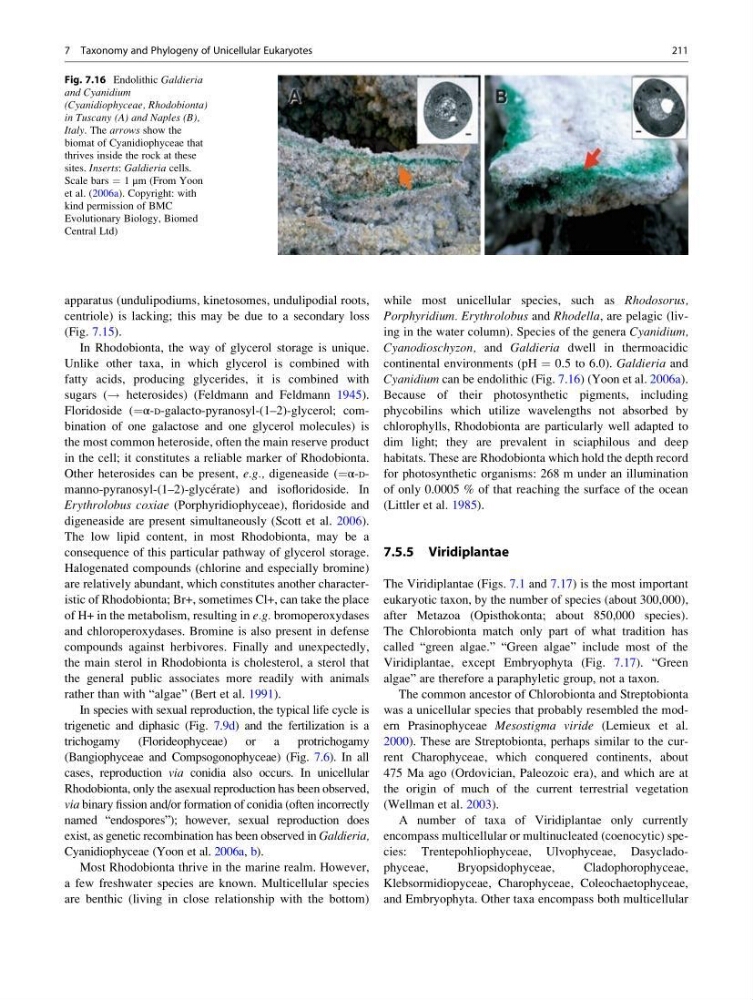
Cyanidium can be endolithic (Fig. 7.16) (Yoon et al. 2006a).
Because of their photosynthetic pigments, including
phycobilins which utilize wavelengths not absorbed by
chlorophylls, Rhodobionta are particularly well adapted to
dim light; they are prevalent in sciaphilous and deep
habitats. These are Rhodobionta which hold the depth record
for photosynthetic organisms: 268 m under an illumination
of only 0.0005 % of that reaching the surface of the ocean
(Littler et al. 1985).
7.5.5 Viridiplantae
The Viridiplantae (Figs. 7.1 and 7.17) is the most important
eukaryotic taxon, by the number of species (about 300,000),
after Metazoa (Opisthokonta; about 850,000 species).
The Chlorobionta match only part of what tradition has
called “green algae.” “Green algae” include most of the
Viridiplantae, except Embryophyta (Fig. 7.17). “Green
algae” are therefore a paraphyletic group, not a taxon.
The common ancestor of Chlorobionta and Streptobionta
was a unicellular species that probably resembled the modern Prasinophyceae Mesostigma viride (Lemieux et al.
2000). These are Streptobionta, perhaps similar to the current Charophyceae, which conquered continents, about
475 Ma ago (Ordovician, Paleozoic era), and which are at
the origin of much of the current terrestrial vegetation
(Wellman et al. 2003).
A number of taxa of Viridiplantae only currently
encompass multicellular or multinucleated (coenocytic) species: Trentepohliophyceae, Ulvophyceae, Dasycladophyceae,
Bryopsidophyceae,
Cladophorophyceae,
Klebsormidiopyceae, Charophyceae, Coleochaetophyceae,
and Embryophyta. Other taxa encompass both multicellular
Fig. 7.16 Endolithic Galdieria
and Cyanidium
(Cyanidiophyceae, Rhodobionta)
in Tuscany (A) and Naples (B),
Italy. The arrows show the
biomat of Cyanidiophyceae that
thrives inside the rock at these
sites. Inserts: Galdieria cells.
Scale bars ¼ 1 μm (From Yoon
et al. (2006a). Copyright: with
kind permission of BMC
Evolutionary Biology, Biomed
Central Ltd)
7 Taxonomy and Phylogeny of Unicellular Eukaryotes
211
centriole) is lacking; this may be due to a secondary loss
(Fig. 7.15).
In Rhodobionta, the way of glycerol storage is unique.
Unlike other taxa, in which glycerol is combined with
fatty acids, producing glycerides, it is combined with
sugars (! heterosides) (Feldmann and Feldmann 1945).
Floridoside (¼α-D-galacto-pyranosyl-(1–2)-glycerol; combination of one galactose and one glycerol molecules) is
the most common heteroside, often the main reserve product
in the cell; it constitutes a reliable marker of Rhodobionta.
Other heterosides can be present, e.g., digeneaside (¼α-Dmanno-pyranosyl-(1–2)-glyce ´rate) and isofloridoside. In
Erythrolobus coxiae (Porphyridiophyceae), floridoside and
digeneaside are present simultaneously (Scott et al. 2006).
The low lipid content, in most Rhodobionta, may be a
consequence of this particular pathway of glycerol storage.
Halogenated compounds (chlorine and especially bromine)
are relatively abundant, which constitutes another characteristic of Rhodobionta; Br+, sometimes Cl+, can take the place
of H+ in the metabolism, resulting in e.g. bromoperoxydases
and chloroperoxydases. Bromine is also present in defense
compounds against herbivores. Finally and unexpectedly,
the main sterol in Rhodobionta is cholesterol, a sterol that
the general public associates more readily with animals
rather than with “algae” (Bert et al. 1991).
In species with sexual reproduction, the typical life cycle is
trigenetic and diphasic (Fig. 7.9d) and the fertilization is a
trichogamy (Florideophyceae) or a protrichogamy
(Bangiophyceae and Compsogonophyceae) (Fig. 7.6). In all
cases, reproduction via conidia also occurs. In unicellular
Rhodobionta, only the asexual reproduction has been observed,
via binary fission and/or formation of conidia (often incorrectly
named “endospores”); however, sexual reproduction does
exist, as genetic recombination has been observed in Galdieria,
Cyanidiophyceae (Yoon et al. 2006a, b).
Most Rhodobionta thrive in the marine realm. However,
a few freshwater species are known. Multicellular species
are benthic (living in close relationship with the bottom)
while most unicellular species, such as Rhodosorus,
Porphyridium. Erythrolobus and Rhodella, are pelagic (living in the water column). Species of the genera Cyanidium,
Cyanodioschyzon, and Galdieria dwell in thermoacidic
continental environments (pH ¼ 0.5 to 6.0). Galdieria and
Cyanidium can be endolithic (Fig. 7.16) (Yoon et al. 2006a).
Because of their photosynthetic pigments, including
phycobilins which utilize wavelengths not absorbed by
chlorophylls, Rhodobionta are particularly well adapted to
dim light; they are prevalent in sciaphilous and deep
habitats. These are Rhodobionta which hold the depth record
for photosynthetic organisms: 268 m under an illumination
of only 0.0005 % of that reaching the surface of the ocean
(Littler et al. 1985).
7.5.5 Viridiplantae
The Viridiplantae (Figs. 7.1 and 7.17) is the most important
eukaryotic taxon, by the number of species (about 300,000),
after Metazoa (Opisthokonta; about 850,000 species).
The Chlorobionta match only part of what tradition has
called “green algae.” “Green algae” include most of the
Viridiplantae, except Embryophyta (Fig. 7.17). “Green
algae” are therefore a paraphyletic group, not a taxon.
The common ancestor of Chlorobionta and Streptobionta
was a unicellular species that probably resembled the modern Prasinophyceae Mesostigma viride (Lemieux et al.
2000). These are Streptobionta, perhaps similar to the current Charophyceae, which conquered continents, about
475 Ma ago (Ordovician, Paleozoic era), and which are at
the origin of much of the current terrestrial vegetation
(Wellman et al. 2003).
A number of taxa of Viridiplantae only currently
encompass multicellular or multinucleated (coenocytic) species: Trentepohliophyceae, Ulvophyceae, Dasycladophyceae,
Bryopsidophyceae,
Cladophorophyceae,
Klebsormidiopyceae, Charophyceae, Coleochaetophyceae,
and Embryophyta. Other taxa encompass both multicellular
Fig. 7.16 Endolithic Galdieria
and Cyanidium
(Cyanidiophyceae, Rhodobionta)
in Tuscany (A) and Naples (B),
Italy. The arrows show the
biomat of Cyanidiophyceae that
thrives inside the rock at these
sites. Inserts: Galdieria cells.
Scale bars ¼ 1 μm (From Yoon
et al. (2006a). Copyright: with
kind permission of BMC
Evolutionary Biology, Biomed
Central Ltd)
7 Taxonomy and Phylogeny of Unicellular Eukaryotes
211