

unbranched glucose polymer with α-1,4 bonds) and amylopectin (a branched glucose polymer with α-1,4 and a few
α-1,6 bonds), are stored in the cytoplasm. Cells are motile
due to two undulipodiums (Cyanophora), non-motile
(Glaucocystis) or present at both motile and non-motile
stages (Gloeochaete). When present, the two undulipodiums
are unequal and bear two rows of unipartite mastigonemes
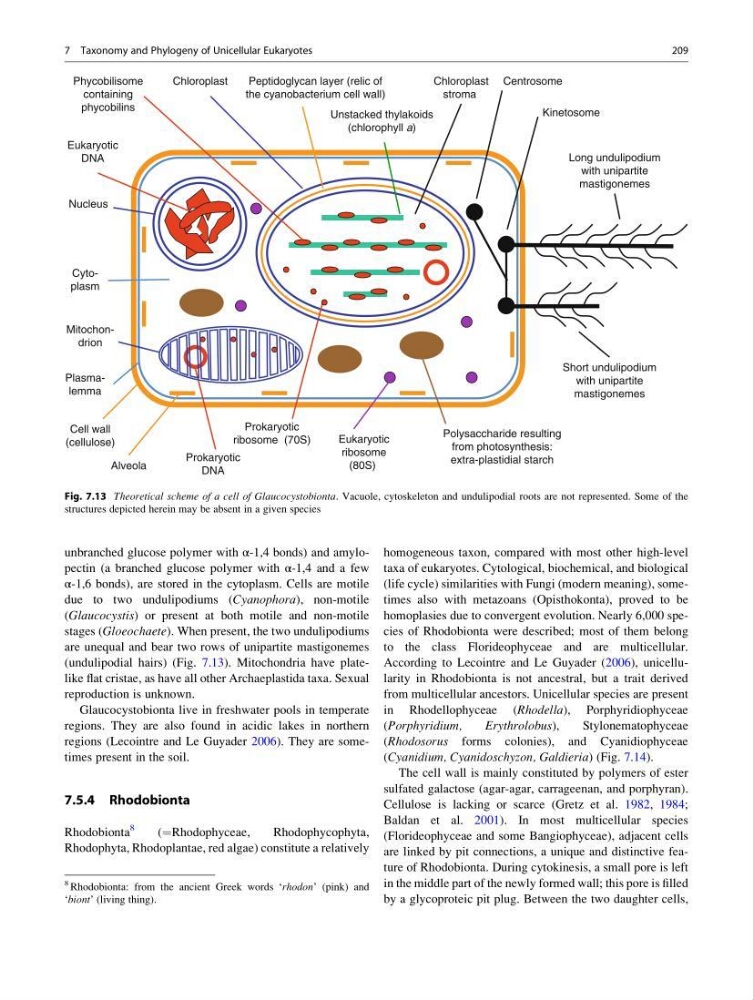
(undulipodial hairs) (Fig. 7.13). Mitochondria have platelike flat cristae, as have all other Archaeplastida taxa. Sexual
reproduction is unknown.
Glaucocystobionta live in freshwater pools in temperate
regions. They are also found in acidic lakes in northern
regions (Lecointre and Le Guyader 2006). They are sometimes present in the soil.
7.5.4 Rhodobionta
Rhodobionta
8
(¼Rhodophyceae,
Rhodophycophyta,
Rhodophyta, Rhodoplantae, red algae) constitute a relatively
homogeneous taxon, compared with most other high-level
taxa of eukaryotes. Cytological, biochemical, and biological
(life cycle) similarities with Fungi (modern meaning), sometimes also with metazoans (Opisthokonta), proved to be
homoplasies due to convergent evolution. Nearly 6,000 species of Rhodobionta were described; most of them belong
to the class Florideophyceae and are multicellular.
According to Lecointre and Le Guyader (2006), unicellularity in Rhodobionta is not ancestral, but a trait derived
from multicellular ancestors. Unicellular species are present
in Rhodellophyceae (Rhodella), Porphyridiophyceae
(Porphyridium,
Erythrolobus),
Stylonematophyceae
(Rhodosorus forms colonies), and Cyanidiophyceae
(Cyanidium, Cyanidoschyzon, Galdieria) (Fig. 7.14).
The cell wall is mainly constituted by polymers of ester
sulfated galactose (agar-agar, carrageenan, and porphyran).
Cellulose is lacking or scarce (Gretz et al. 1982, 1984;
Baldan et al. 2001). In most multicellular species
(Florideophyceae and some Bangiophyceae), adjacent cells
are linked by pit connections, a unique and distinctive feature of Rhodobionta. During cytokinesis, a small pore is left
in the middle part of the newly formed wall; this pore is filled
by a glycoproteic pit plug. Between the two daughter cells,
Cell wall
(cellulose)
Nucleus
Eukaryotic
DNA
Plasmalemma
Cytoplasm
Mitochondrion
Chloroplast
Unstacked thylakoids
(chlorophyll a)
Phycobilisome
containing
phycobilins
Prokaryotic
DNA
Prokaryotic
ribosome (70S)
Eukaryotic
ribosome
(80S)
Polysaccharide resulting
from photosynthesis:
extra-plastidial starch
Alveola
Centrosome
Kinetosome
Long undulipodium
with unipartite
mastigonemes
Short undulipodium
with unipartite
mastigonemes
Peptidoglycan layer (relic of
the cyanobacterium cell wall)
Chloroplast
stroma
Fig. 7.13 Theoretical scheme of a cell of Glaucocystobionta. Vacuole, cytoskeleton and undulipodial roots are not represented. Some of the
structures depicted herein may be absent in a given species
8 Rhodobionta: from the ancient Greek words ‘rhodon’ (pink) and
‘biont’ (living thing).
7 Taxonomy and Phylogeny of Unicellular Eukaryotes
209
α-1,6 bonds), are stored in the cytoplasm. Cells are motile
due to two undulipodiums (Cyanophora), non-motile
(Glaucocystis) or present at both motile and non-motile
stages (Gloeochaete). When present, the two undulipodiums
are unequal and bear two rows of unipartite mastigonemes
(undulipodial hairs) (Fig. 7.13). Mitochondria have platelike flat cristae, as have all other Archaeplastida taxa. Sexual
reproduction is unknown.
Glaucocystobionta live in freshwater pools in temperate
regions. They are also found in acidic lakes in northern
regions (Lecointre and Le Guyader 2006). They are sometimes present in the soil.
7.5.4 Rhodobionta
Rhodobionta
8
(¼Rhodophyceae,
Rhodophycophyta,
Rhodophyta, Rhodoplantae, red algae) constitute a relatively
homogeneous taxon, compared with most other high-level
taxa of eukaryotes. Cytological, biochemical, and biological
(life cycle) similarities with Fungi (modern meaning), sometimes also with metazoans (Opisthokonta), proved to be
homoplasies due to convergent evolution. Nearly 6,000 species of Rhodobionta were described; most of them belong
to the class Florideophyceae and are multicellular.
According to Lecointre and Le Guyader (2006), unicellularity in Rhodobionta is not ancestral, but a trait derived
from multicellular ancestors. Unicellular species are present
in Rhodellophyceae (Rhodella), Porphyridiophyceae
(Porphyridium,
Erythrolobus),
Stylonematophyceae
(Rhodosorus forms colonies), and Cyanidiophyceae
(Cyanidium, Cyanidoschyzon, Galdieria) (Fig. 7.14).
The cell wall is mainly constituted by polymers of ester
sulfated galactose (agar-agar, carrageenan, and porphyran).
Cellulose is lacking or scarce (Gretz et al. 1982, 1984;
Baldan et al. 2001). In most multicellular species
(Florideophyceae and some Bangiophyceae), adjacent cells
are linked by pit connections, a unique and distinctive feature of Rhodobionta. During cytokinesis, a small pore is left
in the middle part of the newly formed wall; this pore is filled
by a glycoproteic pit plug. Between the two daughter cells,
Cell wall
(cellulose)
Nucleus
Eukaryotic
DNA
Plasmalemma
Cytoplasm
Mitochondrion
Chloroplast
Unstacked thylakoids
(chlorophyll a)
Phycobilisome
containing
phycobilins
Prokaryotic
DNA
Prokaryotic
ribosome (70S)
Eukaryotic
ribosome
(80S)
Polysaccharide resulting
from photosynthesis:
extra-plastidial starch
Alveola
Centrosome
Kinetosome
Long undulipodium
with unipartite
mastigonemes
Short undulipodium
with unipartite
mastigonemes
Peptidoglycan layer (relic of
the cyanobacterium cell wall)
Chloroplast
stroma
Fig. 7.13 Theoretical scheme of a cell of Glaucocystobionta. Vacuole, cytoskeleton and undulipodial roots are not represented. Some of the
structures depicted herein may be absent in a given species
8 Rhodobionta: from the ancient Greek words ‘rhodon’ (pink) and
‘biont’ (living thing).
7 Taxonomy and Phylogeny of Unicellular Eukaryotes
209