

part of the taxa that traditionalist botanists and the ICN (the
code of botanical nomenclature) consider as plants, and (ii)
a taxon that is traditionally considered as belonging to
“protozoans” and therefore to the Linnean animal kingdom,
namely Centrohelida, possibly falls within Archaeplastida
(cf. Sect. 7.5.2).
Archaeplastida represent a kingdom whose importance is
pivotal in the biosphere. They encompass ~300,000 species,
:
a
Gametogen
Sporogen
Conidial
loop
Conidial
loop
:
b
Gametogen
Conidial
loop
:
:
c
Sporogen
~
~
Conidial
loop
:
d
Sporogen
Gametogen
Carpoconidiogen
Conidial
loop
Conidial
loop
:
e
Carpoconidiogen
Sporogen
Gametogen
Conidial
loop
Conidial
loop
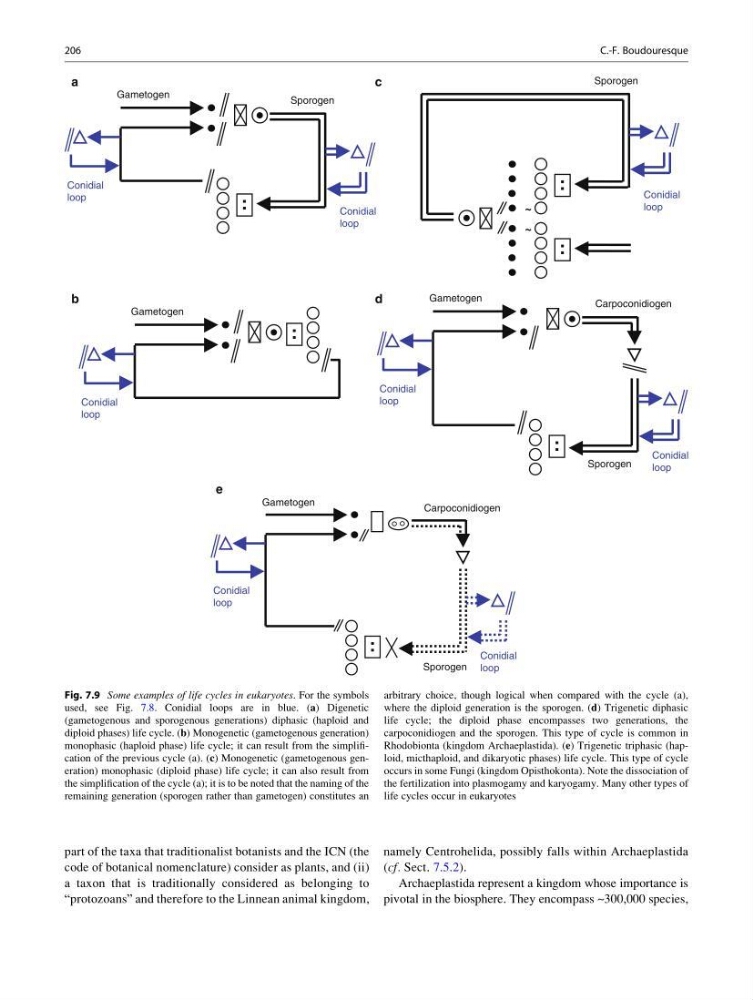
Fig. 7.9 Some examples of life cycles in eukaryotes. For the symbols
used, see Fig. 7.8. Conidial loops are in blue. (a) Digenetic
(gametogenous and sporogenous generations) diphasic (haploid and
diploid phases) life cycle. (b) Monogenetic (gametogenous generation)
monophasic (haploid phase) life cycle; it can result from the simplification of the previous cycle (a). (c) Monogenetic (gametogenous generation) monophasic (diploid phase) life cycle; it can also result from
the simplification of the cycle (a); it is to be noted that the naming of the
remaining generation (sporogen rather than gametogen) constitutes an
arbitrary choice, though logical when compared with the cycle (a),
where the diploid generation is the sporogen. (d) Trigenetic diphasic
life cycle; the diploid phase encompasses two generations, the
carpoconidiogen and the sporogen. This type of cycle is common in
Rhodobionta (kingdom Archaeplastida). (e) Trigenetic triphasic (haploid, micthaploid, and dikaryotic phases) life cycle. This type of cycle
occurs in some Fungi (kingdom Opisthokonta). Note the dissociation of
the fertilization into plasmogamy and karyogamy. Many other types of
life cycles occur in eukaryotes
206
C.-F. Boudouresque
code of botanical nomenclature) consider as plants, and (ii)
a taxon that is traditionally considered as belonging to
“protozoans” and therefore to the Linnean animal kingdom,
namely Centrohelida, possibly falls within Archaeplastida
(cf. Sect. 7.5.2).
Archaeplastida represent a kingdom whose importance is
pivotal in the biosphere. They encompass ~300,000 species,
:
a
Gametogen
Sporogen
Conidial
loop
Conidial
loop
:
b
Gametogen
Conidial
loop
:
:
c
Sporogen
~
~
Conidial
loop
:
d
Sporogen
Gametogen
Carpoconidiogen
Conidial
loop
Conidial
loop
:
e
Carpoconidiogen
Sporogen
Gametogen
Conidial
loop
Conidial
loop
Fig. 7.9 Some examples of life cycles in eukaryotes. For the symbols
used, see Fig. 7.8. Conidial loops are in blue. (a) Digenetic
(gametogenous and sporogenous generations) diphasic (haploid and
diploid phases) life cycle. (b) Monogenetic (gametogenous generation)
monophasic (haploid phase) life cycle; it can result from the simplification of the previous cycle (a). (c) Monogenetic (gametogenous generation) monophasic (diploid phase) life cycle; it can also result from
the simplification of the cycle (a); it is to be noted that the naming of the
remaining generation (sporogen rather than gametogen) constitutes an
arbitrary choice, though logical when compared with the cycle (a),
where the diploid generation is the sporogen. (d) Trigenetic diphasic
life cycle; the diploid phase encompasses two generations, the
carpoconidiogen and the sporogen. This type of cycle is common in
Rhodobionta (kingdom Archaeplastida). (e) Trigenetic triphasic (haploid, micthaploid, and dikaryotic phases) life cycle. This type of cycle
occurs in some Fungi (kingdom Opisthokonta). Note the dissociation of
the fertilization into plasmogamy and karyogamy. Many other types of
life cycles occur in eukaryotes
206
C.-F. Boudouresque