

less than Opisthokonta but more than the other eukaryote
kingdom and are dominant in biomass in the terrestrial realm
where they constitute the basis for landscapes, because of
Embryophyta, e.g. Magnoliophyta, Filicophyta (ferns), and
Bryophyta (mosses). Some terrestrial Magnoliophyta
returned to the marine realm ~100 Ma ago (e.g., the
ancestors of the modern genera Posidonia, Thalassia, and
Zostera). Rhodobionta (“red algae”) and Chlorobionta (part
of the paraphyletic ensemble traditionally called “green
algae”) also belong to Archaeplastida. The inclusion of
Glaucocystobionta is an issue under discussion. As far as
Centrohelida are concerned (Nicolaev et al. 2004), they are
of uncertain taxonomic position and their placement within
Archaeplastida is just a working hypothesis.
Archaeplastida played a prominent role in eukaryote evolution. First, as mentioned above, it is the common ancestor of
Viridiplantae and Rhodobionta, and possibly of Glaucocystobionta, which acquired photosynthesis, due to endosymbiosis
with a cyanobacterium, the latter becoming a chloroplast. This
common ancestor was the first photosynthetic eukaryote, which
had so far only been heterotrophic organisms. Subsequently,
some Archaeplastida, belonging to Rhodobionta and Chlorobionta, founded the photosynthesis in several other eukaryote
kingdoms (e.g., Rhizaria, Alveolata, and Stramenopiles), due to
secondary and tertiary endosymbioses (cf. Sect. 5.4).
In the Archaeplastida configuration adopted here (including Glaucocystobionta and Centrohelida), there are very few
shared characters other than those stemming from molecular
phylogenies. The main shared character in Archaeplastida is
the fine structure of mitochondria, with plate-like flat cristae.
7.5.2 Centrohelida
Centrohelida (also named Centrohelidia, Centroheliozoa,
and Centrohelomonada) were once considered as Heliozoa,
a polyphyletic ensemble whose taxa proved to belong to
e.g. Rhizaria (Heliomonadida) and Stramenopiles
(Actinophryda; cf. Sect. 7.9.1) (Nicolaev et al. 2004). The
evolutionary position of Centrohelida is not clear.
Depending upon the studied genes, phylogenies place
Centrohelida close to Glaucocystobionta and, sometimes,
Rhodobionta (Nicolaev et al. 2004; S ˇ lapeta et al. 2005b;
Moreira et al. 2007) or to Telonemia and Haptobionta
(Yabuki et al. 2010; Burki et al. 2012). The best solution
would probably be to consider Centrohelida as an incertae
sedis
7 taxon (Okamoto and Inouye 2005; Sakaguchi et al.
2007). Several hundreds of species are known.
All Centrohelida are unicellular. Cells are spherical,
around 30–80 μm in diameter, without cell wall and densely
covered with pseudopods named axopods* (slender, raylike
strands of cytoplasm supported internally by a microtubule).
The axopod microtubules arise from a granule named
centroplast, at the center of the cell. A few genera have no
plasmalemma (cytoplasmic membrane) covering, but most
have a coat of scales and spicules; these may be organic or
siliceous and come in various shapes and sizes (Figs. 7.11
and 7.12) (Tregouboff 1953b). The nucleus is non-central.
Mitochondria have plate-like flat cristae (Sakaguchi
et al. 2007), a shared character among Archaeplastida.
Undulipodiums never occur among Centrohelida (CavalierSmith and Chao 2002). Sexual reproduction is unknown.
Centrohelida are non-photosynthetic organisms. Axopods
capture food, unicellular prey, and allow mobile forms to
move about. However, some Centrohelida harbor within
their cytoplasm photosynthetic unicellular symbionts. In
Acanthocystis turfacea, the symbiont belongs to the genus
Chlorella (Viridiplantae). Centrohelida thrive in the marine
and freshwater plankton.
7.5.3 Glaucocystobionta
Glaucocystobionta
(¼Glaucophyta,
Glaucophytes,
Glaucocystophyta, Glaucocystophytes, glaucocystids) is a
taxon of uncertain taxonomic placement. Depending upon
the period and authors, they were included within
Viridiplantae, Rhodobionta, Dinobionta (Alveolata), and
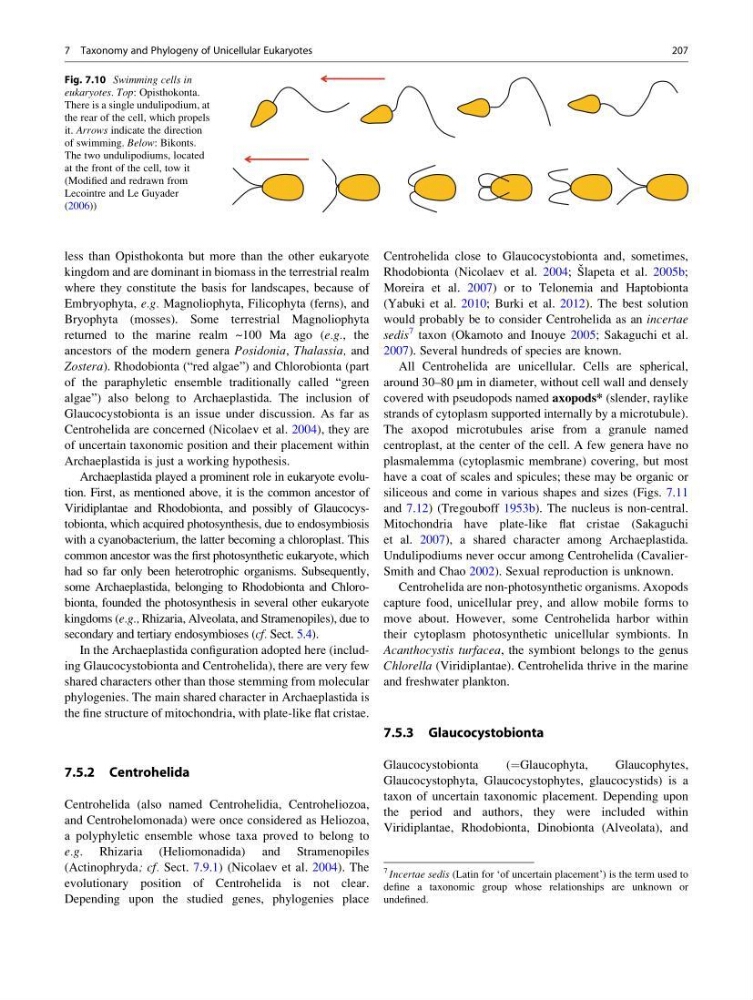
Fig. 7.10 Swimming cells in
eukaryotes. Top: Opisthokonta.
There is a single undulipodium, at
the rear of the cell, which propels
it. Arrows indicate the direction
of swimming. Below: Bikonts.
The two undulipodiums, located
at the front of the cell, tow it
(Modified and redrawn from
Lecointre and Le Guyader
(2006))
7 Incertae sedis (Latin for ‘of uncertain placement’) is the term used to
define a taxonomic group whose relationships are unknown or
undefined.
7 Taxonomy and Phylogeny of Unicellular Eukaryotes
207
kingdom and are dominant in biomass in the terrestrial realm
where they constitute the basis for landscapes, because of
Embryophyta, e.g. Magnoliophyta, Filicophyta (ferns), and
Bryophyta (mosses). Some terrestrial Magnoliophyta
returned to the marine realm ~100 Ma ago (e.g., the
ancestors of the modern genera Posidonia, Thalassia, and
Zostera). Rhodobionta (“red algae”) and Chlorobionta (part
of the paraphyletic ensemble traditionally called “green
algae”) also belong to Archaeplastida. The inclusion of
Glaucocystobionta is an issue under discussion. As far as
Centrohelida are concerned (Nicolaev et al. 2004), they are
of uncertain taxonomic position and their placement within
Archaeplastida is just a working hypothesis.
Archaeplastida played a prominent role in eukaryote evolution. First, as mentioned above, it is the common ancestor of
Viridiplantae and Rhodobionta, and possibly of Glaucocystobionta, which acquired photosynthesis, due to endosymbiosis
with a cyanobacterium, the latter becoming a chloroplast. This
common ancestor was the first photosynthetic eukaryote, which
had so far only been heterotrophic organisms. Subsequently,
some Archaeplastida, belonging to Rhodobionta and Chlorobionta, founded the photosynthesis in several other eukaryote
kingdoms (e.g., Rhizaria, Alveolata, and Stramenopiles), due to
secondary and tertiary endosymbioses (cf. Sect. 5.4).
In the Archaeplastida configuration adopted here (including Glaucocystobionta and Centrohelida), there are very few
shared characters other than those stemming from molecular
phylogenies. The main shared character in Archaeplastida is
the fine structure of mitochondria, with plate-like flat cristae.
7.5.2 Centrohelida
Centrohelida (also named Centrohelidia, Centroheliozoa,
and Centrohelomonada) were once considered as Heliozoa,
a polyphyletic ensemble whose taxa proved to belong to
e.g. Rhizaria (Heliomonadida) and Stramenopiles
(Actinophryda; cf. Sect. 7.9.1) (Nicolaev et al. 2004). The
evolutionary position of Centrohelida is not clear.
Depending upon the studied genes, phylogenies place
Centrohelida close to Glaucocystobionta and, sometimes,
Rhodobionta (Nicolaev et al. 2004; S ˇ lapeta et al. 2005b;
Moreira et al. 2007) or to Telonemia and Haptobionta
(Yabuki et al. 2010; Burki et al. 2012). The best solution
would probably be to consider Centrohelida as an incertae
sedis
7 taxon (Okamoto and Inouye 2005; Sakaguchi et al.
2007). Several hundreds of species are known.
All Centrohelida are unicellular. Cells are spherical,
around 30–80 μm in diameter, without cell wall and densely
covered with pseudopods named axopods* (slender, raylike
strands of cytoplasm supported internally by a microtubule).
The axopod microtubules arise from a granule named
centroplast, at the center of the cell. A few genera have no
plasmalemma (cytoplasmic membrane) covering, but most
have a coat of scales and spicules; these may be organic or
siliceous and come in various shapes and sizes (Figs. 7.11
and 7.12) (Tregouboff 1953b). The nucleus is non-central.
Mitochondria have plate-like flat cristae (Sakaguchi
et al. 2007), a shared character among Archaeplastida.
Undulipodiums never occur among Centrohelida (CavalierSmith and Chao 2002). Sexual reproduction is unknown.
Centrohelida are non-photosynthetic organisms. Axopods
capture food, unicellular prey, and allow mobile forms to
move about. However, some Centrohelida harbor within
their cytoplasm photosynthetic unicellular symbionts. In
Acanthocystis turfacea, the symbiont belongs to the genus
Chlorella (Viridiplantae). Centrohelida thrive in the marine
and freshwater plankton.
7.5.3 Glaucocystobionta
Glaucocystobionta
(¼Glaucophyta,
Glaucophytes,
Glaucocystophyta, Glaucocystophytes, glaucocystids) is a
taxon of uncertain taxonomic placement. Depending upon
the period and authors, they were included within
Viridiplantae, Rhodobionta, Dinobionta (Alveolata), and
Fig. 7.10 Swimming cells in
eukaryotes. Top: Opisthokonta.
There is a single undulipodium, at
the rear of the cell, which propels
it. Arrows indicate the direction
of swimming. Below: Bikonts.
The two undulipodiums, located
at the front of the cell, tow it
(Modified and redrawn from
Lecointre and Le Guyader
(2006))
7 Incertae sedis (Latin for ‘of uncertain placement’) is the term used to
define a taxonomic group whose relationships are unknown or
undefined.
7 Taxonomy and Phylogeny of Unicellular Eukaryotes
207