

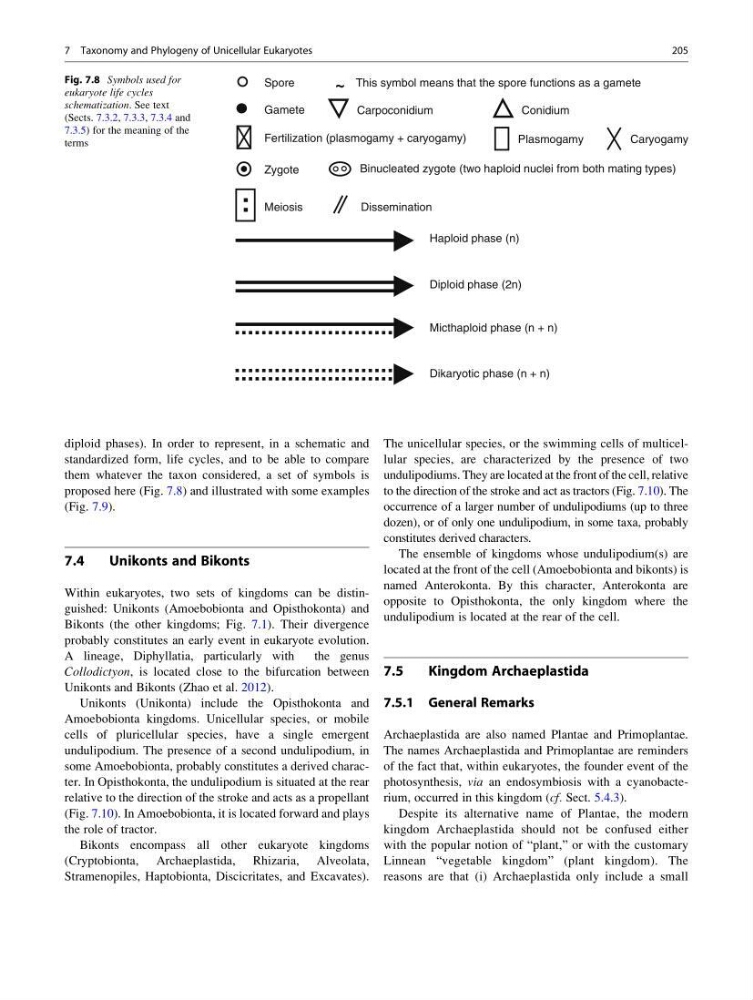
diploid phases). In order to represent, in a schematic and
standardized form, life cycles, and to be able to compare
them whatever the taxon considered, a set of symbols is
proposed here (Fig. 7.8) and illustrated with some examples
(Fig. 7.9).
7.4
Unikonts and Bikonts
Within eukaryotes, two sets of kingdoms can be distinguished: Unikonts (Amoebobionta and Opisthokonta) and
Bikonts (the other kingdoms; Fig. 7.1). Their divergence
probably constitutes an early event in eukaryote evolution.
A lineage, Diphyllatia, particularly with
the genus
Collodictyon, is located close to the bifurcation between
Unikonts and Bikonts (Zhao et al. 2012).
Unikonts (Unikonta) include the Opisthokonta and
Amoebobionta kingdoms. Unicellular species, or mobile
cells of pluricellular species, have a single emergent
undulipodium. The presence of a second undulipodium, in
some Amoebobionta, probably constitutes a derived character. In Opisthokonta, the undulipodium is situated at the rear
relative to the direction of the stroke and acts as a propellant
(Fig. 7.10). In Amoebobionta, it is located forward and plays
the role of tractor.
Bikonts encompass all other eukaryote kingdoms
(Cryptobionta, Archaeplastida, Rhizaria, Alveolata,
Stramenopiles, Haptobionta, Discicritates, and Excavates).
The unicellular species, or the swimming cells of multicellular species, are characterized by the presence of two
undulipodiums. They are located at the front of the cell, relative
to the direction of the stroke and act as tractors (Fig. 7.10). The
occurrence of a larger number of undulipodiums (up to three
dozen), or of only one undulipodium, in some taxa, probably
constitutes derived characters.
The ensemble of kingdoms whose undulipodium(s) are
located at the front of the cell (Amoebobionta and bikonts) is
named Anterokonta. By this character, Anterokonta are
opposite to Opisthokonta, the only kingdom where the
undulipodium is located at the rear of the cell.
7.5
Kingdom Archaeplastida
7.5.1 General Remarks
Archaeplastida are also named Plantae and Primoplantae.
The names Archaeplastida and Primoplantae are reminders
of the fact that, within eukaryotes, the founder event of the
photosynthesis, via an endosymbiosis with a cyanobacterium, occurred in this kingdom (cf. Sect. 5.4.3).
Despite its alternative name of Plantae, the modern
kingdom Archaeplastida should not be confused either
with the popular notion of “plant,” or with the customary
Linnean “vegetable kingdom” (plant kingdom). The
reasons are that (i) Archaeplastida only include a small
Spore
~ This symbol means that the spore functions as a gamete
Gamete
Conidium
Carpoconidium
Fertilization (plasmogamy + caryogamy)
Plasmogamy
Caryogamy
Zygote
Binucleated zygote (two haploid nuclei from both mating types)
Meiosis
:
Dissemination
Haploid phase (n)
Diploid phase (2n)
Micthaploid phase (n + n)
Dikaryotic phase (n + n)
Fig. 7.8 Symbols used for
eukaryote life cycles
schematization. See text
(Sects. 7.3.2, 7.3.3, 7.3.4 and
7.3.5) for the meaning of the
terms
7 Taxonomy and Phylogeny of Unicellular Eukaryotes
205
standardized form, life cycles, and to be able to compare
them whatever the taxon considered, a set of symbols is
proposed here (Fig. 7.8) and illustrated with some examples
(Fig. 7.9).
7.4
Unikonts and Bikonts
Within eukaryotes, two sets of kingdoms can be distinguished: Unikonts (Amoebobionta and Opisthokonta) and
Bikonts (the other kingdoms; Fig. 7.1). Their divergence
probably constitutes an early event in eukaryote evolution.
A lineage, Diphyllatia, particularly with
the genus
Collodictyon, is located close to the bifurcation between
Unikonts and Bikonts (Zhao et al. 2012).
Unikonts (Unikonta) include the Opisthokonta and
Amoebobionta kingdoms. Unicellular species, or mobile
cells of pluricellular species, have a single emergent
undulipodium. The presence of a second undulipodium, in
some Amoebobionta, probably constitutes a derived character. In Opisthokonta, the undulipodium is situated at the rear
relative to the direction of the stroke and acts as a propellant
(Fig. 7.10). In Amoebobionta, it is located forward and plays
the role of tractor.
Bikonts encompass all other eukaryote kingdoms
(Cryptobionta, Archaeplastida, Rhizaria, Alveolata,
Stramenopiles, Haptobionta, Discicritates, and Excavates).
The unicellular species, or the swimming cells of multicellular species, are characterized by the presence of two
undulipodiums. They are located at the front of the cell, relative
to the direction of the stroke and act as tractors (Fig. 7.10). The
occurrence of a larger number of undulipodiums (up to three
dozen), or of only one undulipodium, in some taxa, probably
constitutes derived characters.
The ensemble of kingdoms whose undulipodium(s) are
located at the front of the cell (Amoebobionta and bikonts) is
named Anterokonta. By this character, Anterokonta are
opposite to Opisthokonta, the only kingdom where the
undulipodium is located at the rear of the cell.
7.5
Kingdom Archaeplastida
7.5.1 General Remarks
Archaeplastida are also named Plantae and Primoplantae.
The names Archaeplastida and Primoplantae are reminders
of the fact that, within eukaryotes, the founder event of the
photosynthesis, via an endosymbiosis with a cyanobacterium, occurred in this kingdom (cf. Sect. 5.4.3).
Despite its alternative name of Plantae, the modern
kingdom Archaeplastida should not be confused either
with the popular notion of “plant,” or with the customary
Linnean “vegetable kingdom” (plant kingdom). The
reasons are that (i) Archaeplastida only include a small
Spore
~ This symbol means that the spore functions as a gamete
Gamete
Conidium
Carpoconidium
Fertilization (plasmogamy + caryogamy)
Plasmogamy
Caryogamy
Zygote
Binucleated zygote (two haploid nuclei from both mating types)
Meiosis
:
Dissemination
Haploid phase (n)
Diploid phase (2n)
Micthaploid phase (n + n)
Dikaryotic phase (n + n)
Fig. 7.8 Symbols used for
eukaryote life cycles
schematization. See text
(Sects. 7.3.2, 7.3.3, 7.3.4 and
7.3.5) for the meaning of the
terms
7 Taxonomy and Phylogeny of Unicellular Eukaryotes
205