

Generations are named after the reproductive elements they
produce (Table 7.3). The gametogenous generation (hereafter
“gametogen*”) produces gametes, the sporogenous generation
(hereafter “sporogen*”) produces spores and the carpoconidiogenous generation (hereafter “carpoconidiogen*”)
produces carpoconidia.
6
A phase* is a part of a life cycle characterized by a type
of nuclear structure (ploidy), namely haploid (n), diploid
(2n), micthaploid, and dikaryotic (n + n) (Fig. 7.5).
A phase can encompass one or several generations.
For example, in the life cycle of most Rhodobionta (kingdom Archaeplastida), the diploid phase comprises two
generations, the carpoconidiogen and the sporogen
(Fig. 7.9d).
Overall, a life cycle can encompass one, two, or three
generations. Such life cycles are named monogenetic, digenetic, and trigenetic, respectively. Life cycles having a larger
number of generations (up to 11) do exist, but they are
anecdotal and do not apply to unicellular eukaryotes, with
very few exceptions. Similarly, a life cycle can encompass
one, two, or three of the ploidic phases, n, 2n, and n + n;
they are named monophasic, diphasic, and triphasic, respectively. For example, the life cycle of Rhodobionta (kingdom
Archaeplastida) is generally trigenetic (gametogen,
carpoconidiogen, and sporogen) and diphasic (haploid and
Gametogeneous generation
(‘gametogen’) - (n)
a
b
Sporogenous
generation
(‘sporogen’) (n + n)
Gametogeneous generation
(‘gametogen’) + (n)
c
d
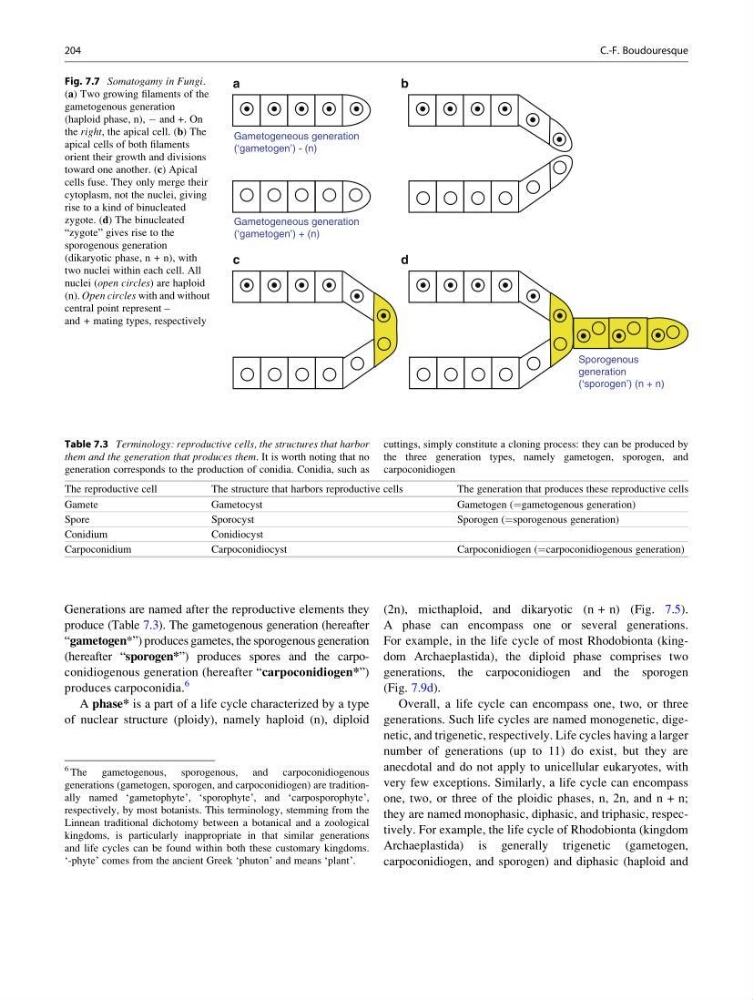
Fig. 7.7 Somatogamy in Fungi.
(a) Two growing filaments of the
gametogenous generation
(haploid phase, n), À and +. On
the right, the apical cell. (b) The
apical cells of both filaments
orient their growth and divisions
toward one another. (c) Apical
cells fuse. They only merge their
cytoplasm, not the nuclei, giving
rise to a kind of binucleated
zygote. (d) The binucleated
“zygote” gives rise to the
sporogenous generation
(dikaryotic phase, n + n), with
two nuclei within each cell. All
nuclei (open circles) are haploid
(n). Open circles with and without
central point represent –
and + mating types, respectively
Table 7.3 Terminology: reproductive cells, the structures that harbor
them and the generation that produces them. It is worth noting that no
generation corresponds to the production of conidia. Conidia, such as
cuttings, simply constitute a cloning process: they can be produced by
the three generation types, namely gametogen, sporogen, and
carpoconidiogen
The reproductive cell
The structure that harbors reproductive cells
The generation that produces these reproductive cells
Gamete
Gametocyst
Gametogen (¼gametogenous generation)
Spore
Sporocyst
Sporogen (¼sporogenous generation)
Conidium
Conidiocyst
Carpoconidium
Carpoconidiocyst
Carpoconidiogen (¼carpoconidiogenous generation)
6 The gametogenous, sporogenous, and carpoconidiogenous
generations (gametogen, sporogen, and carpoconidiogen) are traditionally named ‘gametophyte’, ‘sporophyte’, and ‘carposporophyte’,
respectively, by most botanists. This terminology, stemming from the
Linnean traditional dichotomy between a botanical and a zoological
kingdoms, is particularly inappropriate in that similar generations
and life cycles can be found within both these customary kingdoms.
‘-phyte’ comes from the ancient Greek ‘phuton’ and means ‘plant’.
204
C.-F. Boudouresque
produce (Table 7.3). The gametogenous generation (hereafter
“gametogen*”) produces gametes, the sporogenous generation
(hereafter “sporogen*”) produces spores and the carpoconidiogenous generation (hereafter “carpoconidiogen*”)
produces carpoconidia.
6
A phase* is a part of a life cycle characterized by a type
of nuclear structure (ploidy), namely haploid (n), diploid
(2n), micthaploid, and dikaryotic (n + n) (Fig. 7.5).
A phase can encompass one or several generations.
For example, in the life cycle of most Rhodobionta (kingdom Archaeplastida), the diploid phase comprises two
generations, the carpoconidiogen and the sporogen
(Fig. 7.9d).
Overall, a life cycle can encompass one, two, or three
generations. Such life cycles are named monogenetic, digenetic, and trigenetic, respectively. Life cycles having a larger
number of generations (up to 11) do exist, but they are
anecdotal and do not apply to unicellular eukaryotes, with
very few exceptions. Similarly, a life cycle can encompass
one, two, or three of the ploidic phases, n, 2n, and n + n;
they are named monophasic, diphasic, and triphasic, respectively. For example, the life cycle of Rhodobionta (kingdom
Archaeplastida) is generally trigenetic (gametogen,
carpoconidiogen, and sporogen) and diphasic (haploid and
Gametogeneous generation
(‘gametogen’) - (n)
a
b
Sporogenous
generation
(‘sporogen’) (n + n)
Gametogeneous generation
(‘gametogen’) + (n)
c
d
Fig. 7.7 Somatogamy in Fungi.
(a) Two growing filaments of the
gametogenous generation
(haploid phase, n), À and +. On
the right, the apical cell. (b) The
apical cells of both filaments
orient their growth and divisions
toward one another. (c) Apical
cells fuse. They only merge their
cytoplasm, not the nuclei, giving
rise to a kind of binucleated
zygote. (d) The binucleated
“zygote” gives rise to the
sporogenous generation
(dikaryotic phase, n + n), with
two nuclei within each cell. All
nuclei (open circles) are haploid
(n). Open circles with and without
central point represent –
and + mating types, respectively
Table 7.3 Terminology: reproductive cells, the structures that harbor
them and the generation that produces them. It is worth noting that no
generation corresponds to the production of conidia. Conidia, such as
cuttings, simply constitute a cloning process: they can be produced by
the three generation types, namely gametogen, sporogen, and
carpoconidiogen
The reproductive cell
The structure that harbors reproductive cells
The generation that produces these reproductive cells
Gamete
Gametocyst
Gametogen (¼gametogenous generation)
Spore
Sporocyst
Sporogen (¼sporogenous generation)
Conidium
Conidiocyst
Carpoconidium
Carpoconidiocyst
Carpoconidiogen (¼carpoconidiogenous generation)
6 The gametogenous, sporogenous, and carpoconidiogenous
generations (gametogen, sporogen, and carpoconidiogen) are traditionally named ‘gametophyte’, ‘sporophyte’, and ‘carposporophyte’,
respectively, by most botanists. This terminology, stemming from the
Linnean traditional dichotomy between a botanical and a zoological
kingdoms, is particularly inappropriate in that similar generations
and life cycles can be found within both these customary kingdoms.
‘-phyte’ comes from the ancient Greek ‘phuton’ and means ‘plant’.
204
C.-F. Boudouresque