

Male gamete disseminated and non-mobile,
female gamete non-disseminated, without
trichogyne: protrichogamy
Male gametogen (n)
Male
gametes
Female gametogen (n)
Female
gamete
Male gamete disseminated and non-mobile,
female gamete non-disseminated, with a
trichogyne: trichogamy
Trichogyne
Female gametogen (n)
Male gametogen (n)
Male
gametes
Female
gamete
a
b
Male gametogen (n)
Female gametogen (n)
Male gametocyst
Male
gametes
Female
gamete
Male gametogen (n)
Female gametogen (n)
Male gametocyst
Male
gametes
Female
gamete
Male gamete disseminated and mobile, Female
gamete non disseminated: oogamy
Male gamete disseminated and mobile, female
gamete disseminated and non-mobile: fucogamy
d
c
Male gametogen (n)
Female gametogen (n)
Male gametes
Female gametes
Male and female gametes disseminated and
mobile (undulipodiums): planogamy
Male gametogen (n)
Female gametogen (n)
Male
gamete
Female
gamete
Male and female gametes non-disseminated.
These are individuals that get close together:
cystogamy
e
f
Male
gametocyst
Female
gametocyst
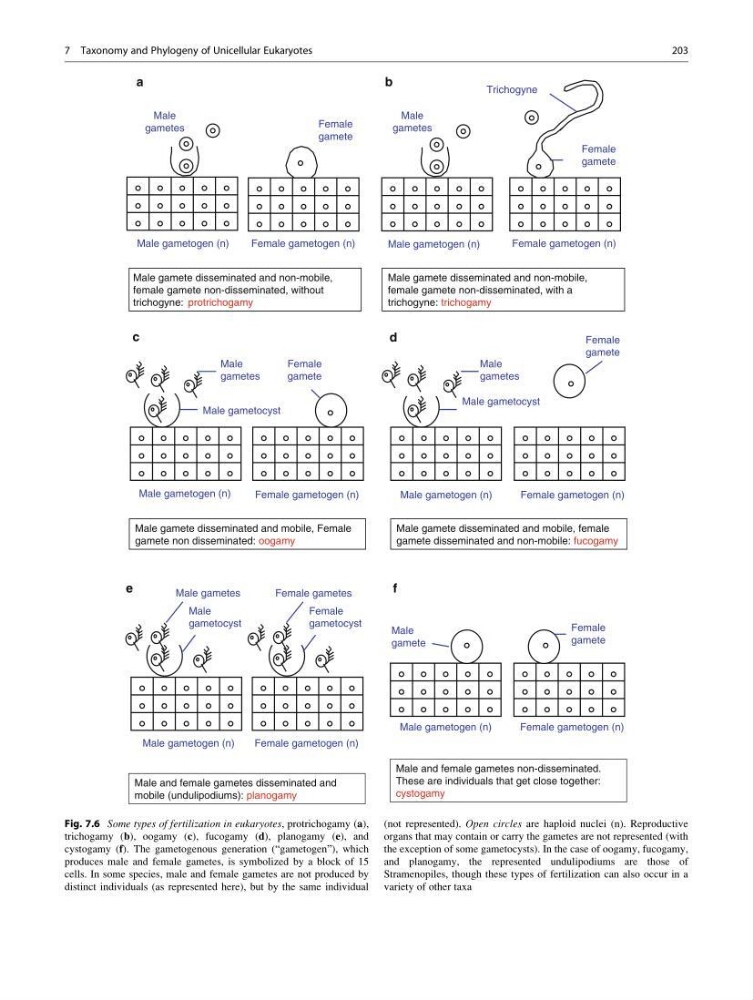
Fig. 7.6 Some types of fertilization in eukaryotes, protrichogamy (a),
trichogamy (b), oogamy (c), fucogamy (d), planogamy (e), and
cystogamy (f). The gametogenous generation (“gametogen”), which
produces male and female gametes, is symbolized by a block of 15
cells. In some species, male and female gametes are not produced by
distinct individuals (as represented here), but by the same individual
(not represented). Open circles are haploid nuclei (n). Reproductive
organs that may contain or carry the gametes are not represented (with
the exception of some gametocysts). In the case of oogamy, fucogamy,
and planogamy, the represented undulipodiums are those of
Stramenopiles, though these types of fertilization can also occur in a
variety of other taxa
7 Taxonomy and Phylogeny of Unicellular Eukaryotes
203
female gamete non-disseminated, without
trichogyne: protrichogamy
Male gametogen (n)
Male
gametes
Female gametogen (n)
Female
gamete
Male gamete disseminated and non-mobile,
female gamete non-disseminated, with a
trichogyne: trichogamy
Trichogyne
Female gametogen (n)
Male gametogen (n)
Male
gametes
Female
gamete
a
b
Male gametogen (n)
Female gametogen (n)
Male gametocyst
Male
gametes
Female
gamete
Male gametogen (n)
Female gametogen (n)
Male gametocyst
Male
gametes
Female
gamete
Male gamete disseminated and mobile, Female
gamete non disseminated: oogamy
Male gamete disseminated and mobile, female
gamete disseminated and non-mobile: fucogamy
d
c
Male gametogen (n)
Female gametogen (n)
Male gametes
Female gametes
Male and female gametes disseminated and
mobile (undulipodiums): planogamy
Male gametogen (n)
Female gametogen (n)
Male
gamete
Female
gamete
Male and female gametes non-disseminated.
These are individuals that get close together:
cystogamy
e
f
Male
gametocyst
Female
gametocyst
Fig. 7.6 Some types of fertilization in eukaryotes, protrichogamy (a),
trichogamy (b), oogamy (c), fucogamy (d), planogamy (e), and
cystogamy (f). The gametogenous generation (“gametogen”), which
produces male and female gametes, is symbolized by a block of 15
cells. In some species, male and female gametes are not produced by
distinct individuals (as represented here), but by the same individual
(not represented). Open circles are haploid nuclei (n). Reproductive
organs that may contain or carry the gametes are not represented (with
the exception of some gametocysts). In the case of oogamy, fucogamy,
and planogamy, the represented undulipodiums are those of
Stramenopiles, though these types of fertilization can also occur in a
variety of other taxa
7 Taxonomy and Phylogeny of Unicellular Eukaryotes
203