

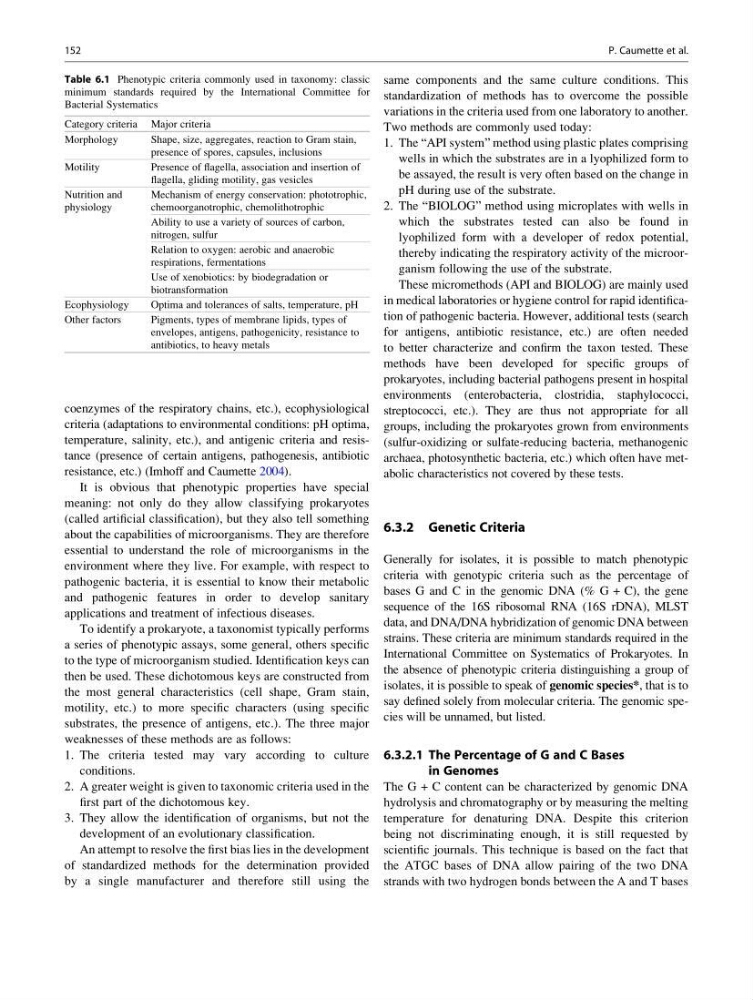
coenzymes of the respiratory chains, etc.), ecophysiological
criteria (adaptations to environmental conditions: pH optima,
temperature, salinity, etc.), and antigenic criteria and resistance (presence of certain antigens, pathogenesis, antibiotic
resistance, etc.) (Imhoff and Caumette 2004).
It is obvious that phenotypic properties have special
meaning: not only do they allow classifying prokaryotes
(called artificial classification), but they also tell something
about the capabilities of microorganisms. They are therefore
essential to understand the role of microorganisms in the
environment where they live. For example, with respect to
pathogenic bacteria, it is essential to know their metabolic
and pathogenic features in order to develop sanitary
applications and treatment of infectious diseases.
To identify a prokaryote, a taxonomist typically performs
a series of phenotypic assays, some general, others specific
to the type of microorganism studied. Identification keys can
then be used. These dichotomous keys are constructed from
the most general characteristics (cell shape, Gram stain,
motility, etc.) to more specific characters (using specific
substrates, the presence of antigens, etc.). The three major
weaknesses of these methods are as follows:
1. The criteria tested may vary according to culture
conditions.
2. A greater weight is given to taxonomic criteria used in the
first part of the dichotomous key.
3. They allow the identification of organisms, but not the
development of an evolutionary classification.
An attempt to resolve the first bias lies in the development
of standardized methods for the determination provided
by a single manufacturer and therefore still using the
same components and the same culture conditions. This
standardization of methods has to overcome the possible
variations in the criteria used from one laboratory to another.
Two methods are commonly used today:
1. The “API system” method using plastic plates comprising
wells in which the substrates are in a lyophilized form to
be assayed, the result is very often based on the change in
pH during use of the substrate.
2. The “BIOLOG” method using microplates with wells in
which the substrates tested can also be found in
lyophilized form with a developer of redox potential,
thereby indicating the respiratory activity of the microorganism following the use of the substrate.
These micromethods (API and BIOLOG) are mainly used
in medical laboratories or hygiene control for rapid identification of pathogenic bacteria. However, additional tests (search
for antigens, antibiotic resistance, etc.) are often needed
to better characterize and confirm the taxon tested. These
methods have been developed for specific groups of
prokaryotes, including bacterial pathogens present in hospital
environments (enterobacteria, clostridia, staphylococci,
streptococci, etc.). They are thus not appropriate for all
groups, including the prokaryotes grown from environments
(sulfur-oxidizing or sulfate-reducing bacteria, methanogenic
archaea, photosynthetic bacteria, etc.) which often have metabolic characteristics not covered by these tests.
6.3.2 Genetic Criteria
Generally for isolates, it is possible to match phenotypic
criteria with genotypic criteria such as the percentage of
bases G and C in the genomic DNA (% G + C), the gene
sequence of the 16S ribosomal RNA (16S rDNA), MLST
data, and DNA/DNA hybridization of genomic DNA between
strains. These criteria are minimum standards required in the
International Committee on Systematics of Prokaryotes. In
the absence of phenotypic criteria distinguishing a group of
isolates, it is possible to speak of genomic species*, that is to
say defined solely from molecular criteria. The genomic species will be unnamed, but listed.
6.3.2.1 The Percentage of G and C Bases
in Genomes
The G + C content can be characterized by genomic DNA
hydrolysis and chromatography or by measuring the melting
temperature for denaturing DNA. Despite this criterion
being not discriminating enough, it is still requested by
scientific journals. This technique is based on the fact that
the ATGC bases of DNA allow pairing of the two DNA
strands with two hydrogen bonds between the A and T bases
Table 6.1 Phenotypic criteria commonly used in taxonomy: classic
minimum standards required by the International Committee for
Bacterial Systematics
Category criteria Major criteria
Morphology
Shape, size, aggregates, reaction to Gram stain,
presence of spores, capsules, inclusions
Motility
Presence of flagella, association and insertion of
flagella, gliding motility, gas vesicles
Nutrition and
physiology
Mechanism of energy conservation: phototrophic,
chemoorganotrophic, chemolithotrophic
Ability to use a variety of sources of carbon,
nitrogen, sulfur
Relation to oxygen: aerobic and anaerobic
respirations, fermentations
Use of xenobiotics: by biodegradation or
biotransformation
Ecophysiology
Optima and tolerances of salts, temperature, pH
Other factors
Pigments, types of membrane lipids, types of
envelopes, antigens, pathogenicity, resistance to
antibiotics, to heavy metals
152
P. Caumette et al.
criteria (adaptations to environmental conditions: pH optima,
temperature, salinity, etc.), and antigenic criteria and resistance (presence of certain antigens, pathogenesis, antibiotic
resistance, etc.) (Imhoff and Caumette 2004).
It is obvious that phenotypic properties have special
meaning: not only do they allow classifying prokaryotes
(called artificial classification), but they also tell something
about the capabilities of microorganisms. They are therefore
essential to understand the role of microorganisms in the
environment where they live. For example, with respect to
pathogenic bacteria, it is essential to know their metabolic
and pathogenic features in order to develop sanitary
applications and treatment of infectious diseases.
To identify a prokaryote, a taxonomist typically performs
a series of phenotypic assays, some general, others specific
to the type of microorganism studied. Identification keys can
then be used. These dichotomous keys are constructed from
the most general characteristics (cell shape, Gram stain,
motility, etc.) to more specific characters (using specific
substrates, the presence of antigens, etc.). The three major
weaknesses of these methods are as follows:
1. The criteria tested may vary according to culture
conditions.
2. A greater weight is given to taxonomic criteria used in the
first part of the dichotomous key.
3. They allow the identification of organisms, but not the
development of an evolutionary classification.
An attempt to resolve the first bias lies in the development
of standardized methods for the determination provided
by a single manufacturer and therefore still using the
same components and the same culture conditions. This
standardization of methods has to overcome the possible
variations in the criteria used from one laboratory to another.
Two methods are commonly used today:
1. The “API system” method using plastic plates comprising
wells in which the substrates are in a lyophilized form to
be assayed, the result is very often based on the change in
pH during use of the substrate.
2. The “BIOLOG” method using microplates with wells in
which the substrates tested can also be found in
lyophilized form with a developer of redox potential,
thereby indicating the respiratory activity of the microorganism following the use of the substrate.
These micromethods (API and BIOLOG) are mainly used
in medical laboratories or hygiene control for rapid identification of pathogenic bacteria. However, additional tests (search
for antigens, antibiotic resistance, etc.) are often needed
to better characterize and confirm the taxon tested. These
methods have been developed for specific groups of
prokaryotes, including bacterial pathogens present in hospital
environments (enterobacteria, clostridia, staphylococci,
streptococci, etc.). They are thus not appropriate for all
groups, including the prokaryotes grown from environments
(sulfur-oxidizing or sulfate-reducing bacteria, methanogenic
archaea, photosynthetic bacteria, etc.) which often have metabolic characteristics not covered by these tests.
6.3.2 Genetic Criteria
Generally for isolates, it is possible to match phenotypic
criteria with genotypic criteria such as the percentage of
bases G and C in the genomic DNA (% G + C), the gene
sequence of the 16S ribosomal RNA (16S rDNA), MLST
data, and DNA/DNA hybridization of genomic DNA between
strains. These criteria are minimum standards required in the
International Committee on Systematics of Prokaryotes. In
the absence of phenotypic criteria distinguishing a group of
isolates, it is possible to speak of genomic species*, that is to
say defined solely from molecular criteria. The genomic species will be unnamed, but listed.
6.3.2.1 The Percentage of G and C Bases
in Genomes
The G + C content can be characterized by genomic DNA
hydrolysis and chromatography or by measuring the melting
temperature for denaturing DNA. Despite this criterion
being not discriminating enough, it is still requested by
scientific journals. This technique is based on the fact that
the ATGC bases of DNA allow pairing of the two DNA
strands with two hydrogen bonds between the A and T bases
Table 6.1 Phenotypic criteria commonly used in taxonomy: classic
minimum standards required by the International Committee for
Bacterial Systematics
Category criteria Major criteria
Morphology
Shape, size, aggregates, reaction to Gram stain,
presence of spores, capsules, inclusions
Motility
Presence of flagella, association and insertion of
flagella, gliding motility, gas vesicles
Nutrition and
physiology
Mechanism of energy conservation: phototrophic,
chemoorganotrophic, chemolithotrophic
Ability to use a variety of sources of carbon,
nitrogen, sulfur
Relation to oxygen: aerobic and anaerobic
respirations, fermentations
Use of xenobiotics: by biodegradation or
biotransformation
Ecophysiology
Optima and tolerances of salts, temperature, pH
Other factors
Pigments, types of membrane lipids, types of
envelopes, antigens, pathogenicity, resistance to
antibiotics, to heavy metals
152
P. Caumette et al.