

kleptoplasty is to be considered (cf. Sect. 5.4.4). It is not
possible to review all the other characters, especially the
cytological (e.g., cell wall) and biochemical (e.g., cellulose)
ones that the tradition has associated with the notion of plant:
none is discriminant enough. Overall, it is impossible to give
an accurate definition to the word “plant.”
14 Moreover, the
continuum of characters that traditionally is attributed to a
“typical” plant and to a “typical” animal can be observed
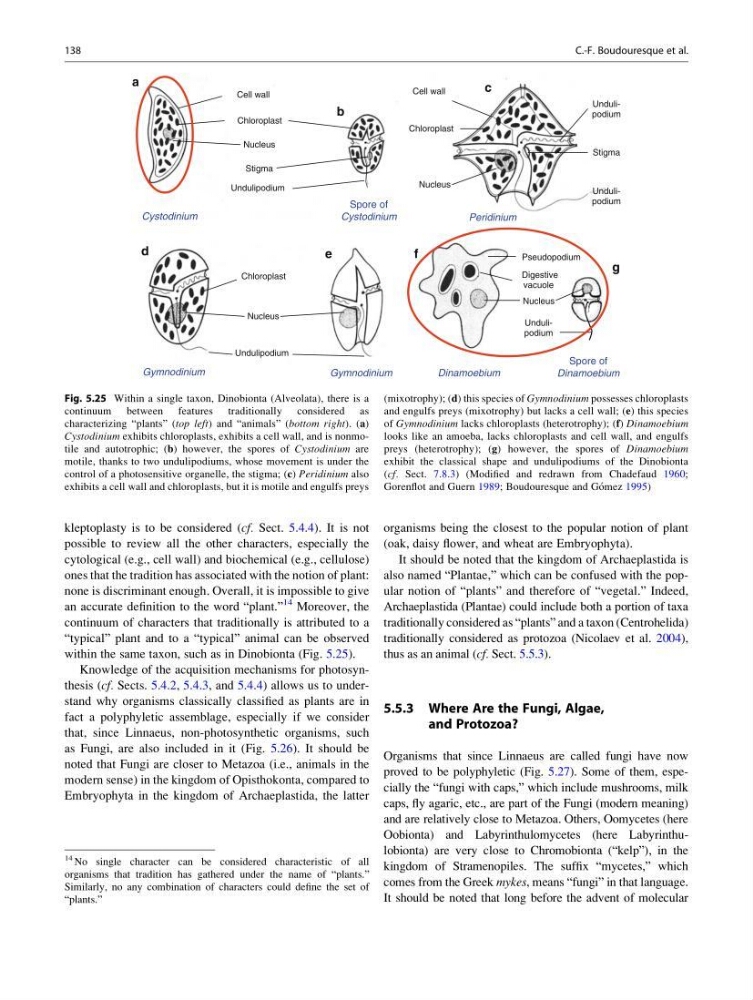
within the same taxon, such as in Dinobionta (Fig. 5.25).
Knowledge of the acquisition mechanisms for photosynthesis (cf. Sects. 5.4.2, 5.4.3, and 5.4.4) allows us to understand why organisms classically classified as plants are in
fact a polyphyletic assemblage, especially if we consider
that, since Linnaeus, non-photosynthetic organisms, such
as Fungi, are also included in it (Fig. 5.26). It should be
noted that Fungi are closer to Metazoa (i.e., animals in the
modern sense) in the kingdom of Opisthokonta, compared to
Embryophyta in the kingdom of Archaeplastida, the latter
organisms being the closest to the popular notion of plant
(oak, daisy flower, and wheat are Embryophyta).
It should be noted that the kingdom of Archaeplastida is
also named “Plantae,” which can be confused with the popular notion of “plants” and therefore of “vegetal.” Indeed,
Archaeplastida (Plantae) could include both a portion of taxa
traditionally considered as “plants” and a taxon (Centrohelida)
traditionally considered as protozoa (Nicolaev et al. 2004),
thus as an animal (cf. Sect. 5.5.3).
5.5.3 Where Are the Fungi, Algae,
and Protozoa?
Organisms that since Linnaeus are called fungi have now
proved to be polyphyletic (Fig. 5.27). Some of them, especially the “fungi with caps,” which include mushrooms, milk
caps, fly agaric, etc., are part of the Fungi (modern meaning)
and are relatively close to Metazoa. Others, Oomycetes (here
Oobionta) and Labyrinthulomycetes (here Labyrinthulobionta) are very close to Chromobionta (“kelp”), in the
kingdom of Stramenopiles. The suffix “mycetes,” which
comes from the Greek mykes, means “fungi” in that language.
It should be noted that long before the advent of molecular
Cell wall
Chloroplast
Nucleus
Stigma
Cystodinium
a
c
b
Spore of
Cystodinium
Undulipodium
Chloroplast
Cell wall
Nucleus
Undulipodium
Stigma
Undulipodium
Peridinium
Gymnodinium
d
Nucleus
Chloroplast
Undulipodium
e
Gymnodinium
f
Dinamoebium
Spore of
Dinamoebium
Nucleus
Digestive
vacuole
Pseudopodium
.
Undulipodium
g
Fig. 5.25 Within a single taxon, Dinobionta (Alveolata), there is a
continuum between features traditionally considered as
characterizing “plants” (top left) and “animals” (bottom right). (a)
Cystodinium exhibits chloroplasts, exhibits a cell wall, and is nonmotile and autotrophic; (b) however, the spores of Cystodinium are
motile, thanks to two undulipodiums, whose movement is under the
control of a photosensitive organelle, the stigma; (c) Peridinium also
exhibits a cell wall and chloroplasts, but it is motile and engulfs preys
(mixotrophy); (d) this species of Gymnodinium possesses chloroplasts
and engulfs preys (mixotrophy) but lacks a cell wall; (e) this species
of Gymnodinium lacks chloroplasts (heterotrophy); (f) Dinamoebium
looks like an amoeba, lacks chloroplasts and cell wall, and engulfs
preys (heterotrophy); (g) however, the spores of Dinamoebium
exhibit the classical shape and undulipodiums of the Dinobionta
(cf. Sect. 7.8.3) (Modified and redrawn from Chadefaud 1960;
Gorenflot and Guern 1989; Boudouresque and Go ´mez 1995)
14 No single character can be considered characteristic of all
organisms that tradition has gathered under the name of “plants.”
Similarly, no any combination of characters could define the set of
“plants.”
138
C.-F. Boudouresque et al.
possible to review all the other characters, especially the
cytological (e.g., cell wall) and biochemical (e.g., cellulose)
ones that the tradition has associated with the notion of plant:
none is discriminant enough. Overall, it is impossible to give
an accurate definition to the word “plant.”
14 Moreover, the
continuum of characters that traditionally is attributed to a
“typical” plant and to a “typical” animal can be observed
within the same taxon, such as in Dinobionta (Fig. 5.25).
Knowledge of the acquisition mechanisms for photosynthesis (cf. Sects. 5.4.2, 5.4.3, and 5.4.4) allows us to understand why organisms classically classified as plants are in
fact a polyphyletic assemblage, especially if we consider
that, since Linnaeus, non-photosynthetic organisms, such
as Fungi, are also included in it (Fig. 5.26). It should be
noted that Fungi are closer to Metazoa (i.e., animals in the
modern sense) in the kingdom of Opisthokonta, compared to
Embryophyta in the kingdom of Archaeplastida, the latter
organisms being the closest to the popular notion of plant
(oak, daisy flower, and wheat are Embryophyta).
It should be noted that the kingdom of Archaeplastida is
also named “Plantae,” which can be confused with the popular notion of “plants” and therefore of “vegetal.” Indeed,
Archaeplastida (Plantae) could include both a portion of taxa
traditionally considered as “plants” and a taxon (Centrohelida)
traditionally considered as protozoa (Nicolaev et al. 2004),
thus as an animal (cf. Sect. 5.5.3).
5.5.3 Where Are the Fungi, Algae,
and Protozoa?
Organisms that since Linnaeus are called fungi have now
proved to be polyphyletic (Fig. 5.27). Some of them, especially the “fungi with caps,” which include mushrooms, milk
caps, fly agaric, etc., are part of the Fungi (modern meaning)
and are relatively close to Metazoa. Others, Oomycetes (here
Oobionta) and Labyrinthulomycetes (here Labyrinthulobionta) are very close to Chromobionta (“kelp”), in the
kingdom of Stramenopiles. The suffix “mycetes,” which
comes from the Greek mykes, means “fungi” in that language.
It should be noted that long before the advent of molecular
Cell wall
Chloroplast
Nucleus
Stigma
Cystodinium
a
c
b
Spore of
Cystodinium
Undulipodium
Chloroplast
Cell wall
Nucleus
Undulipodium
Stigma
Undulipodium
Peridinium
Gymnodinium
d
Nucleus
Chloroplast
Undulipodium
e
Gymnodinium
f
Dinamoebium
Spore of
Dinamoebium
Nucleus
Digestive
vacuole
Pseudopodium
.
Undulipodium
g
Fig. 5.25 Within a single taxon, Dinobionta (Alveolata), there is a
continuum between features traditionally considered as
characterizing “plants” (top left) and “animals” (bottom right). (a)
Cystodinium exhibits chloroplasts, exhibits a cell wall, and is nonmotile and autotrophic; (b) however, the spores of Cystodinium are
motile, thanks to two undulipodiums, whose movement is under the
control of a photosensitive organelle, the stigma; (c) Peridinium also
exhibits a cell wall and chloroplasts, but it is motile and engulfs preys
(mixotrophy); (d) this species of Gymnodinium possesses chloroplasts
and engulfs preys (mixotrophy) but lacks a cell wall; (e) this species
of Gymnodinium lacks chloroplasts (heterotrophy); (f) Dinamoebium
looks like an amoeba, lacks chloroplasts and cell wall, and engulfs
preys (heterotrophy); (g) however, the spores of Dinamoebium
exhibit the classical shape and undulipodiums of the Dinobionta
(cf. Sect. 7.8.3) (Modified and redrawn from Chadefaud 1960;
Gorenflot and Guern 1989; Boudouresque and Go ´mez 1995)
14 No single character can be considered characteristic of all
organisms that tradition has gathered under the name of “plants.”
Similarly, no any combination of characters could define the set of
“plants.”
138
C.-F. Boudouresque et al.