

(i.e., “Where Are the Plants?” cf. Sect. 5.5.2 and “Where
Are the Fungi, Algae, and Protozoa?”; cf. Sect. 5.5.3) are
presented hereafter.
5.5.2 Where Are the Plants?
Intuitively, a plant is motionless while an animal is motile.
Linnaeus, in the eighteenth century, has formalized these
concepts by using the names of plant kingdom and animal
kingdom. But in fact, things are much more complicated.
First of all, there are fixed, nonmobile animals (sponges,
corals). In addition, many organisms that are placed more or
less intuitively among plants can move from one place to
another. Cyanobacteria crawl on the substrate, same for the
diatoms Navicula radiosa and Rhoicosphenia abbreviata
(Chromobionta), the latter species moving at a rate of
2 cm.h
À1 with directional shifts (Bertrand 1991, 1992).
Spirogyra, a filamentous Viridiplantae, propels itself into
water at a speed of 3–5 cm.h
À1 (Kim et al. 2005).
Unicellulars equipped with undulipodia such as
Chlamydomonas (Viridiplantae) and Dinobionta (Alveolata)
are faster, reaching speeds of 72–180 cm.h
À1 , which is
considerable if one refers to their size (Raven and
Richardson 1984).
Neither autotrophy nor the presence of chloroplasts
constitutes shared characters among the living things traditionally known as plants. In all taxa where photosynthesis
occurs, some taxa do not possess it (e.g., in Cyanobacteria
and Dinobionta). In some taxa, this loss is secondary, but this
is not the case of Fungi (modern meaning). Conversely, the
case of non-photosynthetic organisms that practice
Nanoarchaeota
Crenarchaeota
Euryarchaeota
ARCHAEA
Metazoa
Fungi
Archaeplastida
Excavates, Discicristates,
Chromalveolata
EUKARYA
Firmicutes
Planctomycetes
Spirochaetes
Actinobacteria
Fibrobacteres, Chlorobi, Bacteroidetes
BACTERIA
Chlamidiae
Deinococcales, Chloroflexi, Aquificae, Thermotogae, Fusobacteria
Cyanobacteria
Acidobacteria
Delta- epsilonproteobacteria
Alphaproteobacteria
Betaproteobacteria
Gammaproteobacteria
BACTERIA
0,1 substitution
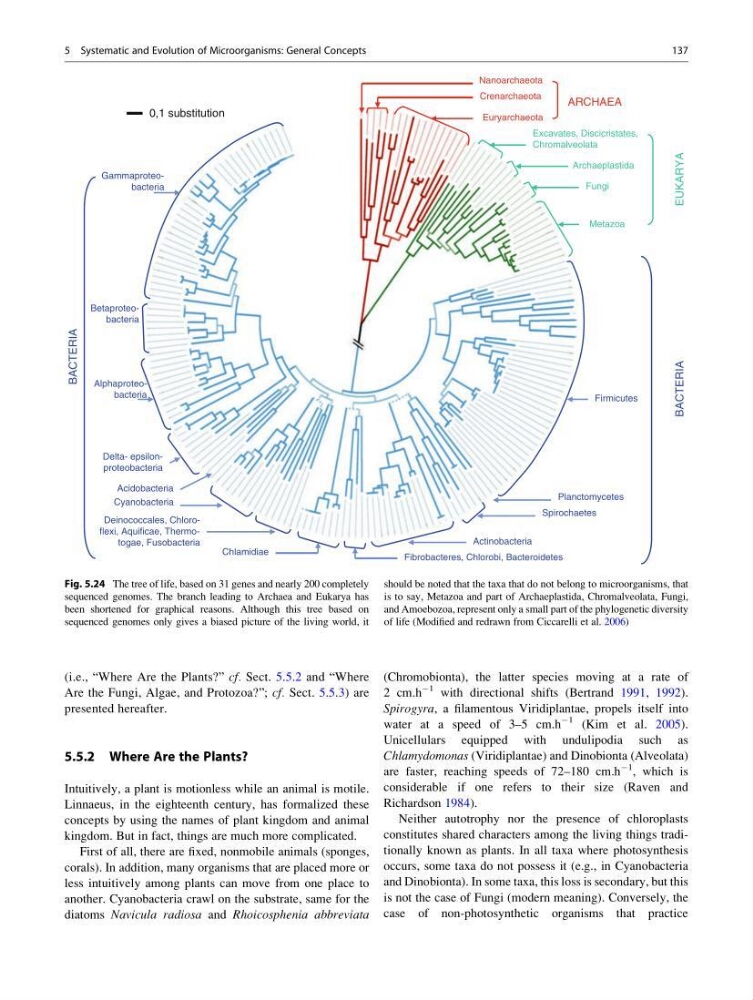
Fig. 5.24 The tree of life, based on 31 genes and nearly 200 completely
sequenced genomes. The branch leading to Archaea and Eukarya has
been shortened for graphical reasons. Although this tree based on
sequenced genomes only gives a biased picture of the living world, it
should be noted that the taxa that do not belong to microorganisms, that
is to say, Metazoa and part of Archaeplastida, Chromalveolata, Fungi,
and Amoebozoa, represent only a small part of the phylogenetic diversity
of life (Modified and redrawn from Ciccarelli et al. 2006)
5 Systematic and Evolution of Microorganisms: General Concepts
137
Are the Fungi, Algae, and Protozoa?”; cf. Sect. 5.5.3) are
presented hereafter.
5.5.2 Where Are the Plants?
Intuitively, a plant is motionless while an animal is motile.
Linnaeus, in the eighteenth century, has formalized these
concepts by using the names of plant kingdom and animal
kingdom. But in fact, things are much more complicated.
First of all, there are fixed, nonmobile animals (sponges,
corals). In addition, many organisms that are placed more or
less intuitively among plants can move from one place to
another. Cyanobacteria crawl on the substrate, same for the
diatoms Navicula radiosa and Rhoicosphenia abbreviata
(Chromobionta), the latter species moving at a rate of
2 cm.h
À1 with directional shifts (Bertrand 1991, 1992).
Spirogyra, a filamentous Viridiplantae, propels itself into
water at a speed of 3–5 cm.h
À1 (Kim et al. 2005).
Unicellulars equipped with undulipodia such as
Chlamydomonas (Viridiplantae) and Dinobionta (Alveolata)
are faster, reaching speeds of 72–180 cm.h
À1 , which is
considerable if one refers to their size (Raven and
Richardson 1984).
Neither autotrophy nor the presence of chloroplasts
constitutes shared characters among the living things traditionally known as plants. In all taxa where photosynthesis
occurs, some taxa do not possess it (e.g., in Cyanobacteria
and Dinobionta). In some taxa, this loss is secondary, but this
is not the case of Fungi (modern meaning). Conversely, the
case of non-photosynthetic organisms that practice
Nanoarchaeota
Crenarchaeota
Euryarchaeota
ARCHAEA
Metazoa
Fungi
Archaeplastida
Excavates, Discicristates,
Chromalveolata
EUKARYA
Firmicutes
Planctomycetes
Spirochaetes
Actinobacteria
Fibrobacteres, Chlorobi, Bacteroidetes
BACTERIA
Chlamidiae
Deinococcales, Chloroflexi, Aquificae, Thermotogae, Fusobacteria
Cyanobacteria
Acidobacteria
Delta- epsilonproteobacteria
Alphaproteobacteria
Betaproteobacteria
Gammaproteobacteria
BACTERIA
0,1 substitution
Fig. 5.24 The tree of life, based on 31 genes and nearly 200 completely
sequenced genomes. The branch leading to Archaea and Eukarya has
been shortened for graphical reasons. Although this tree based on
sequenced genomes only gives a biased picture of the living world, it
should be noted that the taxa that do not belong to microorganisms, that
is to say, Metazoa and part of Archaeplastida, Chromalveolata, Fungi,
and Amoebozoa, represent only a small part of the phylogenetic diversity
of life (Modified and redrawn from Ciccarelli et al. 2006)
5 Systematic and Evolution of Microorganisms: General Concepts
137