

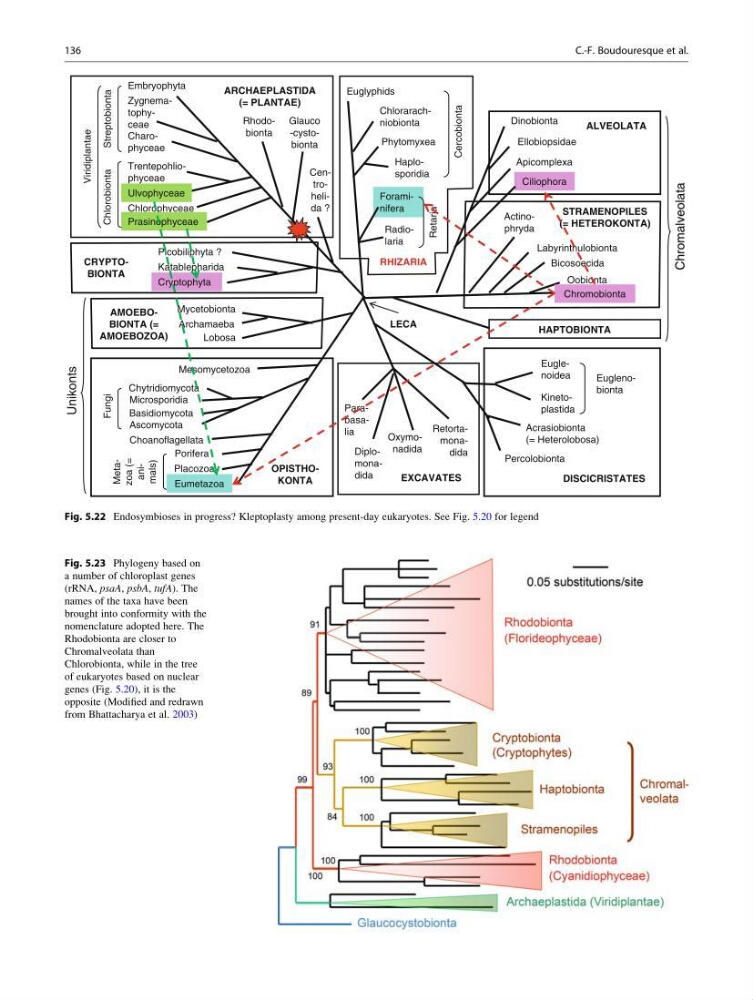
Fig. 5.23 Phylogeny based on
a number of chloroplast genes
(rRNA, psaA, psbA, tufA). The
names of the taxa have been
brought into conformity with the
nomenclature adopted here. The
Rhodobionta are closer to
Chromalveolata than
Chlorobionta, while in the tree
of eukaryotes based on nuclear
genes (Fig. 5.20), it is the
opposite (Modified and redrawn
from Bhattacharya et al. 2003)
Embryophyta
Charophyceae
Chlorophyceae
Prasinophyceae
Rhodobionta
Glauco
-cystobionta
Lobosa
Mycetobionta
Chytridiomycota
Fungi
Choanoflagellata
Metazoa (=
animals)
basalia
monadida
Euglenoidea
Kinetoplastida
Acrasiobionta
(= Heterolobosa)
Percolobionta
Chromobionta
Oobionta
Labyrinthulobionta
Ciliophora
Dinobionta
Apicomplexa
Radiolaria
Foraminifera
Chlorarachniobionta
EXCAVATES
DISCICRISTATES
STRAMENOPILES
(= HETEROKONTA)
ALVEOLATA
RHIZARIA
AMOEBOBIONTA (=
AMOEBOZOA)
OPISTHOKONTA
helida ?
Actinophryda
HAPTOBIONTA
Chromalveolata Chromalveolata
Chlorobionta
Viridiplantae
Euglenobionta
Archamaeba
Phytomyxea
Haplosporidia
Unikonts
monadida
Oxymonadida
Streptobionta
Euglyphids
Retaria
Cercobionta
ARCHAEPLASTIDA
(= PLANTAE)
Ellobiopsidae
Bicosoecida
Eumetazoa
Placozoa
Porifera
Microsporidia
Basidiomycota
Ascomycota
Mesomycetozoa
Picobiliphyta ?
Katablepharida
Cryptophyta
CRYPTOBIONTA
Trentepohliophyceae
Ulvophyceae
tophyceae
LECA
Fig. 5.22 Endosymbioses in progress? Kleptoplasty among present-day eukaryotes. See Fig. 5.20 for legend
136
C.-F. Boudouresque et al.
a number of chloroplast genes
(rRNA, psaA, psbA, tufA). The
names of the taxa have been
brought into conformity with the
nomenclature adopted here. The
Rhodobionta are closer to
Chromalveolata than
Chlorobionta, while in the tree
of eukaryotes based on nuclear
genes (Fig. 5.20), it is the
opposite (Modified and redrawn
from Bhattacharya et al. 2003)
Embryophyta
Charophyceae
Chlorophyceae
Prasinophyceae
Rhodobionta
Glauco
-cystobionta
Lobosa
Mycetobionta
Chytridiomycota
Fungi
Choanoflagellata
Metazoa (=
animals)
basalia
monadida
Euglenoidea
Kinetoplastida
Acrasiobionta
(= Heterolobosa)
Percolobionta
Chromobionta
Oobionta
Labyrinthulobionta
Ciliophora
Dinobionta
Apicomplexa
Radiolaria
Foraminifera
Chlorarachniobionta
EXCAVATES
DISCICRISTATES
STRAMENOPILES
(= HETEROKONTA)
ALVEOLATA
RHIZARIA
AMOEBOBIONTA (=
AMOEBOZOA)
OPISTHOKONTA
helida ?
Actinophryda
HAPTOBIONTA
Chromalveolata Chromalveolata
Chlorobionta
Viridiplantae
Euglenobionta
Archamaeba
Phytomyxea
Haplosporidia
Unikonts
monadida
Oxymonadida
Streptobionta
Euglyphids
Retaria
Cercobionta
ARCHAEPLASTIDA
(= PLANTAE)
Ellobiopsidae
Bicosoecida
Eumetazoa
Placozoa
Porifera
Microsporidia
Basidiomycota
Ascomycota
Mesomycetozoa
Picobiliphyta ?
Katablepharida
Cryptophyta
CRYPTOBIONTA
Trentepohliophyceae
Ulvophyceae
tophyceae
LECA
Fig. 5.22 Endosymbioses in progress? Kleptoplasty among present-day eukaryotes. See Fig. 5.20 for legend
136
C.-F. Boudouresque et al.