

demonstrated in some Dinobionta. The ancestors of
Oobionta, one of the taxa belonging to the polyphyletic
assemblage called “Fungi” (customary meaning cf.
Sect. 5.5.3), have possessed photosynthesis (“green pathway”) but subsequently have lost it (Tyler et al. 2006).
Finally, in Chromobionta, photosynthesis appears to have
been acquired in the first instance through the “green way,”
before being replaced through the “red pathway” (Dagan and
Martin 2009; Moustafa et al. 2009).
Overall, the vertical phylogeny related to the evolution of
nuclear genes overlaps with the phylogeny of chloroplasts,
transmitted vertically (during reproduction) but also horizontally (during secondary and tertiary endosymbioses).
Within a given taxon, such as Viridiplantae, phylogenies
which are based on chloroplast and nuclear genes are congruent (Ane ´ et al. 2005). However, they are not when taking
into account the taxa involved in secondary and tertiary
endosymbioses (Fig. 5.23).
a Non-photosynthetic eukaryote
Digestion
Phagotrophy
Phagotrophy
b
Kleptoplasty
Non-photosynthetic eukaryote
d
Phagotrophy
Secondary or tertiary
endosymbiosis
Non-photosynthetic eukaryote
Phagotrophy
c
Kleptoplasty +
karyoklepty
Non-photosynthetic eukaryote
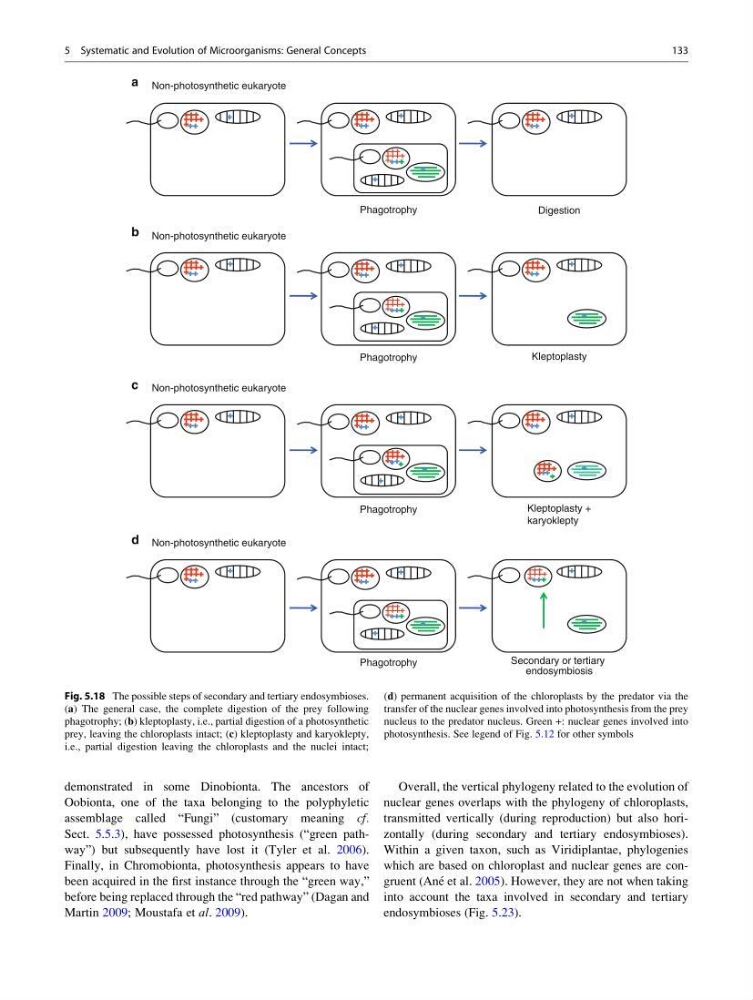
Fig. 5.18 The possible steps of secondary and tertiary endosymbioses.
(a) The general case, the complete digestion of the prey following
phagotrophy; (b) kleptoplasty, i.e., partial digestion of a photosynthetic
prey, leaving the chloroplasts intact; (c) kleptoplasty and karyoklepty,
i.e., partial digestion leaving the chloroplasts and the nuclei intact;
(d) permanent acquisition of the chloroplasts by the predator via the
transfer of the nuclear genes involved into photosynthesis from the prey
nucleus to the predator nucleus. Green +: nuclear genes involved into
photosynthesis. See legend of Fig. 5.12 for other symbols
5 Systematic and Evolution of Microorganisms: General Concepts
133
Oobionta, one of the taxa belonging to the polyphyletic
assemblage called “Fungi” (customary meaning cf.
Sect. 5.5.3), have possessed photosynthesis (“green pathway”) but subsequently have lost it (Tyler et al. 2006).
Finally, in Chromobionta, photosynthesis appears to have
been acquired in the first instance through the “green way,”
before being replaced through the “red pathway” (Dagan and
Martin 2009; Moustafa et al. 2009).
Overall, the vertical phylogeny related to the evolution of
nuclear genes overlaps with the phylogeny of chloroplasts,
transmitted vertically (during reproduction) but also horizontally (during secondary and tertiary endosymbioses).
Within a given taxon, such as Viridiplantae, phylogenies
which are based on chloroplast and nuclear genes are congruent (Ane ´ et al. 2005). However, they are not when taking
into account the taxa involved in secondary and tertiary
endosymbioses (Fig. 5.23).
a Non-photosynthetic eukaryote
Digestion
Phagotrophy
Phagotrophy
b
Kleptoplasty
Non-photosynthetic eukaryote
d
Phagotrophy
Secondary or tertiary
endosymbiosis
Non-photosynthetic eukaryote
Phagotrophy
c
Kleptoplasty +
karyoklepty
Non-photosynthetic eukaryote
Fig. 5.18 The possible steps of secondary and tertiary endosymbioses.
(a) The general case, the complete digestion of the prey following
phagotrophy; (b) kleptoplasty, i.e., partial digestion of a photosynthetic
prey, leaving the chloroplasts intact; (c) kleptoplasty and karyoklepty,
i.e., partial digestion leaving the chloroplasts and the nuclei intact;
(d) permanent acquisition of the chloroplasts by the predator via the
transfer of the nuclear genes involved into photosynthesis from the prey
nucleus to the predator nucleus. Green +: nuclear genes involved into
photosynthesis. See legend of Fig. 5.12 for other symbols
5 Systematic and Evolution of Microorganisms: General Concepts
133