

a new minimum CO 2 content in the atmosphere, unprecedented
since the minimum of 285–260 Ma (Fig. 5.16) and, even
beyond, since the formation of our planet.
11
5.4.5 The “Travels” of the Chloroplast
The occurrence of chloroplast in Archaeplastida (primary
endosymbiosis) corresponds to a massive horizontal gene
transfer (HGT) from cyanobacteria. Thereafter, the chloroplast has evolved along with its host, Archaeplastida (vertical evolution), to differentiate into “red chloroplast” in
Rhodobionta and into “green chloroplast” in Viridiplantae.
Secondary endosymbioses (Fig. 5.20) that involve, on the
one hand, the transfer of a portion of the green chloroplast of
Viridiplantae to Euglenoids, Chlorarachniobionta, and some
Dinobionta (the “green pathway”) and, on the other hand, the
transfer of red chloroplast of Rhodobionta to Haptobionta,
Cryptobionta, Chromobionta and other Dinobionta (the “red
pathway”)
12 correspond, once again, to a massive series of
HGT. In Dinobionta, in addition to direct green and red
pathways, the chloroplast was also formed by tertiary
endosymbioses (Fig. 5.21). Finally, the phenomena of
kleptoplasty and karyoklepty, which are found in nature
today, are perhaps future secondary or tertiary
endosymbioses (Fig. 5.22).
Photosynthesis has not only been acquired: it could also
have been lost secondarily. This is the case in Apicomplexa
(Alveolata), particularly in Plasmodium falciparum, the
causative agent of malaria. The apicoplast is the remnant
of a chloroplast and would come from Rhodobionta
13
(Fig. 5.20; Ko ¨hler et al. 1997; McFadden and Waller
1997). The loss of photosynthesis has also been
a
b
1 mm
300 μm
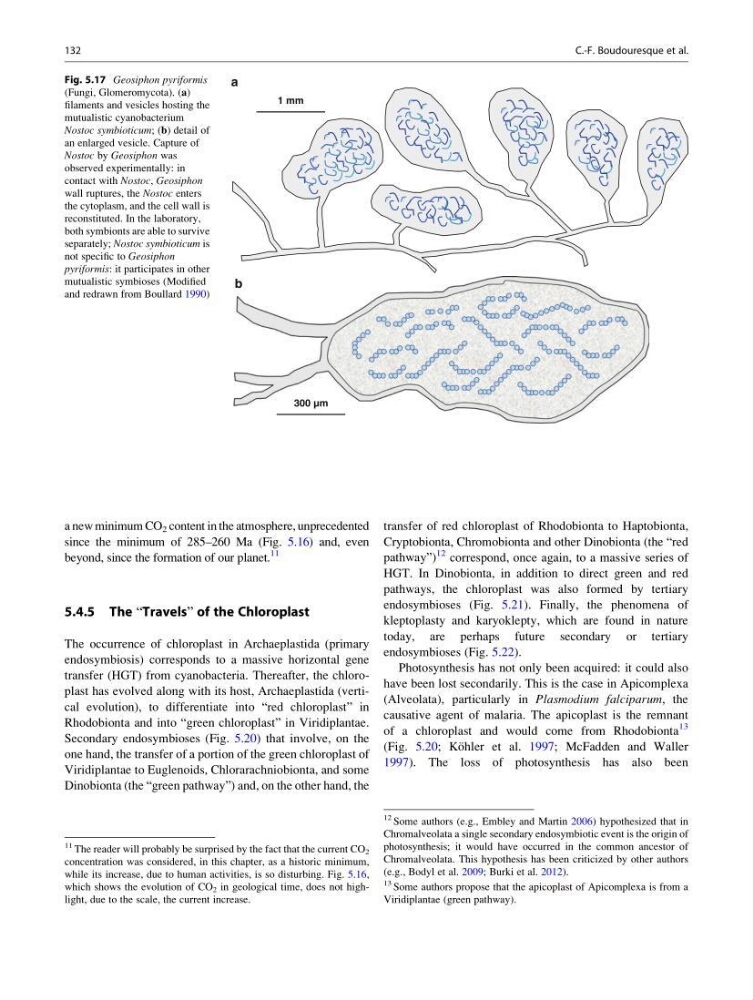
Fig. 5.17 Geosiphon pyriformis
(Fungi, Glomeromycota). (a)
filaments and vesicles hosting the
mutualistic cyanobacterium
Nostoc symbioticum; (b) detail of
an enlarged vesicle. Capture of
Nostoc by Geosiphon was
observed experimentally: in
contact with Nostoc, Geosiphon
wall ruptures, the Nostoc enters
the cytoplasm, and the cell wall is
reconstituted. In the laboratory,
both symbionts are able to survive
separately; Nostoc symbioticum is
not specific to Geosiphon
pyriformis: it participates in other
mutualistic symbioses (Modified
and redrawn from Boullard 1990)
11 The reader will probably be surprised by the fact that the current CO 2
concentration was considered, in this chapter, as a historic minimum,
while its increase, due to human activities, is so disturbing. Fig. 5.16,
which shows the evolution of CO 2 in geological time, does not highlight, due to the scale, the current increase.
12 Some authors (e.g., Embley and Martin 2006) hypothesized that in
Chromalveolata a single secondary endosymbiotic event is the origin of
photosynthesis; it would have occurred in the common ancestor of
Chromalveolata. This hypothesis has been criticized by other authors
(e.g., Bodyl et al. 2009; Burki et al. 2012).
13 Some authors propose that the apicoplast of Apicomplexa is from a
Viridiplantae (green pathway).
132
C.-F. Boudouresque et al.
since the minimum of 285–260 Ma (Fig. 5.16) and, even
beyond, since the formation of our planet.
11
5.4.5 The “Travels” of the Chloroplast
The occurrence of chloroplast in Archaeplastida (primary
endosymbiosis) corresponds to a massive horizontal gene
transfer (HGT) from cyanobacteria. Thereafter, the chloroplast has evolved along with its host, Archaeplastida (vertical evolution), to differentiate into “red chloroplast” in
Rhodobionta and into “green chloroplast” in Viridiplantae.
Secondary endosymbioses (Fig. 5.20) that involve, on the
one hand, the transfer of a portion of the green chloroplast of
Viridiplantae to Euglenoids, Chlorarachniobionta, and some
Dinobionta (the “green pathway”) and, on the other hand, the
transfer of red chloroplast of Rhodobionta to Haptobionta,
Cryptobionta, Chromobionta and other Dinobionta (the “red
pathway”)
12 correspond, once again, to a massive series of
HGT. In Dinobionta, in addition to direct green and red
pathways, the chloroplast was also formed by tertiary
endosymbioses (Fig. 5.21). Finally, the phenomena of
kleptoplasty and karyoklepty, which are found in nature
today, are perhaps future secondary or tertiary
endosymbioses (Fig. 5.22).
Photosynthesis has not only been acquired: it could also
have been lost secondarily. This is the case in Apicomplexa
(Alveolata), particularly in Plasmodium falciparum, the
causative agent of malaria. The apicoplast is the remnant
of a chloroplast and would come from Rhodobionta
13
(Fig. 5.20; Ko ¨hler et al. 1997; McFadden and Waller
1997). The loss of photosynthesis has also been
a
b
1 mm
300 μm
Fig. 5.17 Geosiphon pyriformis
(Fungi, Glomeromycota). (a)
filaments and vesicles hosting the
mutualistic cyanobacterium
Nostoc symbioticum; (b) detail of
an enlarged vesicle. Capture of
Nostoc by Geosiphon was
observed experimentally: in
contact with Nostoc, Geosiphon
wall ruptures, the Nostoc enters
the cytoplasm, and the cell wall is
reconstituted. In the laboratory,
both symbionts are able to survive
separately; Nostoc symbioticum is
not specific to Geosiphon
pyriformis: it participates in other
mutualistic symbioses (Modified
and redrawn from Boullard 1990)
11 The reader will probably be surprised by the fact that the current CO 2
concentration was considered, in this chapter, as a historic minimum,
while its increase, due to human activities, is so disturbing. Fig. 5.16,
which shows the evolution of CO 2 in geological time, does not highlight, due to the scale, the current increase.
12 Some authors (e.g., Embley and Martin 2006) hypothesized that in
Chromalveolata a single secondary endosymbiotic event is the origin of
photosynthesis; it would have occurred in the common ancestor of
Chromalveolata. This hypothesis has been criticized by other authors
(e.g., Bodyl et al. 2009; Burki et al. 2012).
13 Some authors propose that the apicoplast of Apicomplexa is from a
Viridiplantae (green pathway).
132
C.-F. Boudouresque et al.