

Box 5.4: A Very Fast Transition from Parasitism
to Mutualism-Helotism
Charles-Franc ¸ois Boudouresque
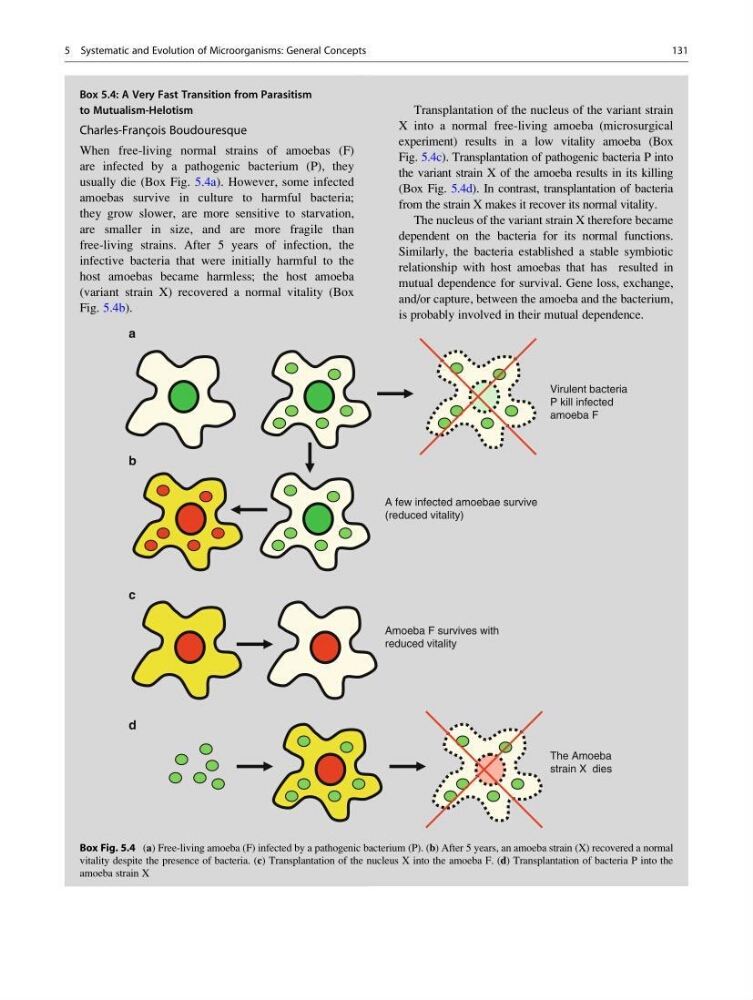
When free-living normal strains of amoebas (F)
are infected by a pathogenic bacterium (P), they
usually die (Box Fig. 5.4a). However, some infected
amoebas survive in culture to harmful bacteria;
they grow slower, are more sensitive to starvation,
are smaller in size, and are more fragile than
free-living strains. After 5 years of infection, the
infective bacteria that were initially harmful to the
host amoebas became harmless; the host amoeba
(variant strain X) recovered a normal vitality (Box
Fig. 5.4b).
(continued)
Box 5.4 (continued)
Transplantation of the nucleus of the variant strain
X into a normal free-living amoeba (microsurgical
experiment) results in a low vitality amoeba (Box
Fig. 5.4c). Transplantation of pathogenic bacteria P into
the variant strain X of the amoeba results in its killing
(Box Fig. 5.4d). In contrast, transplantation of bacteria
from the strain X makes it recover its normal vitality.
The nucleus of the variant strain X therefore became
dependent on the bacteria for its normal functions.
Similarly, the bacteria established a stable symbiotic
relationship with host amoebas that has resulted in
mutual dependence for survival. Gene loss, exchange,
and/or capture, between the amoeba and the bacterium,
is probably involved in their mutual dependence.
Virulent bacteria
P kill infected
amoeba F
A few infected amoebae survive
(reduced vitality)
Amoeba F survives with
reduced vitality
The Amoeba
strain X dies
a
b
c
d
Box Fig. 5.4 (a) Free-living amoeba (F) infected by a pathogenic bacterium (P). (b) After 5 years, an amoeba strain (X) recovered a normal
vitality despite the presence of bacteria. (c) Transplantation of the nucleus X into the amoeba F. (d) Transplantation of bacteria P into the
amoeba strain X
5 Systematic and Evolution of Microorganisms: General Concepts
131
to Mutualism-Helotism
Charles-Franc ¸ois Boudouresque
When free-living normal strains of amoebas (F)
are infected by a pathogenic bacterium (P), they
usually die (Box Fig. 5.4a). However, some infected
amoebas survive in culture to harmful bacteria;
they grow slower, are more sensitive to starvation,
are smaller in size, and are more fragile than
free-living strains. After 5 years of infection, the
infective bacteria that were initially harmful to the
host amoebas became harmless; the host amoeba
(variant strain X) recovered a normal vitality (Box
Fig. 5.4b).
(continued)
Box 5.4 (continued)
Transplantation of the nucleus of the variant strain
X into a normal free-living amoeba (microsurgical
experiment) results in a low vitality amoeba (Box
Fig. 5.4c). Transplantation of pathogenic bacteria P into
the variant strain X of the amoeba results in its killing
(Box Fig. 5.4d). In contrast, transplantation of bacteria
from the strain X makes it recover its normal vitality.
The nucleus of the variant strain X therefore became
dependent on the bacteria for its normal functions.
Similarly, the bacteria established a stable symbiotic
relationship with host amoebas that has resulted in
mutual dependence for survival. Gene loss, exchange,
and/or capture, between the amoeba and the bacterium,
is probably involved in their mutual dependence.
Virulent bacteria
P kill infected
amoeba F
A few infected amoebae survive
(reduced vitality)
Amoeba F survives with
reduced vitality
The Amoeba
strain X dies
a
b
c
d
Box Fig. 5.4 (a) Free-living amoeba (F) infected by a pathogenic bacterium (P). (b) After 5 years, an amoeba strain (X) recovered a normal
vitality despite the presence of bacteria. (c) Transplantation of the nucleus X into the amoeba F. (d) Transplantation of bacteria P into the
amoeba strain X
5 Systematic and Evolution of Microorganisms: General Concepts
131